

Designing Your Life
Bill Burnett
"Designing Your Life" brings the innovative principles of Design Thinking—the same methodology used to create the iPhone and other breakthrough technologies—to the most important project of all: your life. Written by Bill Burnett and Dave Evans, silicon valley veterans and founders of the Stanford Life Design Lab, this book translates their popular university course into a practical manual for everyone. The authors reject the dysfunctional belief that you should simply "find your passion." Instead, they argue that a well-lived life is a creative work in progress, built through experimentation. They introduce tools like the "Odyssey Plan", which asks readers to map out three completely different five-year futures to visualize possibilities beyond their current trajectory. Central to their philosophy is "Prototyping"—the art of trying small, low-risk experiments (like informational interviews or shadowing) to test a career path before committing to it. By reframing failure as part of the process and focusing on "building your way forward," Designing Your Life provides a structured, optimistic framework for navigating transition at any age, regardless of where you’ve been or where you hope to go.
Range: Why Generalists Triumph in a Specialized World
David Epstein
"Range" is a compelling counter-argument to the "10,000-hour rule" and the modern obsession with early hyperspecialization. Science writer David Epstein presents a rigorous case that in most fields—especially complex and unpredictable ones—it is the generalist, not the specialist, who is primed to excel. Epstein opens with the contrasting stories of Tiger Woods (who specialized as a toddler) and Roger Federer (who sampled many sports before focusing on tennis). He argues that while narrow focus works in "kind" learning environments with clear rules (like chess or golf), the real world is largely a "wicked" environment, where patterns are unclear and feedback is delayed. In these chaotic spaces, relying on rigid, specialized experience can actually be a liability. The book champions the value of a "sampling period"—experimenting with various interests early on to find better "match quality" between one's skills and career. Epstein demonstrates that "late bloomers" often overtake early starters because their diverse experiences allow them to apply lateral thinking and connect disparate ideas. Range is a powerful validation for those with winding career paths, proving that wandering is not lost time, but essential preparation for innovation.
The Hero With a Thousand Faces
Joseph Campbell
"The Hero With a Thousand Faces" is the seminal work on comparative mythology by Joseph Campbell, a book that forever changed how we understand storytelling and the human experience. Campbell’s central thesis is that despite vast differences in time, culture, and geography, all great human myths share a single, fundamental structure: the Monomyth. Campbell maps this universal narrative—known as the Hero's Journey—through three distinct stages: Separation, Initiation, and Return. The hero ventures forth from the world of common day into a region of supernatural wonder, encounters fabulous forces (the "Road of Trials"), wins a decisive victory, and comes back with the power to bestow boons on their fellow man. Drawing heavily on the depth psychology of Carl Jung, Campbell interprets these myths not merely as adventure stories, but as metaphors for the psychological journey toward self-actualization. Famous for inspiring George Lucas to create Star Wars, this book is a vital guide for writers, artists, and anyone seeking to understand the spiritual potential of their own life. It leaves readers with Campbell's most enduring advice: "Follow your bliss."

Mindset: The New Psychology of Success
Carol S. Dweck
"Mindset" is the classic work by Stanford University psychologist Carol S. Dweck. The book introduces a core concept that has transformed countless lives: the distinction between a "Fixed Mindset" and a "Growth Mindset." Dweck explains that those with a fixed mindset believe intelligence and talent are innate and unchangeable traits. In contrast, those with a growth mindset believe that abilities can be developed through dedication, hard work, and input from others. This book is not just theoretical psychology; it is a practical manual for shifting one's focus from a desire to "prove" oneself to a desire to "improve" oneself. Carol S. Dweck is a leading expert in the fields of personality, social, and developmental psychology. She is the Lewis and Virginia Eaton Professor of Psychology at Stanford University and a member of the National Academy of Sciences. Her pioneering research on motivation and personality is highly regarded by business leaders like Bill Gates and has profoundly influenced educational philosophies worldwide, making her one of the most respected psychologists of our time. This book is essential because it uncovers the truth about potential. It explains why some naturally gifted people stagnate due to a fear of failure, while seemingly ordinary individuals achieve greatness through resilience. Whether you are a manager looking to improve leadership, a parent hoping to build grit in your children, or an individual seeking a breakthrough, the mental tools provided in this book (such as the concept of "Not Yet") will help you shatter self-imposed limits and build the resilience needed to thrive in a challenging world.
Waking Up
Sam Harris
"Waking Up" is a bridge between two seemingly incompatible worlds: rigorous scientific skepticism and the profound experiences of spiritual life. Written by neuroscientist and philosopher Sam Harris—famously known as one of the "Four Horsemen" of New Atheism—this book argues that there is more to understanding reality than just grasping the physical laws of the universe, but that we do not need religion to access it. Harris contends that spirituality is a matter of consciousness, not creed. His central thesis challenges the feeling most of us have of being a "self"—an ego or passenger residing inside our heads, looking out at the world. Drawing on both neuroscience and the contemplative traditions of the East (specifically Dzogchen and Vipassana), he argues that this "self" is an illusion, and the source of much of our psychological suffering. The book serves as a rational guide to meditation, framing it not as a relaxation technique, but as a tool for empirical investigation into the nature of one's own mind. "Waking Up" invites secular readers to reclaim the wisdom of contemplative practice, proving that it is possible to be spiritual without being religious, and to find a deep sense of peace by simply waking up to the reality of the present moment.
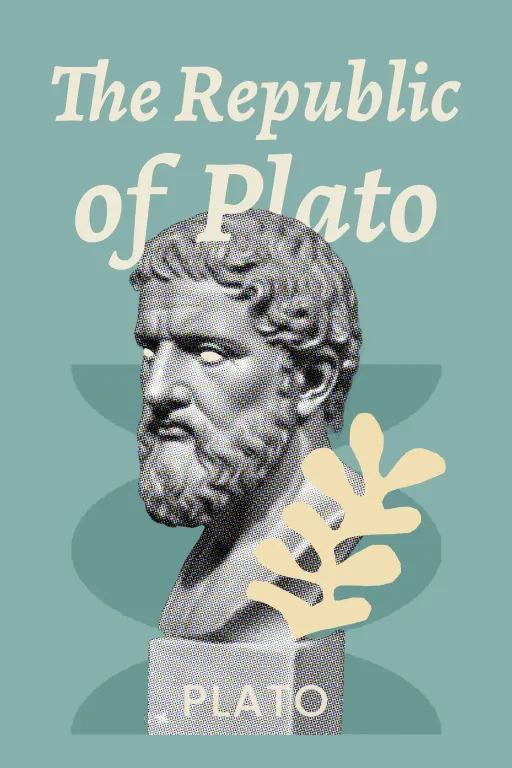
The Republic
Plato
Allan Bloom's acclaimed translation of Plato's Republic, a cornerstone of Western thought, explores fundamental questions of justice, community, and the ideal state. This edition offers a literal translation with notes and an interpretive essay, inviting readers to engage directly with Plato's profound insights into the human condition and the nature of truth. "The Republic" is the foundational text of Western philosophy, written by Plato (around 375 BC). Presented as a Socratic dialogue, it begins with a simple question—What is justice?—and expands into a profound investigation of the ideal state and the human soul. Plato argues that justice is harmony. To define a just individual, he constructs a theoretical "just city" (Kallipolis). He divides this city into three classes: the Producers (craftsmen/farmers), the Auxiliaries (warriors), and the Guardians (rulers). This structure mirrors the tripartite nature of the human soul: Appetite, Spirit, and Reason. Justice occurs when each part performs its own function without interfering with the others, ruled by Reason. The book’s most famous passage is the Allegory of the Cave. Plato depicts humanity as prisoners chained in a cave, watching shadows on a wall and mistaking them for reality. The philosopher’s duty is to break free, ascend to the light (the Form of the Good), and then return to the cave to lead others. This leads to Plato’s most controversial claim: that for a city to be just, it must be ruled by a Philosopher King—someone who loves wisdom more than power.
Tao Te Ching
Lao Tzu
This edition of Lao Tzu's "Tao Te Ching" presents a profound exploration of ancient Chinese philosophy, focusing on the core concepts of Tao (the Way) and Te (Integrity). Divided into two main sections, "Tao Ching" and "Te Ching", the text delves into the nature of existence, the ideal characteristics of a sage, and the principles of effective governance through non-action and humility. Readers will encounter recurring themes of presence and absence, the importance of aligning with natural processes, and the power of embodying the Way in personal conduct. Through 81 chapters, the "Tao Te Ching" offers guidance on understanding the world and one's place within it. This edition further enhances comprehension with a dedicated section on Key Terms, outlining Lao Tzu's central philosophical ideas such as Yu (Presence), Wu (Absence), Tzu-jan (Occurrence appearing of itself), and Wu-wei (Nothing's own doing). These definitions provide context and deeper insight into the text's complex concepts. The book also includes illustrations that reflect the themes and imagery discussed in the Introduction.

Siddhartha
Hermann Hesse
"Siddhartha: An Indian Tale" is a philosophical bildungsroman that follows the spiritual journey of Siddhartha, a young Brahman, as he seeks enlightenment and self-discovery in ancient India. Dissatisfied with the traditional teachings of his upbringing, Siddhartha embarks on a quest that leads him through various paths, including asceticism with the Samanas, encounters with the teachings of Gotama Buddha, and immersion in the world of material pleasures and love. Readers will witness Siddhartha's evolution as he grapples with the limitations of intellectual knowledge and the necessity of personal experience. His journey takes him from a life of spiritual discipline to one of worldly indulgence, and ultimately to a profound understanding of the interconnectedness of all things. Through his relationships with figures like Govinda, Kamala, and the merchant Kamaswami, Siddhartha learns valuable lessons about love, loss, and the elusive nature of true wisdom. Hesse's novel offers a compelling exploration of Eastern philosophy and the search for meaning in a world of illusion. It invites readers to contemplate the nature of self, the allure of worldly pleasures, and the transformative power of embracing one's own unique path to enlightenment.