


How to Read Lacan
Slavoj Žižek
A guide to understanding the complex ideas of Jacques Lacan, one of the most influential psychoanalysts and thinkers of the 20th century. Through a close reading of Lacan's texts and their application to various aspects of culture, art, and ideology, this book offers a unique and accessible entry point into Lacanian thought.

Living Resistance
Kaitlin B. Curtice
Living Resistance forges a path to a more whole now and a more whole tomorrow. It shows how healing ourselves, our communities, our Earth, and our society are all inextricable, and how to gently integrate all levels of being and doing so that our daily acts of living become ways of resisting oppressive forces and bringing new possibilities into being.
Logic and Language
Neville Dean
Explore the principles of symbolic logic and its relationship to language. This book develops skills in reasoning and abstract formalism, with applications in computer science, philosophy, and mathematics. It covers natural deduction, truth semantics, and automated reasoning.
Relational Intelligence
Dharius Daniels
Unlock the power of your relationships! 'Relational Intelligence' is your guide to increasing your relational skills so that you can accomplish your purpose, advance your career, and improve the spiritual, physical, and emotional quality of your life. Discover how to define, discern, align, and assess the relationships in your life to maximize your potential and live a life of purpose.

A Brief History of Everything
Ken Wilber
A comprehensive exploration of the evolution of consciousness, integrating insights from various disciplines, including science, spirituality, and psychology. It seeks to provide a framework for understanding the interconnectedness of all things and our place in the cosmos.
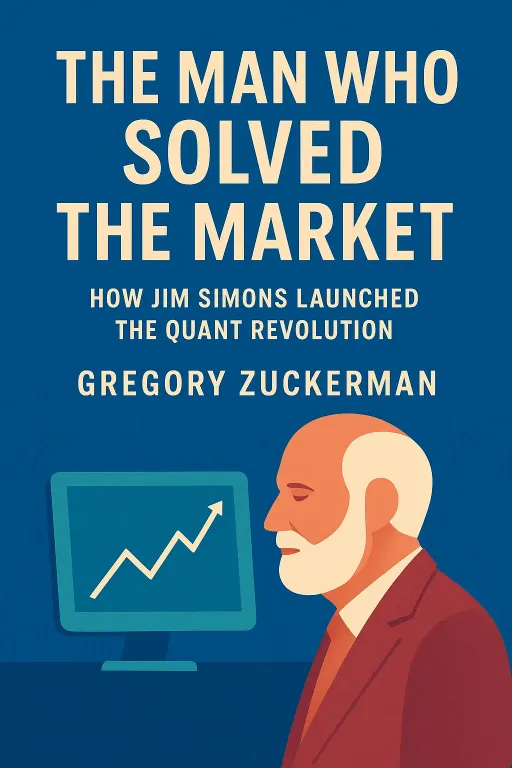
The Man Who Solved the Market
Gregory Zuckerman
"The Man Who Solved the Market" is the incredible, untold story of Jim Simons, a mathematician who conquered Wall Street not by understanding finance, but by cracking the code of the market. Written by journalist Gregory Zuckerman, the book chronicles the rise of Renaissance Technologies, the secretive hedge fund that pioneered the era of algorithmic trading. Simons, a former code-breaker and geometry professor, rejected the traditional Wall Street model of hiring economists and MBAs. Instead, he hired physicists, astronomers, and computer scientists. They viewed the market not as a system of businesses, but as a chaotic mass of data full of hidden, non-random patterns. The result was the Medallion Fund, which generated average annual returns of 66% before fees for decades—shattering the records of Warren Buffett and George Soros. The Man Who Solved the Market is a gripping narrative about the triumph of data over intuition, revealing how a team of eccentric scientists built a money-printing machine that changed the financial world forever.
Sapiens: A Brief History of Humankind
Yuval Noah Harari
Explore the epic history of humankind, from the Stone Age to the present day. Yuval Noah Harari examines how Homo sapiens came to dominate the world, delving into the cognitive, agricultural, and scientific revolutions that shaped our species and its impact on the planet. A thought-provoking journey through the human story.

Bullshit Jobs
David Graeber
"Bullshit Jobs" is a provocative and sharply funny anthropological examination of the modern workplace, written by the late David Graeber, a prominent leader in the Occupy Wall Street movement. The book expands on his viral 2013 essay, investigating a curious economic paradox: In 1930, John Maynard Keynes predicted that technology would allow us to work fifteen-hour weeks. Instead, we are working more than ever, often in roles that seem to serve no purpose. Graeber defines a "bullshit job" as a form of paid employment that is so completely pointless, unnecessary, or pernicious that even the employee cannot justify its existence—though they must pretend otherwise. He classifies these jobs into five distinct taxonomies, including "Flunkies" (who exist only to make their superiors look important) and "Box Tickers" (who create the illusion that an organization is doing something). The book explores the profound psychological toll this takes on the human soul, describing it as "spiritual violence." Graeber argues that our society has developed an inverse relationship between the social value of work and its compensation—caregivers and teachers are paid the least, while those in "bullshit" corporate sectors are paid the most. It is a searing indictment of managerial capitalism and a call to rethink the very nature of labor.