

Technology & Science
The Story of the Human Body
Daniel Lieberman
"The Story of the Human Body" is a sweeping evolutionary history written by Daniel Lieberman, chair of the Department of Human Evolutionary Biology at Harvard. It answers a fundamental question: If natural selection is so powerful, why are we so prone to chronic disease? Lieberman argues that while we have evolved to be upright, endurance-adapted survival machines, we are currently living in an environment for which we were never designed. This concept is known as the "Mismatch Hypothesis." Lieberman explains that our bodies are adapted for the Stone Age—a life of scarcity and intense physical activity. However, cultural evolution (farming, industry, and technology) has moved faster than biological evolution. We now inhabit a world of super-abundant calories and sedentary comfort. The result is a plague of "dysevolution"—diseases like type 2 diabetes, heart disease, and osteoporosis that are rare in hunter-gatherer societies but rampant in the modern world. We evolved to crave sugar and conserve energy because those traits once ensured survival; now, they ensure illness. The Story of the Human Body is a lucid, scientific guide that argues we must change our environment, not just our habits, to align with our evolutionary legacy.
How the World Really Works
Vaclav Smil
"How the World Really Works" is a data-driven reality check on the physical foundations of our modern civilization, written by Vaclav Smil. Smil, a renowned energy scientist and Bill Gates’ favorite author, aims to cure the "magical thinking" that dominates current debates about climate change and the green energy transition. Smil argues that before we can fix the world, we must understand the material realities that sustain it. He identifies the "Four Pillars" of modern life: Ammonia (for fertilizer/food), Steel, Concrete, and Plastics. He demonstrates that our dependence on the fossil fuels required to produce these materials is far deeper than most realize. The book is not a denial of climate change, but a denial of utopian timelines. Smil explains why total decarbonization by 2050 is physically impossible without causing societal collapse. By analyzing everything from globalization to risk assessment, How the World Really Works offers a scientifically grounded, agnostic guide to understanding the massive inertia of our energy systems, arguing that we must balance high ideals with hard numbers.
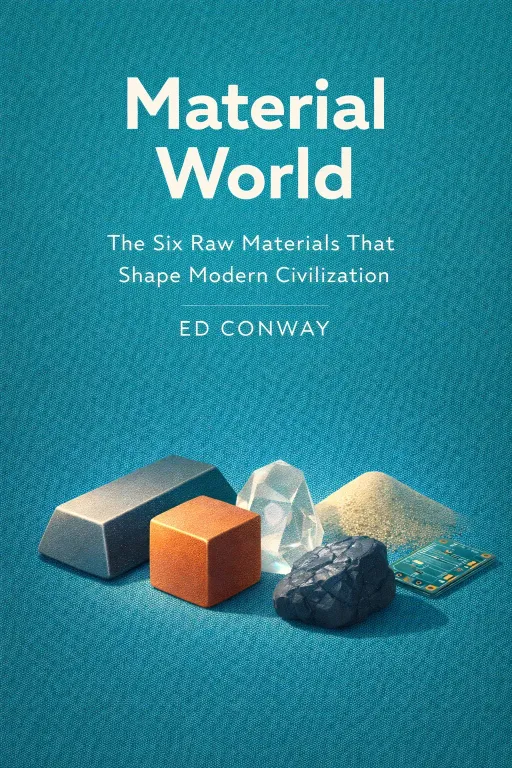
Material World
Ed Conway
Ed Conway's "Material World: A Substantial Story of Our Past and Future" explores the surprising and profound impact of essential materials on human civilization. The book delves into the history, economics, science, and technology surrounding six key substances: sand, salt, iron, copper, oil, and lithium. Each material is examined in detail, revealing its multifaceted nature and its critical role in shaping our past, present, and future. Readers will embark on a journey through time and across industries, discovering how these materials have influenced everything from ancient societies to modern technological advancements and green energy transitions. The book promises to illuminate the hidden connections between these fundamental elements and the course of human history, offering a new perspective on the world around us. By exploring the extraction, properties, and significance of each material, "Material World" provides a comprehensive understanding of their impact on global geopolitics, environmental sustainability, and the future of our planet.
The Information
James Gleick
Acclaimed science writer James Gleick presents an eye-opening vision of how information has transformed the world, tracing a history from the invention of alphabets and the telegraph to the development of information theory and the digital deluge of the modern era. Along the way he profiles the innovators who shaped our understanding of information — from Charles Babbage, Ada Lovelace, and Samuel Morse to Alan Turing and Claude Shannon — and shows how their ideas altered the nature of human knowledge and communication. The Information combines history, biography, and science to explain the rise of the concept of information — its theoretical foundations, practical inventions, and cultural consequences — and examines how we now live amid a flood of data, messages, images, and signals that both empower and overwhelm us.
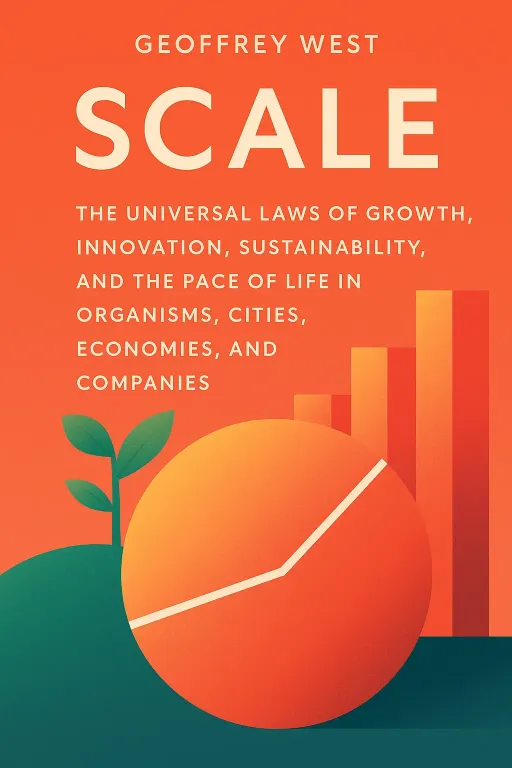
Scale
Geoffrey West
"Scale" is a groundbreaking work of complexity science written by theoretical physicist Geoffrey West. The book sets out to uncover the hidden mathematical laws that govern the lifecycle of everything from plants and animals to cities and corporations. West argues that despite their complexity, these diverse systems follow simple, predictable patterns determined by their size. The foundation of the book is Kleiber’s Law, which observes that as organisms get larger, they become more efficient. An elephant is 10,000 times heavier than a mouse but consumes only 1,000 times more energy. This is sub-linear scaling, a pattern of diminishing returns that eventually limits growth and dictates that all biological life must die. However, West discovers that cities break this rule. Cities exhibit super-linear scaling. When a city doubles in size, it does not just double its infrastructure; it produces an exponential increase in wealth, innovation, and crime. This 15% bonus per capita makes cities engines of infinite growth. The downside is that this growth demands an ever-accelerating pace of life. "Scale" warns that to sustain this trajectory, humanity must innovate at faster and faster intervals to avoid a total systemic collapse.
Information
Cesar Hidalgo
Explore the universe through the lens of information, from the smallest atom to the largest economies. This book delves into the growth of information, its battle against entropy, and the mechanisms that drive complexity in our world. Discover how information, knowledge, and knowhow intertwine to shape our physical, biological, social, and economic realities.

Exhalation
Ted Chiang
"Exhalation" is a collection of science fiction and fantasy short stories by Ted Chiang that delves into thought-provoking explorations of time, causality, free will, and the nature of existence. Through intricate narratives and philosophical inquiries, the book invites readers to contemplate the profound implications of technological advancements and the human condition. Readers will encounter a fabric merchant traveling through time in "The Merchant and the Alchemist's Gate," a mechanical anatomist dissecting his own being in "Exhalation," and the societal impact of devices that predict choices in "What's Expected of Us." "The Lifecycle of Software Objects" explores the complex relationships between humans and intelligent digital life forms, while "Dacey's Patent Automatic Nanny" examines the consequences of machine-mediated childcare. Finally, "The Truth of Fact, the Truth of Feeling" questions the nature of memory and truth in an age of perfect digital recall, drawing parallels with oral cultures to highlight how technology shapes human identity and understanding of the past.
On the Origin of Species
Charles Darwin
Explore Charles Darwin's groundbreaking theories on evolution and natural selection in 'On the Origin of Species.' This seminal work challenges conventional wisdom and presents a compelling argument for the interconnectedness of life, forever changing our understanding of the natural world.