

A Brief History of Everything
Ken Wilber
A comprehensive exploration of the evolution of consciousness, integrating insights from various disciplines, including science, spirituality, and psychology. It seeks to provide a framework for understanding the interconnectedness of all things and our place in the cosmos.
The Republic
Plato
Allan Bloom's acclaimed translation of Plato's Republic, a cornerstone of Western thought, explores fundamental questions of justice, community, and the ideal state. This edition offers a literal translation with notes and an interpretive essay, inviting readers to engage directly with Plato's profound insights into the human condition and the nature of truth. "The Republic" is the foundational text of Western philosophy, written by Plato (around 375 BC). Presented as a Socratic dialogue, it begins with a simple question—What is justice?—and expands into a profound investigation of the ideal state and the human soul. Plato argues that justice is harmony. To define a just individual, he constructs a theoretical "just city" (Kallipolis). He divides this city into three classes: the Producers (craftsmen/farmers), the Auxiliaries (warriors), and the Guardians (rulers). This structure mirrors the tripartite nature of the human soul: Appetite, Spirit, and Reason. Justice occurs when each part performs its own function without interfering with the others, ruled by Reason. The book’s most famous passage is the Allegory of the Cave. Plato depicts humanity as prisoners chained in a cave, watching shadows on a wall and mistaking them for reality. The philosopher’s duty is to break free, ascend to the light (the Form of the Good), and then return to the cave to lead others. This leads to Plato’s most controversial claim: that for a city to be just, it must be ruled by a Philosopher King—someone who loves wisdom more than power.
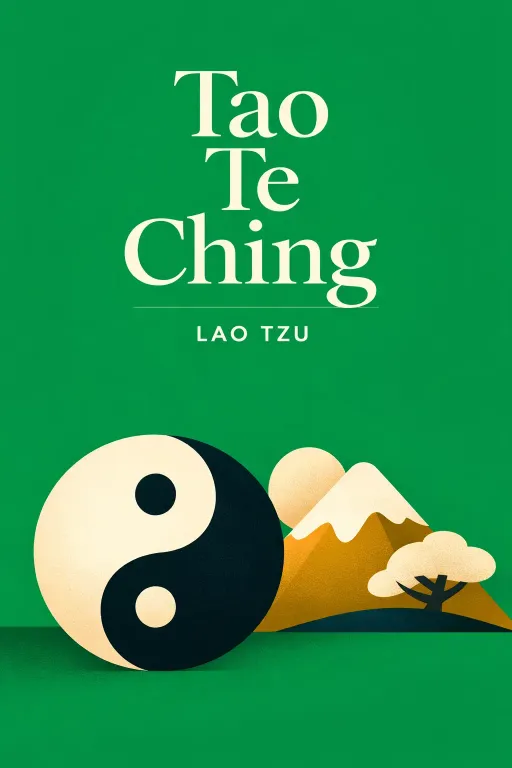
Tao Te Ching
Lao Tzu
This edition of Lao Tzu's "Tao Te Ching" presents a profound exploration of ancient Chinese philosophy, focusing on the core concepts of Tao (the Way) and Te (Integrity). Divided into two main sections, "Tao Ching" and "Te Ching", the text delves into the nature of existence, the ideal characteristics of a sage, and the principles of effective governance through non-action and humility. Readers will encounter recurring themes of presence and absence, the importance of aligning with natural processes, and the power of embodying the Way in personal conduct. Through 81 chapters, the "Tao Te Ching" offers guidance on understanding the world and one's place within it. This edition further enhances comprehension with a dedicated section on Key Terms, outlining Lao Tzu's central philosophical ideas such as Yu (Presence), Wu (Absence), Tzu-jan (Occurrence appearing of itself), and Wu-wei (Nothing's own doing). These definitions provide context and deeper insight into the text's complex concepts. The book also includes illustrations that reflect the themes and imagery discussed in the Introduction.

Siddhartha
Hermann Hesse
"Siddhartha: An Indian Tale" is a philosophical bildungsroman that follows the spiritual journey of Siddhartha, a young Brahman, as he seeks enlightenment and self-discovery in ancient India. Dissatisfied with the traditional teachings of his upbringing, Siddhartha embarks on a quest that leads him through various paths, including asceticism with the Samanas, encounters with the teachings of Gotama Buddha, and immersion in the world of material pleasures and love. Readers will witness Siddhartha's evolution as he grapples with the limitations of intellectual knowledge and the necessity of personal experience. His journey takes him from a life of spiritual discipline to one of worldly indulgence, and ultimately to a profound understanding of the interconnectedness of all things. Through his relationships with figures like Govinda, Kamala, and the merchant Kamaswami, Siddhartha learns valuable lessons about love, loss, and the elusive nature of true wisdom. Hesse's novel offers a compelling exploration of Eastern philosophy and the search for meaning in a world of illusion. It invites readers to contemplate the nature of self, the allure of worldly pleasures, and the transformative power of embracing one's own unique path to enlightenment.
Meditations
Marcus Aurelius
"Meditations" is a unique masterpiece of philosophy, unique because it was never intended to be a book. It is the private journal of Marcus Aurelius, the Roman Emperor who ruled from 161 to 180 AD. Written largely while on military campaigns, these notes were the Emperor's method for keeping himself sane, humble, and disciplined amidst the chaos of war and plague. It serves as the definitive text on Stoic philosophy in practice. Marcus repeatedly reminds himself of the central Stoic dogma: the Dichotomy of Control. He argues that we have no control over external events—the weather, the opinions of others, or death itself—but we have absolute control over our own minds and how we choose to interpret those events. The book is a manual for building an "Inner Citadel"—a fortress of the mind that no external misfortune can breach. Filled with short, powerful aphorisms, Meditations teaches that the quality of your life is determined by the quality of your thoughts. It remains a timeless guide for anyone seeking to cultivate resilience, emotional stability, and moral strength in a turbulent world.
Zen and the Art of Motorcycle Maintenance
Robert M. Pirsig
"Zen and the Art of Motorcycle Maintenance" is a modern philosophical classic that defies easy categorization. Written by Robert Pirsig, the book is framed as a fictionalized autobiography recounting a summer motorcycle trip across the American Northwest taken by the narrator and his young son, Chris. The physical journey serves as a backdrop for a series of philosophical talks, which Pirsig calls "Chautauquas." In these reflections, the narrator explores a fundamental rift in modern life: the conflict between the Romantic view of the world—which appreciates beauty and surface aesthetics—and the Classical view, which seeks to understand the underlying mechanics and form. Pirsig uses the motorcycle as the central metaphor. To a romantic, a broken motorcycle is a frustrating mystery; to a classicist, it is a rational puzzle waiting to be solved. The narrator attempts to reconcile these two worldviews through his theory of "Quality," a concept that transcends both mind and matter. The book is also a psychological thriller, as the narrator is slowly revealed to be haunted by Phaedrus, his former brilliant but unstable self who was driven insane by his obsessive pursuit of this very truth.
Things Hidden Since the Foundation of the World
René Girard
"Things Hidden Since the Foundation of the World" presents a groundbreaking exploration of fundamental anthropology, arguing that mimetic desire—the human tendency to imitate others' desires—lies at the heart of human culture and conflict. Through the lens of the "victimage mechanism," René Girard examines how societies historically manage rivalry and violence through ritual sacrifice and the creation of cultural institutions. The book posits that religion originates from a fundamental misunderstanding of this sacrificial process, where a surrogate victim is scapegoated to restore social order. Readers will delve into the origins of culture, myth, and the process of hominization itself, all viewed through the framework of mimetic desire and the victimage mechanism. Girard analyzes myths as veiled accounts of a "founding murder" and contrasts them with "texts of persecution" that begin to expose the arbitrariness of sacrificial violence. The book then shifts its focus to the Judaeo-Christian scriptures, arguing that they uniquely reveal the founding murder and offer a non-sacrificial understanding of God. Ultimately, "Things Hidden Since the Foundation of the World" challenges conventional interpretations of both religious texts and the foundations of human culture. It proposes a radical re-evaluation of Christian theology, advocating for a non-sacrificial reading of the Gospels and critiquing the historical "sacrificial reading" of Christ's death. This book offers a profound and thought-provoking analysis of violence, religion, and the very nature of human society.
The Black Swan
Nassim Nicholas Taleb
"The Black Swan" is a ferocious attack on our understanding of the world, written by former options trader and risk analyst Nassim Nicholas Taleb. Taleb argues that history is not driven by predictable trends, but by rare, high-impact events that are impossible to predict. He calls these events "Black Swans." A Black Swan has three characteristics: it is an outlier that lies outside the realm of regular expectations, it carries an extreme impact, and human nature causes us to concoct explanations for its occurrence after the fact. This retrospective explanation makes the event seem explainable and predictable when it was not. Taleb mocks the experts and economists who use standard bell-curve statistics to model the world. He argues that while the bell curve applies to physical traits like height in the safe world of Mediocristan, it is useless for social and financial matters in the volatile world of Extremistan. In this latter world, a single observation can render thousands of days of data irrelevant. Taleb illustrates this with the parable of the Turkey. For 1,000 days, the turkey is fed by the farmer, and every day its statistical confidence grows that the farmer loves it. On day 1,001, the day of Thanksgiving, something unpredictable happens that changes everything. The book is a plea to stop trying to predict the specific future and instead build robustness against negative Black Swans while positioning ourselves to benefit from positive ones.