

Economics & Money

The Millionaire Next Door
Thomas J. Stanley
Uncover the surprising secrets of America's wealthy in The Millionaire Next Door. This groundbreaking book challenges common misconceptions about wealth, revealing the simple habits and lifestyles that lead to financial independence. Discover how ordinary people accumulate extraordinary wealth and learn how you can apply these principles to your own life.
Rich Dad's Guide to Investing
Robert Kiyosaki
Returning from Vietnam in 1973, Robert Kiyosaki had no job, no money, and no assets. This book chronicles his journey, guided by his rich dad, to becoming a sophisticated investor. Learn how to think like a rich investor, build a strong business, and navigate the world of investing, regardless of your current financial situation. Discover the secrets to acquiring the 3-Es: education, experience, and excessive cash, and unlock the potential to invest like the wealthy.
Rich Dad's Retire Young Retire Rich
Robert T. Kiyosaki
Discover how to retire young and rich with Robert Kiyosaki's guide to leveraging your mind, plan, and actions. Learn the secrets to financial freedom and building wealth through business, paper assets, and real estate, so you can escape the rat race and live the life you've always dreamed of.
Rich Dad's Who Took My Money?
Robert T. Kiyosaki
Discover the secrets to turning a small investment into an ultra-high return with Rich Dad's formula for financial success. Learn how to integrate different asset classes, leverage financial forces, and take control of your money to achieve financial synergy and beat the average investor.

Rich Dad's Increase Your Financial IQ
Robert T. Kiyosaki
Unlock the secrets to financial success with Rich Dad's Increase Your Financial IQ. Learn how to navigate the new rules of money, develop your financial intelligence, and turn financial problems into opportunities for growth. Discover the five financial IQs that will empower you to make smarter decisions and achieve financial freedom.
Why Nations Fail
Daron Acemoglu
Why Nations Fail by Daron Acemoglu and James A. Robinson is a sweeping explanation of why some countries achieve lasting prosperity while others remain trapped in poverty. Rejecting geography, culture, or ignorance as primary causes, the authors argue that the decisive factor is institutions—specifically whether political and economic systems are inclusive or extractive. Inclusive institutions protect property rights, enforce the rule of law, and create incentives for innovation and participation across society. Extractive institutions, by contrast, concentrate power and wealth in the hands of a few, stifling competition and blocking broad-based growth. Through vivid historical case studies—from North and South Korea to colonial Latin America, medieval Venice, and modern Africa—the book shows how small institutional differences can compound over centuries into vast gaps in wealth and stability. What makes Why Nations Fail influential is not just its ambition, but its clarity: prosperity is not accidental, nor is poverty inevitable. Economic success depends on political choices, power struggles, and the institutions they produce. For readers seeking a framework to understand global inequality, state failure, and long-run development, this book offers one of the most durable and widely debated explanations of our modern world.

The Revolt of the Public
Martin Gurri
"The Revolt of the Public: And The Crisis of Authority in the New Millennium" examines the profound impact of the information age on established institutions and the rise of a networked public. It argues that society is undergoing a fundamental shift from hierarchical structures to a more egalitarian, digitally-driven landscape, resulting in a global crisis of authority. Through case studies and analysis, the book explores how the explosion of information and the rise of independent digital channels have empowered ordinary individuals, challenged governmental legitimacy, and fueled widespread distrust in institutions ranging from government and media to science and finance. Readers will gain insight into the dynamics of this turbulent age, understanding how the networked public operates, what motivates its anti-authority stance, and how it differs from traditional notions of "the people" or "the masses." The book dissects the 'failure of government' in modern democracies, attributing it to the gap between utopian promises and realistic capabilities, further exacerbated by the public's access to information and platforms for dissent. It also explores the dangers of nihilism within democratic processes, where constant negation and distrust threaten the stability of the system. Ultimately, "The Revolt of the Public" grapples with the choices facing individuals and governments in this new era. It advocates for honest expectations of government, increased transparency, and open communication as potential pathways to rebuild trust and reconcile personal choices with democratic systems. The book serves as a warning about the fragility of democracy in the face of unchecked negation and distrust, urging a critical discussion on how to navigate the ongoing collision between the networked public and traditional hierarchies.
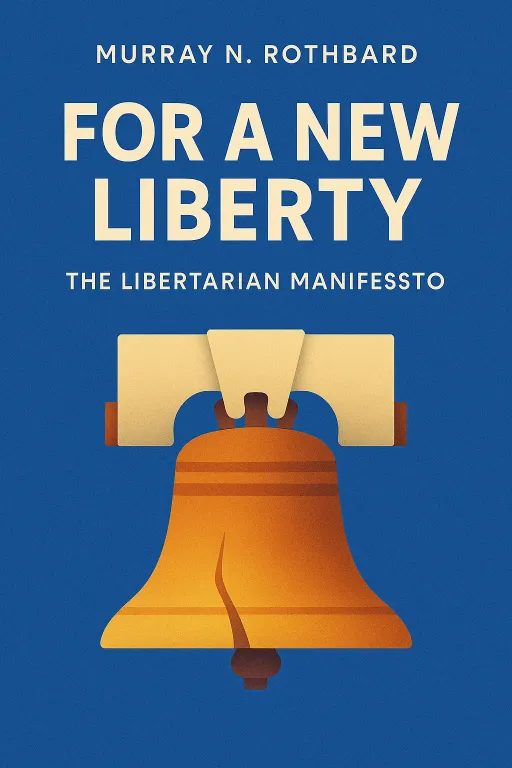
For a New Liberty
Murray N. Rothbard
A comprehensive exploration of libertarian principles and their application to contemporary issues. Rothbard makes a compelling case for individual liberty, limited government, and free markets, challenging conventional political ideologies and offering a radical vision for a free society.