

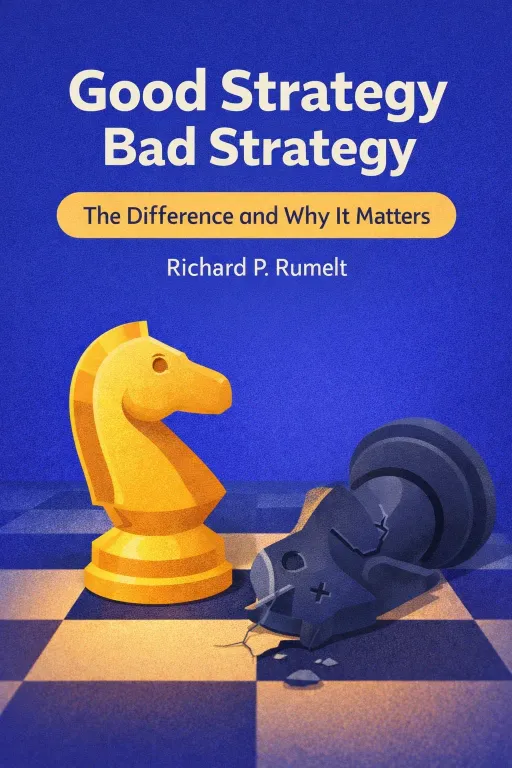
Good Strategy Bad Strategy
Richard P. Rumelt
"Good Strategy Bad Strategy" is a no-nonsense demolition of corporate jargon written by Richard Rumelt, a professor at UCLA Anderson School of Management. Rumelt argues that most of what passes for strategy in the business world is actually just wishful thinking. He attacks the "template-style" planning that confuses ambition with action, asserting that a strategy is not a list of lofty goals but a specific, coherent design for overcoming a critical challenge. The core of the book is a framework Rumelt calls The Kernel. A good strategy must contain three essential elements. First is a Diagnosis that defines the challenge and simplifies the overwhelming complexity of reality. Second is a Guiding Policy which is the overall approach chosen to cope with the obstacle identified in the diagnosis. Third is a set of Coherent Actions which are coordinated steps designed to carry out the guiding policy. Rumelt contrasts this with Bad Strategy. He identifies bad strategy by its reliance on "fluff," which is the use of buzzwords to mask an absence of thought. It fails to face the problem, mistakes financial goals for strategy, and presents a laundry list of conflicting priorities rather than a focused path forward. "Good Strategy Bad Strategy" teaches that the heart of strategy is the willingness to make hard choices and the discipline to say no to a wide variety of interests and demands.
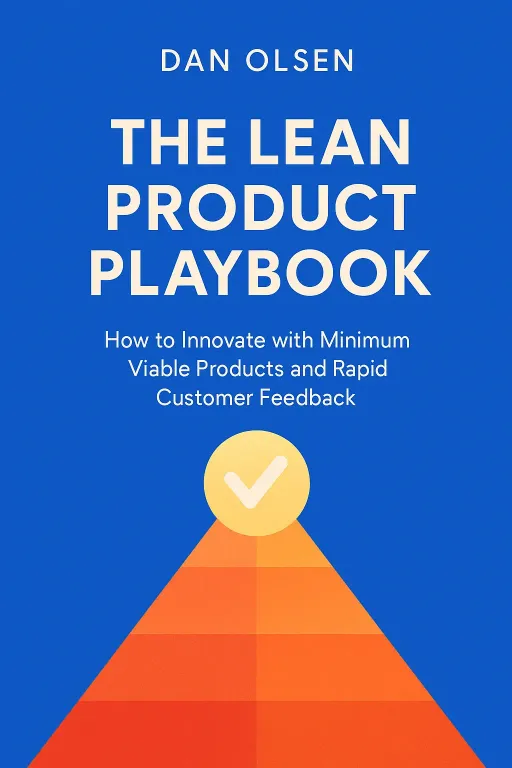
The Lean Product Playbook
Dan Olsen
This book provides a practical, step-by-step guide to applying Lean Startup principles for building successful products that customers love. Author Dan Olsen introduces the Product-Market Fit Pyramid and the Lean Product Process, a six-step framework for determining target customers, identifying underserved needs, defining value propositions, specifying MVP features, creating prototypes, and testing with customers. It delves into essential topics like UX design, Agile development, and using analytics to optimize products, offering a comprehensive playbook for innovators and entrepreneurs aiming to achieve product-market fit and minimize product failure.
Jobs to Be Done
Stephen Wunker
Discover a straightforward process that enables companies to consistently uncover new opportunities and generate great ideas. Based on the groundbreaking work of Harvard Business School Professor Clayton Christensen, this book provides a roadmap for customer-centered innovation, helping you understand customer needs, attitudes, and behaviors to create original and profitable solutions.
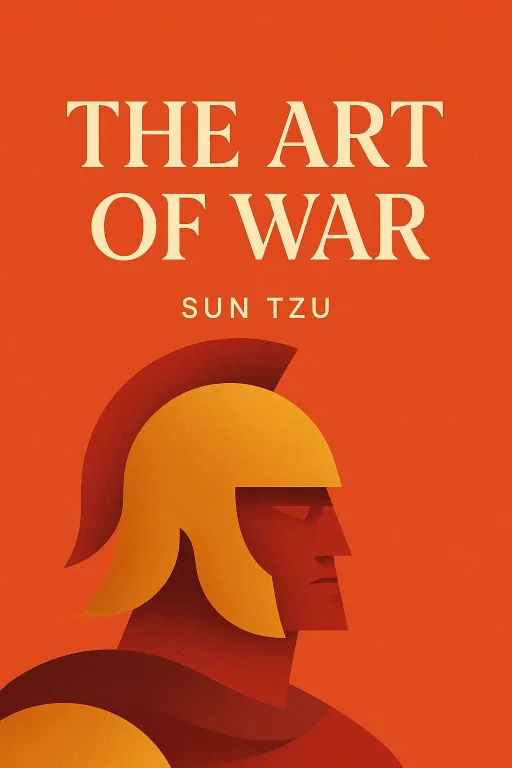
The Art of War
Sun Tzu
"The Art of War" is the most influential treatise on strategy ever written. Attributed to the ancient Chinese general Sun Tzu, this text dates back roughly 2,500 years yet remains a staple in military academies and business boardrooms alike. Unlike typical war manuals that focus on weapons or brute force, Sun Tzu treats conflict as a matter of psychology, timing, and information. The central philosophy of the book is that the highest form of generalship is not to win a hundred battles, but to defeat the enemy without fighting at all. Sun Tzu argues that warfare is based on deception. He advises commanders to appear weak when they are strong and strong when they are weak, manipulating the enemy's perception to gain a tactical advantage. The text is devoted to specific aspects of warfare, from the use of spies to the layout of terrain. Its most famous lesson emphasizes the power of preparation and self-awareness: if you know the enemy and know yourself, you need not fear the result of a hundred battles. The Art of War endures because its advice on leadership, planning, and outmaneuvering opponents applies just as effectively to politics and commerce as it does to the battlefield.
Thinking in Bets
Annie Duke
"Thinking in Bets" is a practical guide to decision-making written by Annie Duke, a former World Series of Poker champion and cognitive psychology doctoral student. Duke uses the high-stakes world of professional poker to explain how to make smart choices in a world defined by uncertainty. She argues that most people treat life like chess, where all the pieces are visible and the right move always leads to a win. However, life is actually like poker: a game of incomplete information where you can make the absolute best decision and still lose due to luck. The central concept of the book is the danger of Resulting. This is the psychological trap where we judge the quality of a decision based solely on its outcome. If a drunk driver gets home safely, we do not say they made a good decision, yet in our own lives, we constantly credit our success to skill and our failures to bad luck. Duke argues that we must decouple the process from the result to truly learn. The book advocates for Probabilistic Thinking. Instead of viewing the world in black and white—right or wrong, true or false—we should train ourselves to think in percentages. By admitting "I am 60% sure," we open ourselves to new information and reduce the emotional sting of being wrong. "Thinking in Bets" provides tools to overcome our biases, urging us to stop trying to be "right" and start trying to be accurate.
Superhuman Innovation
Chris Duffey
Explore how artificial intelligence is revolutionizing business and society. Discover practical strategies and a superhuman framework to leverage AI for innovation, competitive advantage, and personal growth. Learn how AI can amplify human abilities and transform the way we work and live.
Competing Against Luck
Clayton M. Christensen
Discover the key to successful innovation with 'Competing Against Luck.' This book introduces the Theory of Jobs to Be Done, a groundbreaking approach to understanding customer behavior and creating products and services that people will eagerly purchase. Learn how to move beyond hit-or-miss innovation and achieve predictable growth by focusing on the progress your customers are striving to make.