Beyond the Org Chart: Building Resilient, High-Performing Teams.
Golden Hook & Introduction
SECTION
Nova: Atlas, what do you know about "organizational charts"?
Atlas: Oh, Nova. They're those beautiful, colorful spiderwebs we draw to pretend we know who's in charge. Mostly, they just tell you who to blame when things go sideways.
Nova: You're not wrong! And that cynical, yet strangely accurate, take is exactly what we're tackling today. We're going beyond the org chart to explore how to build truly resilient, high-performing teams, not just on paper, but in practice.
Atlas: That's a huge promise, especially for anyone out there trying to build a sustainable culture. It often feels like you're constantly fighting against the very structure you've inherited or even created.
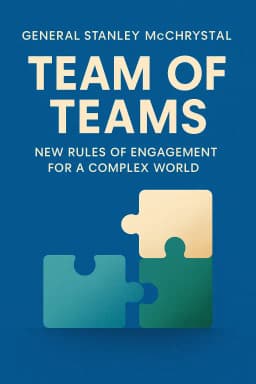
Nova: Absolutely. And today's insights are drawn from two groundbreaking books that fundamentally rethink how organizations function: Stanley McChrystal's "Team of Teams" and Colin Bryar and Bill Carr's "Working Backwards."
Atlas: Two very different sources, I imagine?
Nova: Wildly different, but surprisingly complementary. McChrystal, a decorated four-star general, didn't just write a book; he literally revolutionized military operations in Iraq, transforming an entrenched, hierarchical force into an agile network to combat a new kind of enemy. He proved that even the most rigid structures can adapt.
Atlas: Whoa. A four-star general going agile? That’s not what I picture when I think of the military.
Nova: Exactly! And Bryar and Carr? They were Amazon insiders, two of the earliest employees who helped build the very mechanisms that made Amazon... well, Amazon. They literally wrote the playbook on how a company obsessed with its customers can scale at an unprecedented rate.
Atlas: So, we're talking about lessons from the battlefield and the boardroom, both aiming at the same thing: peak performance in a fast-changing world. I'm curious, Nova, what's the biggest "blind spot" these traditional structures create that makes them so vulnerable?
The Blind Spot: Why Traditional Structures Fail Agile Teams
SECTION
Nova: The biggest blind spot, Atlas, is that traditional hierarchies are optimized for in a predictable world. Think of that classic pyramid structure: clear command lines, information flowing up, decisions flowing down. It’s like a massive, slow-moving battleship. In its day, it was incredibly powerful.
Atlas: I guess that makes sense. You need order, especially in big operations. But I imagine the world isn't so predictable anymore.
Nova: Precisely. Today, the world is less like a battleship battle and more like a swarm of speedboats darting in every direction. The environment is complex, highly interdependent, and constantly shifting. That battleship, while powerful, is too slow to react. Information gets stuck in silos, decisions get bogged down in layers of approval, and by the time a strategy is formulated and trickles down, the landscape has changed.
Atlas: Honestly, that sounds like my Monday mornings. For our listeners who are managing high-pressure teams, this concept might feel impossible to implement. But isn't structure good? Don't we need clear lines of command, especially when things get chaotic? For someone trying to build a sustainable culture, that clarity feels vital.
Nova: It does, but clarity of is different from clarity of and. The traditional structure creates a kind of tunnel vision. Each department, each silo, becomes incredibly efficient at its specific task, but they lose sight of the broader mission. They become isolated, optimizing their own little piece without understanding how it impacts the whole. This leads to missed opportunities, duplicated efforts, and a complete lack of agility.
Atlas: That sounds rough, but what's the alternative? Just chaos? We're talking about building cultures, not just companies. How do you foster adaptability without losing cohesion, without everyone just doing their own thing? If you give everyone autonomy, how do you ensure they're all rowing in the same direction?
Nova: That's the deep question, and it’s where these books offer truly profound insights. The answer isn't less structure, it's a of structure. It’s about moving from a rigid, top-down control model to one that thrives on networks, shared understanding, and empowered execution. It's about designing organizations that can be both highly aligned incredibly agile.
The Shift: From Efficiency to Adaptability with 'Team of Teams' and Amazon's 'Single-Threaded Leaders'
SECTION
Nova: This brings us to McChrystal's "Team of Teams." He faced a decentralized, adaptable enemy in Al-Qaeda in Iraq. His Joint Special Operations Task Force, or JSOC, was a hierarchical, efficient machine. But they were losing. They were too slow.
Atlas: Wait, so a military special ops unit, arguably the most hierarchical organization, became... agile? That sounds a bit out there. How do you get a massive, disciplined organization to suddenly trust everyone with execution?
Nova: He realized their enemy wasn't a conventional army; it was a network. To fight a network, you need a network. So, he made two radical shifts: "shared consciousness" and "empowered execution." "Shared consciousness" meant breaking down those silos. Instead of a "need-to-know" culture, where information was hoarded, he fostered a "need-to-share" culture. Every day, thousands of people across different units would share intelligence, plans, and challenges in real-time, in massive video conferences.
Atlas: So, everyone knew what everyone else was doing? Like, a global water cooler chat, but with higher stakes?
Nova: Exactly, but highly structured. It meant that a drone operator knew what a special forces team was doing on the ground, and vice versa. This created a collective understanding of the battlefield, allowing teams to make decisions without waiting for layers of approval. And that led to "empowered execution." Once everyone had that shared understanding, frontline teams were trusted and given the authority to make decisions on the spot, without having to escalate every little thing up the chain of command.
Atlas: I can see how that would be powerful for a military unit in a crisis, where speed is life or death. But what about a company? Amazon's "single-threaded leader" sounds almost the opposite – one person owning a project. How do you reconcile "team of teams" shared consciousness with a "single-threaded leader" that sounds like a mini-CEO?
Nova: That’s a brilliant question, Atlas, and it highlights how seemingly different approaches can achieve the same outcome: speed and adaptability. Amazon's "single-threaded leader" isn't about top-down command in the traditional sense. It's about assigning one person, with a dedicated, focused team, to own a specific customer problem or initiative from end-to-end. This leader has clear responsibility, clear authority, and is unencumbered by other distractions.
Atlas: So, it's not a dictator, but more like a highly focused entrepreneur within the company, with the power to move fast?
Nova: Precisely. They cut through bureaucracy. They don't have to get consensus from ten different departments. They have the resources and the mandate to make high-velocity decisions. This mechanism allows Amazon, a company of hundreds of thousands, to still innovate at the speed of a startup. It's about empowering one individual to drive a clear outcome, much like McChrystal empowered his frontline units. Both models are about decentralizing decision-making while centralizing information and strategic alignment.
Atlas: That’s a perfect example. So basically you’re saying, it’s not about abandoning structure, but about designing structures that prioritize information flow and empowered decision-making, whether that's through a network or a highly focused leader. That's actually really inspiring for anyone trying to scale with intention and build resilient, high-performing structures.
Synthesis & Takeaways
SECTION
Nova: Absolutely. The profound insight here is that the goal isn't just efficiency anymore; it's. It's about building organizations that can constantly learn, evolve, and respond to an ever-changing environment. Both McChrystal and Amazon show us that to do that, you need to push decision-making to the edges, to the people closest to the problem, and then ensure everyone has the context and shared purpose to make those decisions effectively.
Atlas: Honestly, that sounds like my Monday mornings. It's not just about drawing a new org chart, is it? It’s about building a culture of trust and transparency where everyone feels like they own a piece of the mission. For those of us building cultures, not just products, it's about trusting our intuition about people, but then backing it up with these kinds of intentional designs. It's about recognizing that people to contribute effectively.
Nova: Exactly. These models aren't just about speed; they're about fostering deep human connection and collective intelligence. When people feel seen, heard, and empowered, they don't just perform better; they. They become more engaged, more innovative, and ultimately, more resilient. It’s a shift from viewing employees as cogs in a machine to valuing them as intelligent, autonomous nodes in a dynamic network.
Atlas: That gives me chills. So, for our listeners who are navigating their own organizational designs, what's one immediate step they can take to start shifting towards this "team of teams" mindset, even if they're not leading a special ops unit?
Nova: Start with "shared consciousness." Encourage your teams to regularly share not just their progress, but their challenges, their learnings, and their insights, not just up the chain, but horizontally across departments. Create dedicated spaces or forums for cross-functional knowledge sharing. Even a simple 15-minute weekly "what I learned this week" session can start to break down those silos.
Atlas: I love that. It's about creating those informal networks of knowledge. It's about truly hearing your team, and your market. It's about empowering people to connect and contribute beyond their immediate task. And that's what we're all about here.
Nova: Absolutely. The most resilient teams aren't built on paper, but in practice, through intentional design and a culture of trust. And if you're curious about how these insights can be applied to real-world challenges, we'd love to hear your experiences. Share your thoughts on social media using #AibraryPodcast.
Atlas: We're always looking to connect with fellow architects of culture and talent whisperers. Share your organizational design wins and woes with us.
Nova: This is Aibrary. Congratulations on your growth!