Unlocking Team Potential: The Power of Intentional Leadership
Golden Hook & Introduction
SECTION
Nova: What if I told you the best way to lead a high-performing team isn't by being in charge, but by actually giving up control? Sounds completely counterintuitive, right?
Atlas: Oh, I know that feeling. For anyone trying to build a strong team, that just sounds like a recipe for absolute chaos, especially in high-stakes environments. My instincts scream, "More control!"
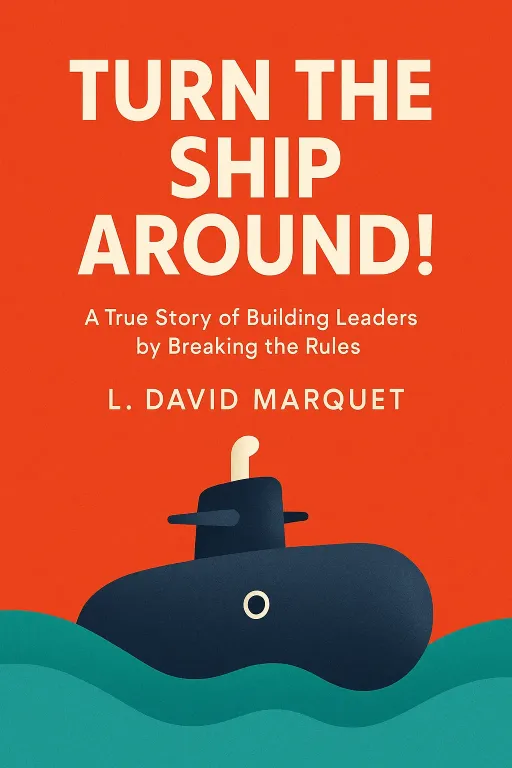
Nova: Exactly! But the data, and some incredible real-world transformations, tell a very different story. Today, we're diving into a book that fundamentally shifted my perspective on leadership: "Turn the Ship Around!" by L. David Marquet.
Atlas: Ah, Marquet. The submarine captain, right? That’s what always intrigued me about this book – it’s not some corporate guru’s theory, it’s from someone who commanded a nuclear submarine. That's a pretty intense environment to experiment with leadership.
Nova: Absolutely. And that unique, high-pressure context is precisely why his insights are so potent. He was tasked with turning around the USS Santa Fe, a submarine known for its abysmal morale and performance. His journey from giving orders to cultivating leaders is a masterclass in empowerment.
The Leader-Leader Revolution: Empowering Ownership
SECTION
Nova: Marquet realized early on that his traditional, top-down, "leader-follower" approach was actually making things worse. He had a profound epiphany during a drill. He gave a junior officer an order: "Take the ship to 100% power." The officer just froze.
Atlas: Whoa. In a submarine, that’s… not ideal.
Nova: Not ideal at all. And it hit Marquet that the officer wasn't incompetent; he simply wasn't empowered to think beyond the order. He was waiting for instructions, not taking ownership.
Atlas: I can see how that would happen. We're all conditioned to follow the chain of command, especially in rigid structures. So, what did Marquet do? Did he just yell louder?
Nova: Quite the opposite. He flipped the script entirely. He started saying, "I intend to flood tube one," instead of "Flood tube one." And he encouraged his crew to do the same. This subtle shift transformed every interaction.
Atlas: So you’re saying instead of "Do this," it became "This is what I intend to do, what are your thoughts?"
Nova: Precisely. It forced the crew to engage their brains, understand the intent, identify potential problems, and offer solutions. It moved from compliance to commitment. They had to be technically competent enough to execute, but also strategically aware enough to challenge.
Atlas: That’s fascinating. But wait, looking at this from a strategic builder's perspective, isn't that risky? How do you ensure competence and alignment when everyone's making decisions? For our listeners who are talent magnets, they want to empower, but they also need results.
Nova: That’s a critical point, Atlas. Marquet wasn't advocating for anarchy. He emphasized two pillars: technical competence and organizational clarity. You empower people who know what they're doing and understand the mission. He invested heavily in training and ensured everyone knew the "why" behind the "what."
Atlas: Okay, so it’s not just "do whatever you want." It’s "I trust you to know what you're doing, and I trust you to understand the objective, so tell me your plan."
Nova: Exactly! The crew became a team of leaders, not just followers. And the results were staggering. The USS Santa Fe went from dead last to best in the fleet, with unprecedented retention and promotion rates. It proved that giving control, paradoxically, multiplies leadership.
Atlas: That’s actually really inspiring. It challenges the assumption that leadership is a scarce resource held only at the top. It sounds like it cultivates a deep sense of ownership.
The Intrinsic Drivers: Autonomy, Mastery, and Purpose
SECTION
Atlas: So, if we’re giving people more control, what’s actually driving them to use it effectively? Is it just the responsibility, or is there something deeper at play that Marquet intuitively tapped into?
Nova: That's a brilliant question, and it leads us perfectly to our second profound insight from Daniel Pink's groundbreaking book, "Drive." Pink, a former speechwriter who pivoted to studying the science of motivation, argues that traditional external motivators often fail.
Atlas: You mean like bonuses and promotions? The classic carrot and stick?
Nova: Exactly. Pink reveals that for creative, knowledge-based work, these external rewards can actually performance and dampen innovation. He posits that true engagement and high performance stem from three intrinsic drivers: autonomy, mastery, and purpose.
Atlas: Autonomy, mastery, and purpose. That makes me wonder, how does that translate into tangible results for someone building a team, especially if they're used to more traditional metrics? How do you measure the ROI on 'purpose'?
Nova: That's a great challenge. The ROI on purpose isn't always a direct line on a spreadsheet, but it's massive in terms of retention, innovation, and overall team satisfaction. Think about open-source software projects, like Linux or Wikipedia. No one is getting paid a salary to contribute. They do it for the mastery of their craft, the autonomy to work on what they choose, and the purpose of contributing to a larger, shared project.
Atlas: Wow, that’s a perfect example. People pouring thousands of hours into something purely for the intrinsic reward. That’s a powerful testament to Pink’s ideas.
Nova: It is. Autonomy gives us control over our tasks, time, team, and technique. Mastery is our desire to get better at something that matters. And purpose is the yearning to do what we do in the service of something larger than ourselves.
Atlas: So, for a talent magnet, designing roles and a culture that provides these three things would be key to attracting and retaining top performers. How do leaders actually implement this? Like, how do you give autonomy without losing sight of business objectives?
Nova: It's about granting autonomy over work gets done, not necessarily work gets done. You set the strategic objectives, the "what," and then you empower your team with the "how." For mastery, it's about providing continuous learning opportunities, challenging assignments, and feedback. And purpose? That’s about clearly articulating the mission and connecting individual contributions to the bigger picture.
Atlas: It sounds like Marquet’s "leader-leader" model provides the perfect structure for Pink’s intrinsic motivators to flourish. If everyone understands the intent and has the competence, then autonomy, mastery, and purpose become the natural fuel.
Synthesis & Takeaways
SECTION
Nova: Absolutely. The cold fact is, a command-and-control approach stifles innovation and engagement. But when you combine Marquet’s structural empowerment with Pink’s understanding of human motivation, you create an environment where every team member feels empowered, takes ownership, and contributes their best work.
Atlas: That’s a powerful synthesis. It directly addresses the challenge of unlocking full team potential and building sustainable growth, not just chasing short-term gains. It's about building a team that's intrinsically driven, not just externally compliant.
Nova: Precisely. And that brings us to our tiny step, something you can try at your very next team meeting. Instead of asking "What should I do?" when a problem arises, try asking your team members, "What do you intend to do?"
Atlas: Oh, I like that. It’s such a simple rephrasing, but it immediately shifts the burden of thought and ownership. And really listen to the answer, even if it's not what you expected. That's where the real ownership begins.
Nova: Exactly. It's a small linguistic tweak with enormous potential to cultivate a leader-leader mindset. So, we invite you to reflect: How can you create more opportunities for autonomy, mastery, and purpose within your team?
Atlas: And what's one small piece of control you could give up this week to empower a team member?
Nova: This is Aibrary. Congratulations on your growth!