The 'Adapt or Die' Law: Building a Resilient Business Culture
Golden Hook & Introduction
SECTION
Nova: What if the very thing you think makes your business resilient—that tight control, that clear, unyielding hierarchy—is actually its greatest weakness?
Atlas: Hold on, Nova. For anyone who's ever built something from the ground up, anyone who's driven by impact and market leadership, that sounds a bit counterintuitive. My instinct, and I imagine many of our listeners' instincts, is that more control equals more stability, more predictability.
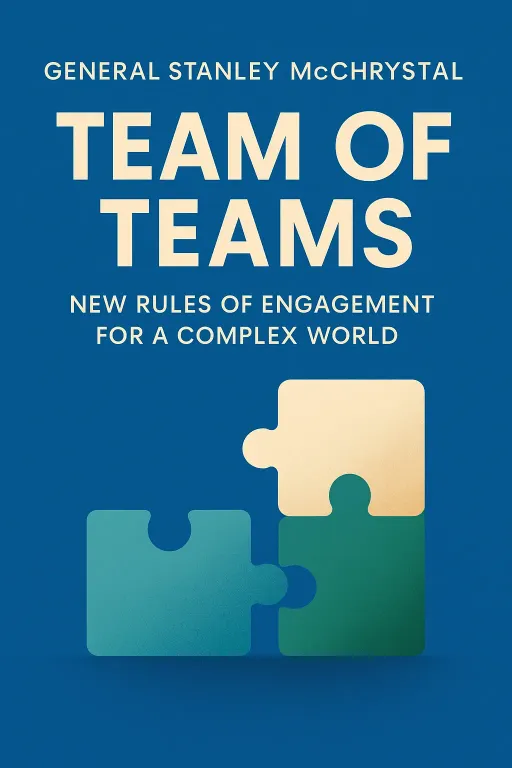
Nova: Exactly! That's the conventional wisdom we're challenging today. Because in a world that's shifting faster than ever, the old ways of building resilience just don't cut it. We need radical adaptability, and it comes from the most unexpected places. Today, we're diving into two groundbreaking books that flip this entire notion on its head: "Team of Teams" by General Stanley McChrystal and "Turn the Ship Around!" by L. David Marquet.
Atlas: Wow, a general and a submarine captain? Those are environments synonymous with rigid command structures. I'm already intrigued by how they'd advocate for anything control.
Nova: Absolutely. These are highly acclaimed works in leadership circles precisely because they challenge those assumptions. McChrystal, a special forces commander, had to completely rethink how his elite units operated to combat a decentralized enemy. And Marquet, transforming a struggling nuclear submarine crew, is perhaps the ultimate case study in pushing decision-making down the chain of command. They both found that true resilience, true agility, doesn't come from a single, all-knowing brain at the top, but from distributed intelligence.
Deconstructing Hierarchies: The Shift to Empowered Networks
SECTION
Nova: So let's start with General Stanley McChrystal's "Team of Teams." He describes how the US military, a quintessential hierarchy, found itself struggling against Al-Qaeda in Iraq. Their enemy was agile, decentralized, and moved incredibly fast. The military's traditional structure, designed for efficiency and control in predictable warfare, was actually making them brittle.
Atlas: That makes sense. If your enemy can change tactics on a dime, and you need to go through three layers of command just to get approval for a new strategy, you're going to be left behind.
Nova: Precisely. McChrystal realized they needed to transform into an "adaptable team of teams." This wasn't about abandoning discipline, but about shifting from a "command and control" model to one built on what he calls "shared consciousness" and "empowered execution."
Atlas: Shared consciousness... I can see how that would be critical. It’s like everyone having access to the same playbook, the same real-time intel. But how does a large, established organization, especially one built on clear chains of command, actually that? Isn't relinquishing control risky for market leadership, for hitting those strategic goals?
Nova: That's the crux of it. It's not about relinquishing control; it's about redefining it. For McChrystal, shared consciousness meant radical transparency. They implemented daily operational rhythm meetings, where every unit, from intelligence to special operations, shared what they knew, what they were doing, and what they. This wasn't about top-down directives; it was about creating a collective understanding of the battlefield.
Atlas: So it's less about 'everyone doing whatever they want' and more about 'everyone knowing what everyone else is doing, and why.' Like a hive mind, but with individual autonomy. I can see how that would inform better decisions down the line. It's about empowering people with information.
Nova: Exactly. And the second part, "empowered execution," meant giving those informed teams the authority to act. If you have shared consciousness, you trust that your people, armed with the best available information, will make the right decisions in the moment, without having to wait for approval from above. This isn't anarchy; it's a new form of disciplined collaboration. It requires a massive mindset shift from top leadership, moving from being a chess master to a gardener, cultivating the environment for success.
Leadership at Every Level: Fostering Autonomy and Ownership
SECTION
Nova: And that naturally leads us to the second key idea we need to talk about, which often acts as a counterpoint to what we just discussed: the concept of leadership at every level, as championed by L. David Marquet in "Turn the Ship Around!" Shared consciousness needs empowered execution to truly work, and that means pushing decision-making authority down.
Atlas: A nuclear submarine? That's the ultimate 'command and control' environment! Every decision is critical, every action meticulously planned. How could you possibly give away control there without disaster? That sounds like a recipe for chaos, not resilience.
Nova: That's what makes Marquet's story so compelling. When he took command of the USS Santa Fe, it was one of the worst-performing submarines in the fleet. He realized his crew was just waiting to be told what to do, which stifled initiative and fostered a culture of mediocrity. His radical shift was to implement a "leader-leader" model, moving away from the traditional "leader-follower" dynamic.
Atlas: What does that even mean in practice? I'm picturing a captain telling a junior officer, "You decide if we dive or surface." That just seems impossible.
Nova: It's much more nuanced, but incredibly powerful. Instead of giving direct orders, Marquet trained his crew to say, "Captain, I intend to..." rather than "Captain, permission to..." This simple linguistic shift forced them to take ownership, to think through the plan, and to articulate their intentions. It meant they had to understand the 'why' behind their actions, not just the 'what.'
Atlas: Oh, I see. So it wasn't about them making decisions blindly. It was about them taking the initiative to formulate the plan, then informing the captain, who could then provide context or guidance if needed. It transformed them from order-takers to decision-makers, fostering leadership at every level.
Nova: Exactly. He called it "control without command." The results were astounding. The Santa Fe went from worst to first in the fleet, not because Marquet was a better micromanager, but because he built a culture where everyone was empowered, competent, and accountable. They had to be; their lives, and the mission, depended on it.
Atlas: That’s fascinating. So, for a strategic builder looking to make an impact, this isn't just about delegating tasks, but delegating? What's the smallest, safest way to start doing that, especially when you feel like you need to maintain oversight for quality and strategic direction?
Synthesis & Takeaways
SECTION
Nova: That's a brilliant question, Atlas, and it gets to the heart of what both McChrystal and Marquet teach us. True resilience isn't about rigid strength or absolute control; it's about dynamic adaptability and the distributed intelligence of empowered people. The common thread is trust and transparency. You can't empower people if you don't trust them with information and the authority to act on it.
Atlas: So, instead of seeing decentralization as a loss of control, it's about amplifying impact by distributing intelligence and ownership. It's about building a system where the organization itself learns and adapts, not just the person at the top, which aligns perfectly with dominating a niche market or even global expansion.
Nova: Precisely. And the tiny step, the actionable insight from all this, is deceptively simple but profoundly impactful: Identify one routine decision you currently make. Delegate it completely to a team member. Provide them with all the necessary context, but no prescriptive instructions. Let them own the decision, the process, and the outcome.
Atlas: That’s a powerful shift in mindset – trusting instincts, as our listener profile suggests, but also trusting the instincts you help cultivate in others. It's about building a culture where everyone feels like a leader, capable of making strategic contributions.
Nova: And that, ultimately, is how you build a business culture that doesn't just adapt, but thrives in any environment. It's about unleashing potential, not containing it.
Atlas: That’s a profound thought to end on. Empowering others is empowering yourself.
Nova: Absolutely.
Nova: This is Aibrary. Congratulations on your growth!