Stop Managing Tasks, Start Leading Systems: The Guide to Empowering Your Agent Teams.
Golden Hook & Introduction
SECTION
Nova: You know, Atlas, for so many of us, especially those deep in the trenches of building complex Agent systems, we're taught that great leadership means having all the answers, being the ultimate decision-maker, the bottleneck, I mean, the of the operation.
Atlas: Oh man, I feel that in my bones, Nova. It's the classic "if you want something done right, do it yourself," or at least, "micromanage it yourself." Especially when you're dealing with cutting-edge tech that no one else fully grasps. There's a certain comfort in control, right?
Nova: Absolutely! And that comfort, that ingrained belief, is precisely what can secretly stifle the very innovation we're desperate to unlock. What if I told you that the path to truly empowering your Agent teams – to making them not just efficient, but wildly innovative – actually lies in giving up that control?
Atlas: Whoa, really? Giving up control? That sounds… counterintuitive, to say the least, especially when we're talking about the intricate dance of autonomous agents and their complex interactions. How on earth do you build robust systems by letting go? That sounds like a recipe for chaos, not success.
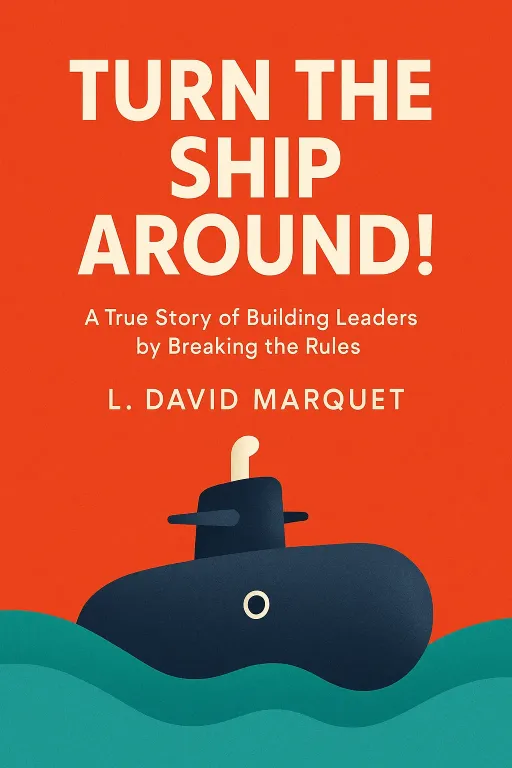
Nova: Well, it’s a radical idea, but it’s been proven in some of the most high-stakes environments imaginable. Today, we're diving into the transformative insights from a book called by L. David Marquet. It's a leadership masterpiece that challenges the very foundation of traditional management, advocating for a 'leader-leader' model. And while Marquet's original context was a nuclear submarine, its principles are profoundly relevant to the dynamic, rapidly evolving world of Agent systems.
Atlas: A nuclear submarine? That’s about as far from Agent development as you can get, yet I’m intrigued. So, you’re suggesting the lessons from a vessel designed for ultimate command and control can teach us about decentralization and empowerment in tech? I'm listening.
The Bottleneck of Top-Down Management in Agent Systems
SECTION
Nova: Exactly! Because the core problem Marquet identifies, the "cold fact" as we call it, transcends industries. It's this: as an architect and innovator, you might find yourself deep in technical details, optimizing code, designing intricate agent architectures. But true impact, especially in a field that's moving as fast as AI Agents, comes from empowering your team, not just optimizing the tech itself.
Atlas: I can see that. I mean, we're building systems that are designed to be autonomous, to make decisions. But then we, as leaders, often fall back into this habit of wanting to make every single decision for the human teams building them. It's a strange dichotomy.
Nova: It is! And traditional top-down management, where decisions flow from the top, through layers, down to the implementers, actually stifles the very innovation you seek. Think about it: in Agent systems, you're dealing with emergent behaviors, unpredictable interactions, and a constant need for rapid adaptation. If every micro-decision has to bubble up to a single leader, what happens?
Atlas: Bottleneck. Massive bottleneck. Decision-making slows to a crawl. The people closest to the problem, who have the most context, have to wait for approval from someone often several steps removed. And by the time the approval comes, the context might have changed, or a new problem has emerged.
Nova: Precisely. Imagine an Agent team developing a complex multi-modal decision framework. A junior developer spots a crucial flaw in how two agents are integrating data. In a traditional 'leader-follower' model, they report it up. Their manager assesses it, perhaps escalates it to the lead architect—that’s you, the future architect—who then has to carve out time from their strategic thinking to dive into this specific bug, make a decision, and push it back down.
Atlas: Oh, I've been there. Both as the junior developer waiting anxiously, and as the architect pulling my hair out trying to triage a hundred little issues while also needing to design the next generation of the system. It's exhausting, and frankly, it's not efficient. It feels like I'm managing tasks, not leading a robust system.
Nova: That’s the core of it. You become the central processing unit for every single operational decision. And in a field where rapid iteration and localized intelligence are paramount, that model is fundamentally broken. It drains creativity, it disempowers those on the front lines, and it drastically slows down your ability to adapt and innovate. The team might be technically brilliant, but their collective intelligence is constrained by the slowest link in the decision chain.
Unleashing Autonomy: The 'Leader-Leader' Model for Agent Teams
SECTION
Nova: So, if the problem is too much central control, what if the solution isn't just control, but a complete redefinition of how control itself operates? What if we could build an environment where everyone, from the most junior engineer to the senior architect, feels empowered to contribute their absolute best to complex Agent development?
Atlas: Okay, I’m listening. Because the idea of a team where everyone is genuinely empowered to act, not just follow orders, sounds like a dream. But how do you prevent it from devolving into anarchy? How do you ensure everyone is pulling in the same direction without a central hand on the rudder?
Nova: That's where Marquet's 'leader-leader' model comes in. It's not about abandoning leadership; it's about decentralizing it. It’s about creating an environment where everyone feels like a leader, not just a follower waiting for instructions. The fundamental shift is from "tell me what to do" to "I intend to..."
Atlas: "I intend to..." That's a powerful reframe. So, instead of asking for permission, they state their plan of action? But what if their intentions are off-base? What if they make a bad call, especially in a critical Agent deployment?
Nova: That's why the 'leader-leader' model isn't just about handing over the reins. It's built on three pillars: technical competence, clarity of intent, and psychological safety. First, you invest heavily in making sure your team has the skills and knowledge to make good decisions – they are your technical experts after all. Second, you, as the formal leader, clearly articulate the – the strategic intent, the desired outcomes for the Agent system. This gives them the boundaries and the north star.
Atlas: So, the leader sets the destination, but the team navigates the specific route? That resonates with the "system and practice" learning style. It means the leader's job shifts from micro-managing tasks to ensuring the team has the skills and the vision.
Nova: Exactly! And the third pillar, psychological safety, is critical. It means creating an environment where people feel safe to voice concerns, to experiment, and yes, even to make mistakes, knowing they'll be supported, not punished. Imagine an Agent team working on an explainability module. Instead of the architect dictating every algorithm choice, a team member, perhaps a data scientist, comes forward and says, "I intend to implement a LIME-based approach for this specific agent's decisions, because I believe it offers the best balance of interpretability and computational efficiency for our current data pipeline. I've documented my reasoning and potential trade-offs."
Atlas: That’s amazing! That’s a fundamentally different conversation than, "Should I use LIME or SHAP?" It pushes the ownership and the critical thinking down to where the actual work is happening. The leader's role then becomes more about coaching, asking probing questions, and ensuring alignment with the overall system's goals, rather than making the technical call themselves.
Nova: Precisely. This empowerment leads to faster decision cycles, higher quality outcomes because the experts closest to the problem are solving it, and an explosion of innovation because people feel trusted to experiment. It's about leading a system of empowered agents – both human and artificial – rather than managing a checklist of tasks. This fundamentally solves the problem of bottlenecked decision-making by empowering every team member to contribute their best to complex agent development.
Synthesis & Takeaways
SECTION
Nova: Ultimately, what Marquet's 'leader-leader' model teaches us, and what's so profoundly applicable to future architects and innovation explorers in the Agent space, is that true leadership isn't about being the smartest person in the room or having all the answers. It's about building a system where everyone be the smartest person in their specific domain, and where their intelligence is leveraged, not limited.
Atlas: That's a huge shift in mindset. It’s moving from a scarcity mentality of control to an abundance mentality of distributed intelligence. It's about recognizing that the "Agent" in "Agent team" isn't just about the AI, but about the human agents who build and deploy them.
Nova: Absolutely. And for our pragmatic, action-oriented listeners, this isn't just theory. It starts with a tiny, yet powerful, step.
Atlas: Okay, I'm ready for the "Tiny Step." What's the immediate action we can take to start this transformation?
Nova: Identify one decision you usually make for your team – just one, maybe a seemingly small one – and instead, empower a team member to own that decision completely. Offer your support, your context, your strategic intent, but not your direct instruction or direction. Let them make the call, learn from the outcome, and grow into that leadership space.
Atlas: Wow. That's actually incredibly powerful. It’s a tangible way to break the habit of control and start building that 'leader-leader' muscle, both for you and for your team. It’s like planting a seed of autonomy and watching it grow.
Nova: Exactly. It's about trusting your team to be the innovative, problem-solving agents you hired them to be. It's how you move from merely managing tasks to truly leading systems.
Atlas: This has been incredibly insightful, Nova. It's not just a different way to lead, it's a different way to think about leadership itself, especially in our fast-paced, complex world of Agent development.
Nova: My pleasure, Atlas. It’s a journey, but one that promises immense rewards for both leaders and their teams.
Nova: This is Aibrary. Congratulations on your growth!