Stop Managing, Start Leading: The Guide to Empowering Your Team.
Golden Hook & Introduction
SECTION
Nova: Atlas, I have a challenge for you. Five words. Describe traditional, top-down leadership. Go!
Atlas: Oh, I like this. Okay... Micromanaging, stifling, exhausting, slow, outdated.
Nova: Ouch! You're not holding back. But honestly, that's the perfect, albeit brutal, segue into what we're dissecting today: a book simply titled "Stop Managing, Start Leading: The Guide to Empowering Your Team." This isn't just another leadership book; it cuts straight to the heart of why so many organizations, despite having brilliant people, feel fundamentally stuck.
Atlas: Right? I can definitely relate to that feeling of stagnation. So, it's basically saying, the way we've always approached leadership might actually be the very thing holding us back from true potential?
Nova: Exactly. The cold, hard fact the book lays bare is that traditional top-down leadership often stifles initiative and limits organizational potential. It's like having a high-performance engine and only ever letting it idle. We're talking about a system that inherently disengages the very people you need to be most engaged.
Atlas: That makes me wonder, how did we even get here? If it's so obviously counterproductive, why is it still the default for so many?
Nova: Well, historically, it made sense in certain contexts, particularly in industrial models where efficiency through strict control was paramount. But the world has evolved. The book argues that true leadership in today's complex environment empowers every individual, fostering an environment where innovation and responsibility don't just happen by accident, but thrive by design.
The Problem with Traditional Top-Down Leadership
SECTION
Nova: Think about it: in a traditional "leader-follower" model, who holds all the information? Who makes all the decisions? Who bears all the responsibility?
Atlas: Typically, the leader. The person at the top.
Nova: Precisely. And what does that cultivate in the team below? A culture of waiting. Of looking up for answers. Of taking minimal initiative because, well, that's the leader's job. This isn't about blaming leaders; it's about recognizing a systemic flaw. Imagine a scenario: a critical client issue arises. Under a traditional model, the team member closest to the problem, the one with the most immediate context, has to escalate it. They wait for approval, for a solution to be handed down.
Atlas: I've been there. You're sitting on information, you know what needs to happen, but you can't act until you get the green light. It's incredibly frustrating, and honestly, it makes you feel like just a cog in the machine.
Nova: Exactly! And not only is it frustrating, it’s inefficient. The delay alone can cost time, money, and client trust. But more profoundly, it robs that team member of the opportunity to develop their own critical thinking, problem-solving skills, and leadership muscle. Over time, that leads to widespread disengagement. People stop bringing their best ideas because they learn their ideas won't be trusted or implemented anyway.
Atlas: That sounds rough, but isn't that just delegation? Giving someone a task to do?
Nova: That's a great question, and it's where many leaders get stuck. Delegation is often about assigning tasks. What we're talking about here is far deeper. It's about assigning and. It's about empowering someone not just to a task, but to how it should be done, to navigate its complexities, and to be fully accountable for the outcome. The book highlights that this fundamental difference is what unlocks true potential. You're not just offloading work; you're cultivating a leader.
Atlas: So basically you're saying, if you're a leader who wants to build systems and drive lasting change, relying on the old top-down approach is actually counterproductive to your own goals? It's like trying to build a skyscraper with only one person laying bricks.
Nova: That's a perfect analogy. You're limiting your strategic impact because you're constantly pulled into operational decisions that your team could, and should, be handling. It drains your energy and prevents you from focusing on the visionary work you're truly meant to do.
The Leader-Leader Model: Empowering Initiative
SECTION
Nova: But what if there was a way to ignite that initiative, not just in a few key players, but across the entire team? What if everyone could operate with the mindset of a leader?
Atlas: That sounds a bit out there. Like, in theory, great. In practice, how does that even work without total chaos? I mean, someone still has to set the direction, right?
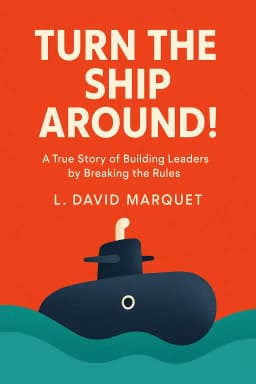
Nova: This is where "Stop Managing, Start Leading" really shines, drawing heavily on the insights from L. David Marquet's groundbreaking work, "Turn the Ship Around!" Marquet was a submarine captain who inherited a crew that was, frankly, disengaged and underperforming. His initial instinct, like many leaders, was to take charge, tell them what to do, and fix everything himself.
Atlas: A classic move. The hero complex.
Nova: Exactly. But he quickly realized that his crew was simply waiting for instructions. They were brilliant, capable individuals, but they were operating in a leader-follower system that had trained them to be passive. So, Marquet made a radical shift. He decided to push authority to the lowest possible levels. His core philosophy became "don't just tell me what you're going to do; tell me what you to do."
Atlas: Wait, hold on. So, he wasn't just giving them more tasks. He was asking them to make the actual decisions? On a nuclear submarine, where mistakes can be catastrophic? That sounds incredibly risky.
Nova: It was, and that's precisely why his story is so compelling. He wasn't abdicating responsibility; he was cultivating it. Instead of saying, "Engine room, increase speed to 10 knots," he'd hear, "Captain, I intend to increase speed to 10 knots." This subtle linguistic shift was revolutionary. It forced the crew member to take ownership, to think through the implications, and to ensure they had the competence and clarity to execute. If they didn't, it would become clear in their "intention" statement, allowing Marquet to coach, not command.
Atlas: Wow. So, the cause of the problem was disengaged followers, and the process was this radical shift in communication and authority. What was the outcome? Did it actually work?
Nova: It was an astounding success. His crew went from being the worst-performing submarine to the best in the fleet, achieving unprecedented levels of initiative, morale, and operational excellence. They were making decisions, innovating, and taking responsibility in ways no one thought possible. They became a "leader-leader" model, where everyone felt empowered to act, leading to faster, higher-quality decisions and a profound sense of ownership.
Atlas: That’s incredible. I can see how that would address the problem of disengaged teams and foster a culture of ownership. But for our listeners who are managing high-pressure teams in, say, a tech environment or a strategic consulting firm, how do you translate "submarine captain" into "team lead"? How do you ensure that pushing authority down doesn't just lead to more mistakes or confusion when the stakes are still incredibly high?
Nova: That’s the core challenge, and the book addresses it head-on. It's not about anarchy; it's about clarity and competence. Marquet ensured his crew had the technical competence, and then he gave them crystal-clear organizational clarity: the strategic intent, the goals, the boundaries. When people know needs to be achieved and, and they have the skills, they can be trusted to figure out the. It's about building trust and then backing it up with continuous development and clear communication of purpose. It truly solves the problem of disengaged teams by providing a clear framework for building a culture of ownership and high performance.
Synthesis & Takeaways
SECTION
Nova: So, what we're really talking about here is a profound shift in mindset. It's moving from the idea that a leader's job is to manage tasks and people, to the idea that a leader's job is to cultivate more leaders.
Atlas: Right. It’s about building systems for empowerment, not just solving individual problems. It resonates deeply with the idea of building lasting change, rather than just putting out fires.
Nova: Exactly. It's about trusting your inner compass, as our user profile suggests, and embracing the unknown of what your team can achieve when truly unleashed. It means letting go a little, but gaining so much more in collective impact.
Atlas: And for those of us who are visionary integrators, always looking to amplify our impact, this isn't just a soft skill. It's a strategic imperative. It's leveraging the full human capital of your organization.
Nova: Absolutely. And this week, we want to give you a "Tiny Step" from the book to put this into practice. Identify one decision you typically make for your team, and empower a team member to own that decision completely this week. Don't just delegate the task, delegate the. Coach them, support them, but let them own it.
Atlas: That's a powerful and actionable challenge. It forces you to embrace that strategic delegation mindset and trust your team in a new way.
Nova: It does. It’s a small step, but it's the beginning of a much larger transformation towards a leader-leader culture.
Atlas: And a powerful way to build lasting change.
Nova: This is Aibrary. Congratulations on your growth!