Stop Managing, Start Leading: The Guide to Empowering Your Team.
Golden Hook & Introduction
SECTION
Nova: We often hear that classic sidestep in the corporate world, don't we? "Oh, it wasn't my fault." Or, "That department dropped the ball." But what if that very phrase, that instinct to deflect, was the single biggest barrier to true, impactful leadership?
Atlas: Hold on, Nova. Are you saying we should actively seek out blame? Because for a lot of our listeners, especially those managing complex projects and high-stakes operations, the idea of taking responsibility for sounds less like empowerment and more like a fast track to burnout.
Nova: Absolutely not, Atlas. I'm talking about a profound shift in mindset. What if true power, the kind that transforms teams, came from claiming responsibility for absolutely everything that happens on your watch, even the things outside your direct control? It’s a radical idea, but it's the core of what we're unpacking today. We're diving into the transformative philosophy behind "Stop Managing, Start Leading: The Guide to Empowering Your Team," drawing heavily from two titans in the field.
Atlas: Okay, I’m intrigued. Because that sounds like a heavy burden, but if it unlocks real power, I'm listening. Who are these titans?
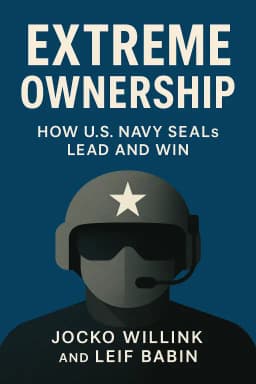
Nova: Our first stop is with the profound insights of Jocko Willink and Leif Babin, authors of "Extreme Ownership." Now, these aren't your typical boardroom gurus. They are former U. S. Navy SEAL officers who commanded Task Unit Bruiser, which was one of the most highly decorated special operations units during the Iraq War. Their leadership principles weren't forged in a conference room, Atlas, but in the crucible of life-or-death combat. That context gives their ideas an undeniable gravity, a stark, visceral truth.
Atlas: Wow. So, we're not talking about theoretical frameworks here; we're talking about lessons learned when the stakes were literally everything. That definitely adds a layer of intensity to the concept of 'ownership.'
The Unyielding Burden of Extreme Ownership
SECTION
Nova: Exactly. And that's where "Extreme Ownership" begins. It’s the foundational principle that a true leader takes absolute and unwavering responsibility for everything that happens under their command. No excuses, no pointing fingers, no 'not my job.' If it impacts your mission, it's your responsibility.
Atlas: But wait, I mean, how far does that go? For someone leading a large team, with dozens of moving parts and individual contributors, it's inevitable that mistakes will happen. Are you saying a leader should take the fall for, say, a junior team member’s coding error that leads to a system crash? Even if they weren't directly involved?
Nova: Absolutely. And that's the counter-intuitive brilliance of it. Let's imagine a scenario. A critical software deployment goes sideways. The junior engineer missed a crucial step. The immediate reaction might be to blame the engineer, or perhaps the QA team for not catching it. But a leader practicing extreme ownership steps forward and says, "This is my fault. I failed to ensure the process was robust enough. I failed to train my team adequately. I failed to set clear expectations."
Atlas: That sounds incredibly tough. I imagine a lot of our listeners, especially those in high-pressure project management roles, might feel like that's just an invitation to become a scapegoat for every departmental mishap. Isn't there a point where you need to hold individuals accountable?
Nova: You absolutely hold individuals accountable, but here's the profound difference: own the failure for not preventing failure. It's not about being a scapegoat, Atlas. It's about understanding that as the leader, you are responsible for the entire ecosystem. If the team member failed, you failed to equip them. If the process broke, you failed to design it effectively. The leader's responsibility isn't just for their own actions, but for the performance of the entire team, the effectiveness of the systems, and the clarity of the mission.
Atlas: I see. So, it’s not about shielding individuals from consequences, but about the leader looking inward first. It’s saying, "Where did miss the mark in creating the conditions for success?" That’s a radical shift from the typical blame game.
Nova: It is. And the outcome is transformative. When a leader takes that level of responsibility, two powerful things happen. First, it fosters immense trust within the team. They see their leader isn't afraid to own mistakes, which creates psychological safety for them to admit their own. Second, it drives genuine problem-solving. Instead of arguing about is to blame, the focus immediately shifts to to fix the problem and to prevent it from happening again. It's about cultivating a culture of decisive action, not just accountability.
From Manager to Leader: Cultivating Leader-Leaders
SECTION
Nova: Once you've shouldered that extreme ownership, the next logical step is to distribute that power responsibly. Because a leader who takes the responsibility but hoards all the decision-making power creates a bottleneck. And that brings us to our second profound insights, from L. David Marquet, author of "Turn the Ship Around!"
Atlas: Okay, so we're moving from owning all the problems to empowering the team to solve them. Marquet, if I remember correctly, has a fascinating background too, right?
Nova: He does. Marquet was a commander in the U. S. Navy, specifically a nuclear submarine commander. His book chronicles his experience taking command of the, a submarine that was dead last in every performance metric. He transformed it into a top-performing vessel by flipping the traditional 'leader-follower' model on its head.
Atlas: So, how do you turn a struggling submarine, or any struggling team for that matter, into a high-performing unit just by changing how decisions are made?
Nova: Marquet realized that the traditional command-and-control structure, where leaders tell subordinates exactly what to do, stifled initiative and critical thinking. He famously shifted to a 'leader-leader' model. Instead of giving orders, he empowered his crew to decisions. He taught them to say, "I intend to..." rather than "Permission to..."
Atlas: That sounds revolutionary, but for a strategic operator, isn't there a huge risk of chaos or inexperienced decisions if everyone's a 'leader'? How do you ensure competence and alignment when you 'turn the ship around' in such a dramatic way?
Nova: That's the critical question, and it's where the synergy with extreme ownership comes in. Empowerment isn't abdication. Marquet didn't just tell his crew, "Go make decisions!" He rigorously trained them, clarified the intent behind missions, and ensured they understood the "why" behind every action. He created an environment where subordinates were not just capable of making decisions, but to, and where they felt safe to learn from those decisions.
Atlas: So, it's not about letting go of control entirely, but about elevating the entire team's capacity for leadership. It’s like, instead of being the single brain controlling many limbs, you're cultivating many brains, each capable of strategic thought and decisive action within a clear framework.
Nova: Precisely. He found that when people are given genuine control and responsibility, they become deeply invested. They understand the mission, they have the competence, and they feel the ownership. It's about moving from a system where people need permission to act, to one where they declare their intentions and execute them, with the leader's role shifting to coaching, clarifying, and removing obstacles. It transforms efficiency and fosters tangible results, which I know is music to the ears of our optimization-driven listeners.
Synthesis & Takeaways
SECTION
Nova: So, when you combine the unyielding burden of extreme ownership with the profound empowerment of cultivating leader-leaders, you create a truly formidable organizational culture. Extreme Ownership provides the foundation of trust and accountability, where everyone knows the buck stops with the leader, fostering safety. The Leader-Leader model then provides the framework for distributed decision-making and genuine empowerment, where that responsibility is then shared intelligently.
Atlas: I guess that makes sense. It's about building a team where everyone feels the weight of leadership, but also the freedom to act, creating a synergy that's greater than the sum of its parts. It's not just about getting tasks done, but about cultivating a collective ownership that drives continuous improvement. For our listeners who are constantly seeking mastery and optimal outcomes, this is about transforming a team into a living, breathing, problem-solving organism.
Nova: Absolutely. It’s moving beyond managing tasks to truly guiding and empowering people. It means accepting that your team's success, and indeed their failures, are a direct reflection of your leadership. And the tiny step you can take today, for your next team challenge, is to openly take full responsibility for the outcome, regardless of individual contributions. Try it. See how it shifts the dynamic, not just for your team, but for your own sense of leadership.
Atlas: What if the biggest barrier to your team's success isn't their capability, but your willingness to truly own everything, and then empower them to do the same?
Nova: This is Aibrary. Congratulations on your growth!