How to Build a Culture of Ownership Without Micromanaging.
Golden Hook & Introduction
SECTION
Nova: Most leaders believe that to get results, you need more control, more oversight, more hands-on management. What if I told you that's the fastest way to kill initiative, innovation, and ultimately, your team's potential?
Atlas: Whoa, that's a bold claim, Nova. For anyone in a leadership position, especially in high-stakes environments where precision and results are everything, giving up control sounds like a recipe for absolute chaos. How is that even remotely possible?
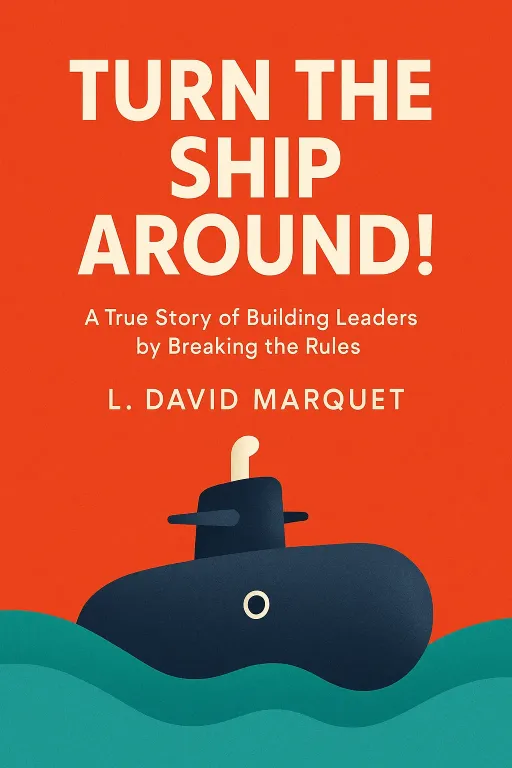
Nova: It's a radical truth, Atlas, and it's at the very heart of our discussion today. We're diving deep into two groundbreaking works: L. David Marquet's "Turn the Ship Around!" and Daniel H. Pink's "Drive." What's fascinating is Marquet's background. He was a US Navy submarine commander, tasked with turning around the lowest-performing nuclear submarine in the fleet. He didn't do it by barking more orders; he did it by literally giving away command and empowering his crew. His story is so compelling it's become a cornerstone of modern leadership thinking, especially in how we rethink autonomy.
Atlas: I mean, a nuclear submarine? That's about as high-stakes as it gets. For our listeners who are, say, an architect leading a complex engineering project or a strategist designing a new market entry, the idea of just 'letting go' feels incredibly counter-intuitive. They're driven by impact, by creating solutions. They need precision.
Nova: Exactly. But it's not about 'letting go' in a reckless way. It's about a fundamental shift from a 'leader-follower' model to a 'leader-leader' model. And that naturally leads us into our first core idea.
The 'Leader-Leader' Revolution: Delegating Decision-Making, Not Just Tasks
SECTION
Nova: The traditional leadership paradigm is simple: the leader thinks, the followers do. Marquet realized this model was inherently flawed, especially in complex, rapidly changing environments. It creates bottlenecks, stifles creativity, and disconnects the people with the most information—those on the front lines—from the power to act. His solution was revolutionary: give control to those who have the information.
Atlas: So he literally just told his crew, "You're in charge now, figure it out"? That seems incredibly naive, bordering on dangerous, particularly for a nuclear submarine. What about competence? What about accountability when things go wrong?
Nova: Not at all. It was highly intentional. Marquet's core philosophy was "Don't move information to authority, move authority to where the information is." He didn't just dump responsibility; he built the capacity for his crew to responsibility. He started by making his junior officers, who had direct knowledge of the submarine's systems and operations, responsible for making decisions. For example, instead of Marquet giving an order like "Come to periscope depth," a junior officer would say, "Captain, I intend to come to periscope depth."
Atlas: That's a subtle but powerful shift in language. "I intend to," rather than "Request permission to." What's the real difference there?
Nova: The difference is everything, Atlas. "Request permission" means the leader still owns the decision. "I intend to" means the junior officer has already thought through the action, considered the risks, and is taking ownership. Marquet's role then shifted from giving orders to providing intent. He'd ask, "What are your watch team's thoughts on this? Have you considered X, Y, and Z?" He was coaching, not commanding. He was clarifying needed to be achieved and, allowing them to figure out.
Atlas: Okay, so it’s not just about delegating a task, it's delegating the for that task, within a clear framework. But how do you ensure those decisions are good ones, especially when the stakes are so high? It sounds like a lot of trust, but trust needs to be earned.
Nova: Absolutely. And Marquet broke it down into two crucial components: technical competence and organizational clarity. His crew had to be technically proficient, which meant rigorous training. And the had to be crystal clear. Everyone needed to understand the mission, the overall goals, and the constraints. With those two elements in place, his team could make incredibly complex decisions, even under pressure. The result? The USS Santa Fe went from dead last to best in the fleet, with unprecedented retention and promotion rates. It became a breeding ground for future leaders.
Atlas: That's incredible. It's like he built a system where everyone became a mini-CEO of their own domain, but all aligned to a singular mission. For an architect designing a new system, it’s about empowering the engineers on the ground who understand the granular details to make real-time choices, rather than waiting for a top-down directive. That's a huge shift from typical project management.
The Intrinsic Drive: Autonomy, Mastery, and Purpose as Ownership Catalysts
SECTION
Nova: And what Marquet tapped into, whether he knew it explicitly or not, are the very intrinsic motivators Daniel Pink unpacks so brilliantly in 'Drive.' Pink argues that for complex, creative work—which describes most of what our listeners do—traditional rewards like bonuses and promotions are far less effective than intrinsic motivators.
Atlas: That's a big statement. So, you're saying money doesn't matter? Come on, Nova. Everyone needs to be compensated fairly. Are we just going to ignore that?
Nova: Not at all! Pink is very clear: money is a "hygiene factor." You need to be paid fairly, and if you're not, that will be a de-motivator. But once that baseline is met, simply throwing more money at people doesn't necessarily make them more engaged or foster true ownership. What truly ignites that spark are three things: Autonomy, Mastery, and Purpose.
Atlas: Okay, break those down for me. Autonomy, I think I get. It's about control over your own work, right? But how does a leader actually foster mastery or purpose in a team that might be focused on, well, quarterly reports and hitting targets?
Nova: Great questions. Autonomy is the desire to direct our own lives. It's not just about flex hours, it's about choice over we do, we do it, we do it, and we do it with. Leaders can foster this by giving team members more say in project selection, allowing them to experiment with different approaches, or even letting them define their own schedules within certain parameters.
Atlas: So, it's about giving them the reins, even if it's just for a small part of the journey. That makes sense.
Nova: Exactly. Then there's Mastery: the urge to get better at something that matters. People are inherently driven to improve, to feel competent, to achieve expertise. Leaders can foster mastery by providing challenging assignments, offering continuous learning opportunities, mentorship, and creating an environment where failure is seen as a learning opportunity, not a career-ender. Think about open-source software developers who dedicate thousands of hours to coding for no direct pay—they're driven by mastery.
Atlas: That resonates with the 'Architect' mindset. They want to continually refine their craft, build better, more efficient systems. It's not just about finishing a project; it's about the elegance of the solution.
Nova: Precisely. And finally, Purpose: the yearning to do what we do in the service of something larger than ourselves. People want their work to matter, to contribute to something meaningful. Leaders can foster purpose by transparently connecting individual tasks to the larger organizational mission, to the customer impact, or to a broader societal benefit. When people understand the 'why' behind their 'what,' their ownership skyrockets.
Atlas: That gives me chills, honestly. For our listeners who are innovators, driven to create solutions for global good, connecting their daily tasks to that larger vision is incredibly powerful. It's the difference between building a bridge and building a legacy.
Synthesis & Takeaways
SECTION
Nova: So, when you combine Marquet's 'leader-leader' model—which is essentially operationalizing autonomy and competence—with Pink's understanding of intrinsic motivators, you get a powerful blueprint for building a culture of genuine ownership. It's about shifting from the leader as a controller to the leader as a cultivator.
Atlas: That's a profound reframe. It's not about being hands-off; it's about being hands-on in a different way—building capability and clarifying intent, rather than dictating every move. So, for our listeners who are Architects or Strategists, building complex solutions, where can they start? Where in their team can they delegate decision-making authority, not just tasks, starting this week?
Nova: That's the deep question, isn't it? My advice: Start small, but start meaningfully. Identify one recurring decision that you, as a leader, currently make, but which a team member has all the information to make effectively. Perhaps it's a specific technical choice, a resource allocation for a sub-project, or even how a particular meeting is run. Delegate that, not just the task. Provide your clear intent—what you want to achieve—and then step back and support them. Be there to coach, not to command.
Atlas: It's about trusting your team to build, not just follow blueprints. That’s a huge shift in mindset, but the potential impact for innovation, for engagement, and for truly impactful solutions, is enormous. It's about creating a ripple effect of leadership throughout the entire organization, leading to better outcomes and a more fulfilled team.
Nova: Absolutely. It transforms a team from a collection of cogs into a dynamic network of problem-solvers, all intrinsically motivated to contribute their best. It's the ultimate strategy for amplifying your impact through others, for the global good.
Atlas: Amazing insights, Nova. That's a powerful way to end.
Nova: This is Aibrary. Congratulations on your growth!