The System's Dance: Designing Humane Futures with Donella Meadows
Golden Hook & Introduction
SECTION
Dr. Celeste Vega: Have you ever seen a city try to solve traffic congestion by building more highways, only to find that a few years later, the traffic is even worse? It’s a maddeningly common story. We pour billions into a solution, and the problem bites back, harder. This isn't a failure of engineering or funding. It's a failure to see the system.
Freddie Williams: That's exactly right, Celeste. That traffic example is the poster child for what systems thinkers call 'policy resistance.' It feels like you're pushing against a stubborn wall, but you're actually pushing against the system's own logic. It's pushing back, and our job is to understand why.
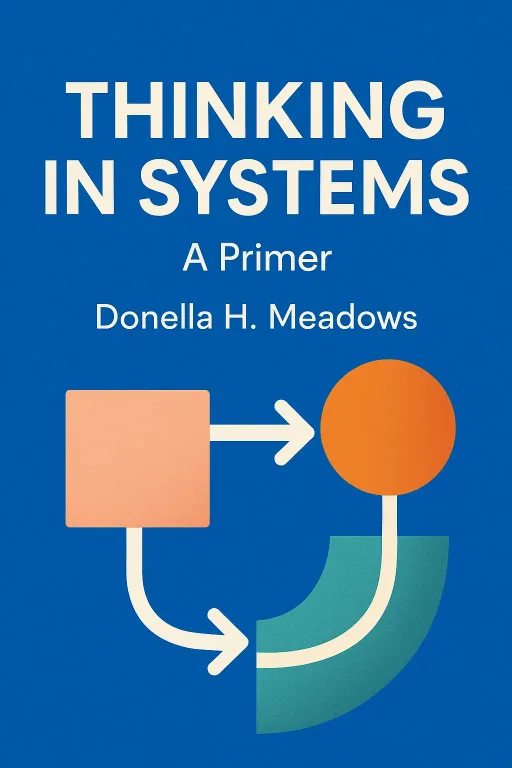
Dr. Celeste Vega: And that's exactly what we're here to do. Today, we're diving into Donella Meadows' classic, 'Thinking in Systems,' to understand these paradoxes. We'll explore this from two powerful perspectives. First, we'll uncover why our best-laid plans so often backfire by looking at the invisible structures that govern behavior.
Freddie Williams: And then, we'll dissect one of the most common and destructive patterns in human systems: the 'Escalation' trap, and discuss how to design our way out of it.
Dr. Celeste Vega: I'm Dr. Celeste Vega, and here to guide us is someone who does this for a living, systems designer Freddie Williams. Freddie, your work is at the intersection of governance, infrastructure, and creating human-centered solutions. This book must feel like a foundational text for you.
Freddie Williams: It is. It gives a language and a framework to the complex, messy realities we face every day. It helps us move from just reacting to problems to actually designing more resilient and equitable systems.
Deep Dive into Core Topic 1: The Invisible Structure: Why Our Actions Backfire
SECTION
Dr. Celeste Vega: I love that phrase, 'policy resistance.' And Donella Meadows gives us a fantastic way to think about this. She says a system, to a large extent, causes its own behavior. To explain this, she uses a simple Slinky. If you hold a Slinky and let it go, it bounces. If you hold a block of wood and let it go, it just thuds on the ground. The bouncing isn't just because of your hand; it's inherent to the coiled, springy structure of the Slinky itself. Your hand just unleashes the behavior that's already there.
Freddie Williams: And most policy is like the hand. It's an external push on a society that already has its own Slinky-like structure. We often ignore the Slinky and then act surprised when it bounces in unexpected ways.
Dr. Celeste Vega: Exactly! And this leads to incredibly counter-intuitive outcomes. Meadows tells this brilliant story about a car dealership to illustrate the point. Imagine you're a car dealer, and your goal is simple: keep about a hundred cars on your lot. Things are going fine, but then, for some reason, demand suddenly doubles. You're selling cars like crazy, which sounds great, but your inventory is plummeting. You see the number of cars on the lot drop to fifty, then thirty... you start to panic.
Freddie Williams: The natural reaction is to order more cars. A lot more cars.
Dr. Celeste Vega: Precisely. So you double your orders to the factory. But here's the catch: there's a delay. It takes a few weeks for those new cars to be manufactured and delivered. In the meantime, you're still selling, and your lot is looking emptier and emptier. So you panic more and increase your orders again. Finally, the first huge batch of cars arrives. Your lot is full again! But then the second huge batch you ordered also arrives. Suddenly, you're drowning in cars. You have 200 cars when you only want 100.
Freddie Williams: So you slam on the brakes. You cut your orders to zero.
Dr. Celeste Vega: You got it. But you're still overstocked, so you keep your orders at zero for weeks. Eventually, you sell down the excess inventory. But because you haven't ordered anything for so long, a new shortage is already on its way. The system is locked in this wild boom-and-bust cycle. And here's the kicker from Meadows' analysis: if the dealer tries to react —say, by checking inventory every day instead of every week—the oscillations get. The swings between having way too many cars and way too few become even more extreme.
Freddie Williams: That's fascinating, and it's a pattern we see everywhere. It's the delay in the system combined with a reactive decision-maker that creates the oscillation. In government, we see this constantly with social benefit programs. A report comes out showing a spike in need for, say, housing assistance. So, a huge initiative is launched to fast-track applications.
Dr. Celeste Vega: The 'order more cars' reaction.
Freddie Williams: Exactly. But it takes 18 months to hire the staff, set up the offices, and get the program running at full scale. By the time all those resources finally hit the ground, the economic conditions might have changed. The nature of the housing crisis may have shifted. You end up with a massive, expensive program that's perfectly designed to solve last year's problem, creating a huge mismatch and wasted effort. The 'solution' is completely out of sync with the reality it's trying to address.
Dr. Celeste Vega: So you're saying the 'fix' itself becomes part of the problem cycle? It amplifies the very instability it was meant to cure.
Freddie Williams: Precisely. The focus in systems thinking, then, shouldn't be on the speed of reaction. It should be on understanding the delays and stabilizing the system. In that car dealer example, the solution isn't to order faster. It's to hold a slightly larger buffer of inventory, or to have better long-range demand forecasting. It's about changing the structure, not just reacting with more force.
Deep Dive into Core Topic 2: The Escalation Trap: The Anatomy of Destructive Competition
SECTION
Dr. Celeste Vega: That idea of a 'fix' becoming part of the problem is a perfect bridge to our second topic: system traps. These are common structures that produce problematic behaviors. And one of the most recognizable is 'Escalation.' Meadows defines it as a dynamic where the state of one party is determined by trying to surpass the state of another. This creates a reinforcing feedback loop.
Freddie Williams: An arms race.
Dr. Celeste Vega: A classic arms race. Think of two kids yelling at each other in the back of a car. One yells, so the other has to yell louder, which makes the first one yell even louder. It spirals up and up until a parent—an outside force—intervenes and tells them both to be quiet. Or think of two gas stations on opposite corners. One drops its price by a cent. The other has to match it, and maybe drop it another cent to get an edge. They both keep cutting prices until neither one is making any profit.
Freddie Williams: They're trapped. The logic of the system forces them to continue a behavior that is ultimately destructive for both of them.
Dr. Celeste Vega: Exactly. Meadows uses the example of advertising wars. Imagine two soda companies, ColaCo and FizzUp. ColaCo launches a huge, expensive Super Bowl ad. Now, the executives at FizzUp feel they have to respond with an even bigger, more spectacular campaign. The goal shifts from simply selling soda to having a larger 'share of voice' than the competitor. Costs spiral upwards, but the total market share for both companies might not even change. It's a massive expenditure of resources for no real net gain.
Freddie Williams: And in the public sector, this is the classic inter-departmental budget battle. It happens every single year. The Department of Health secures a 5% budget increase. The leadership at the Department of Education sees this, and now they feel they need at least a 6% increase, not just to fund their programs, but to demonstrate their relative importance within the government.
Dr. Celeste Vega: It's not about absolute need, it's about relative position.
Freddie Williams: Right. It becomes an escalation dynamic fueled by perception and status. The loudest, most politically savvy department gets the resources, not necessarily the one with the most evidence-based need. The whole system becomes inefficient and driven by internal competition rather than the public good.
Dr. Celeste Vega: So how do you break that cycle? Meadows suggests two main ways. The first is 'unilateral disarmament'—one party just decides to stop competing. The one kid in the back of the car just goes quiet.
Freddie Williams: Which is incredibly difficult. In a competitive environment like government or business, it's often perceived as weakness. You risk getting run over.
Dr. Celeste Vega: Which leaves the second, more structural solution: negotiate a new system with 'balancing loops' that control the escalation. This is the parent in the car saying, "The new rule is: no yelling."
Freddie Williams: And that's exactly where my work in institutional design comes in. We focus on designing those balancing loops. For the budget battle, a balancing loop could be an independent, non-partisan budget office. Their job is to create and enforce allocation criteria based on objective evidence and long-term strategic goals, not on which department head has the most political clout. That office acts as the 'parent in the room,' breaking the reinforcing loop of the departments trying to out-shout each other.
Dr. Celeste Vega: So you're literally designing the 'rules of the game' to prevent the game from destroying itself or becoming counter-productive. That's a powerful concept. You're not just playing the game; you're changing the board.
Freddie Williams: That's the goal. To build a better board. One that's more fair, more stable, and ultimately produces more human-centered outcomes.
Synthesis & Takeaways
SECTION
Dr. Celeste Vega: So, to bring this all together, we've seen that systems have an internal logic—a structure, like a Slinky, that causes their behavior. And if we don't see that structure, our 'solutions' can backfire and make things worse, just like with the frantic car dealer.
Freddie Williams: And we've also seen how those structures can trap us in destructive cycles, like the 'Escalation' trap, where rational actors are forced into irrational, collective behavior.
Dr. Celeste Vega: The shift in thinking this requires is just huge. It's a move away from looking for someone or something to blame.
Freddie Williams: Exactly. It moves us away from blame and towards curiosity. When you're stuck in a problem that won't go away, the most powerful question you can ask is not 'Who is at fault?' It's 'What is the structure that is producing this result?' That question is the key that unlocks everything else. It forces you to look at the connections, the delays, the feedback loops—the whole system.
Dr. Celeste Vega: A perfect summary. So for our listeners, the next time you face a persistent, frustrating problem, whether it's at work, in your community, or even in your own family, resist the urge to just act faster or push harder.
Freddie Williams: Take a step back. Try to sketch out the system on a piece of paper. Who are the actors? What are the goals? Where are the delays?
Dr. Celeste Vega: And ask Freddie's question: What's the underlying structure here? That's the first step in learning to dance with the system, not just fight against it. Freddie, thank you so much for sharing your expertise. This has been incredibly illuminating.
Freddie Williams: My pleasure, Celeste. It's a conversation we need to be having more often.