The Engineer's Compass: Navigating Project Chaos with Systems Thinking
Golden Hook & Introduction
SECTION
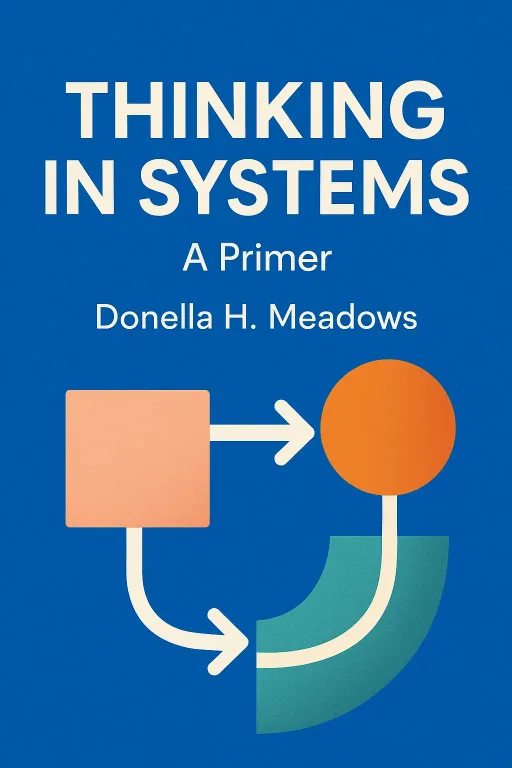
Shakespeare: As a project manager, you're told to solve problems. But what if the real challenge isn't solving problems, but managing 'messes'—those complex tangles of issues where every solution seems to create a new problem? Donella Meadows, in her classic 'Thinking in Systems,' argues that our very instinct to act fast, to put out the fire, can be the thing that burns the house down. It's a deeply counter-intuitive idea. Today we'll dive deep into this from two powerful perspectives, with our guest Dante, an experienced project manager. Dante, welcome. Does that idea of managing 'messes' rather than 'problems' ring true for you?
Dante: It rings incredibly true, Shakespeare. In engineering, a project is never a straight line. It’s a web. A delay in one component from a supplier in Asia can ripple through and affect a software integration test in North America three weeks later. You’re not just solving the delay; you're managing the entire, tangled, messy web. That quote is the story of my life.
Shakespeare: I love that. The tangled web. Well, that's exactly what we're here to un-tangle. Today we'll dive deep into this from two powerful perspectives. First, we'll explore why our gut reactions to fix problems can paradoxically make them worse, using the story of a car dealer who nearly went bankrupt by being too efficient.
Dante: I'm intrigued. Efficiency is usually the goal.
Shakespeare: Exactly. And then, we'll dissect a common but destructive trap called 'Escalation' and discuss the courageous, almost inhuman, ways to escape it.
Deep Dive into Core Topic 1: The Counter-Intuitive System: Why 'Fixing' It Can Break It
SECTION
Shakespeare: So let's start with that core, unsettling idea: the system, to a large extent, causes its own behavior. Meadows uses a simple, brilliant demonstration to make this point. Imagine I'm holding a Slinky, that classic metal coil toy, from the top. I let it go, and it bounces up and down. Dante, what made the Slinky bounce?
Dante: Well, the obvious answer is your hand. You let it go. The action of your hand caused the reaction of the Slinky.
Shakespeare: That's what everyone says! But then, Meadows says, imagine I do the same thing with a cardboard box. I hold it, I let it go. It just thuds on the floor. No bounce. So I ask again: what made the Slinky bounce?
Dante: Ah, I see. It’s not your hand. It’s the Slinky itself. The bouncing is inherent to its structure, its coiled nature. The hand just released a behavior that was already waiting to happen.
Shakespeare: Precisely! The bouncing is in the. And this is the first major shift in thinking. We are trained to look for the external event, the hand that dropped it. A systems thinker looks at the structure of the Slinky itself.
Dante: That's a perfect metaphor. In a project, we often blame an external event—a sudden client request, a supplier delay, a spec change. We blame 'the hand'. But the Slinky metaphor suggests the real issue might be our project's 'structure'—our communication protocols, our inventory levels, our team's capacity. It's our inability to absorb that shock that's the real problem.
Shakespeare: Exactly! And this is where it gets dangerous, when our good intentions lead to chaos. This brings us to the story of the car dealer. It's a fantastic illustration of this principle in action. Picture a car dealer who wants to keep about 100 cars on his lot. Business is steady. Then, one day, demand suddenly jumps. Cars start selling faster.
Dante: Okay, so his inventory drops. As a manager, his first thought is: order more cars to get back to 100.
Shakespeare: Correct. He sees the gap, and he acts to close it. But there’s a delay—it takes time for the new cars to be delivered. So even though he’s ordered more, his inventory keeps dropping for a while, which makes him a little nervous. He thinks, "I need to be more responsive, I need to act faster."
Dante: A very common managerial instinct. Shorten the reaction time. Be more agile.
Shakespeare: He does just that. He tells his team, "From now on, whatever our shortfall is, I want you to order the replacement cars and get them here in two days instead of three." He's trying to be a better, more efficient manager. But when you look at the graph of what happens next, it's terrifying. The inventory levels on his lot start swinging wildly.
Dante: Oscillating?
Shakespeare: Violently. One month, he's got a desperate shortage, with only 20 cars on the lot and angry customers. The next month, he's got a massive surplus, with over 500 cars overflowing the lot, capital tied up, a financial disaster. His attempt to fix the problem faster made the system wildly unstable. The book's conclusion is stark and unforgettable: "Acting faster makes the oscillations worse!"
Dante: That's the bullwhip effect in a nutshell. I've seen this exact thing in manufacturing. A small, temporary increase in customer demand for a product causes the retail manager to place a slightly larger order. The wholesale manager sees that larger order and, to be safe, orders even more from the manufacturer. The manufacturer sees that and ramps up production massively. A month later, demand returns to normal, and the entire supply chain, from the factory to the store, is drowning in excess inventory.
Shakespeare: You're all trying to be responsive, but you're just amplifying the noise.
Dante: We're shaking the Slinky harder and harder, thinking it will make it stop bouncing. This is a huge insight. Our drive for speed and responsiveness, if not paired with an understanding of the system's delays and structure, can be our own undoing.
Deep Dive into Core Topic 2: The Escalation Trap: Winning the Battle, Losing the War
SECTION
Shakespeare: So if reacting faster isn't always the answer, what about how we deal with other people, with competitors? That brings us to our second key idea, a system trap Meadows calls 'Escalation.' It's a reinforcing feedback loop where your state is determined by being better than your competitor, and their state is determined by being better than you.
Dante: A classic arms race.
Shakespeare: An arms race, an advertising war, even two kids in the back of a car. 'He hit me, so I'll hit him harder!' 'He got a new toy, so I need a bigger one!' Meadows points out that this system, if left unchecked, has only one logical outcome: collapse. Someone eventually runs out of money, or energy, or political will. The growth is exponential, and nothing can grow exponentially forever.
Dante: This is everywhere in the corporate world. I've seen two engineering departments competing for the annual budget. One team inflates their project's potential ROI to get more funding. The other team sees that and inflates theirs even more. In the end, promises are made that can't be kept, resources are misallocated, and both projects under-deliver. The company loses.
Shakespeare: A perfect example. And you bring up a fascinating point there, Dante. There's a certain philosophy about human nature that fits here perfectly.
Dante: Yes, I was just thinking about that. It's the idea of doing things that follow human nature versus cultivating a character that can act against it. Escalation is pure human nature. It's our tribal, competitive instinct. To see someone get ahead and feel the immediate, visceral need to catch up and surpass them. It's easy. It's intuitive. It's '顺人性'—following our innate programming.
Shakespeare: A brilliant connection. Because the solutions Meadows proposes are anything but easy or intuitive. She says there are two main ways out of an escalation trap. The first is unilateral disarmament. You just... stop. You refuse to compete on that metric.
Dante: That sounds terrifying from a business perspective. If my competitor launches a huge marketing campaign and I do nothing, I lose market share. It feels like surrender.
Shakespeare: It feels like it. But it interrupts the reinforcing loop. The second way is to negotiate a new system. Both parties agree to rules that control the escalation—like spending caps in political campaigns, or treaties limiting warheads. But both of these solutions require something that goes against that raw, competitive instinct.
Dante: Exactly. This is the other side of that philosophy: '逆人性'—acting against our base nature. It requires discipline, trust, and immense self-confidence. To unilaterally disarm, you have to be so confident in your own strategy that you're willing to look weak in the short term to win in the long term. It's what separates a merely good manager from a truly great leader.
Shakespeare: You mentioned an interest in innovators like Jeff Bezos. Does this connect to them?
Dante: I think so. People say Amazon won the bookstore war, but that's not quite right. While everyone was locked in an escalation trap over who could be the best online retailer, Bezos and his team were building something else entirely: Amazon Web Services. They effectively disarmed from the retail war and created a whole new system, a new game that no one else was playing. They didn't just play the game better; they changed the game board. That's a '逆人性' move. It requires a vision beyond the immediate competition.
Synthesis & Takeaways
SECTION
Shakespeare: What a powerful way to frame it. So, as we draw to a close, we're left with two profound ideas from Donella Meadows. First, that a system's behavior comes from its structure, and our intuitive, fast reactions can be a trap that creates wild instability.
Dante: We have to look at the Slinky, not just the hand.
Shakespeare: And second, we must learn to recognize the destructive pattern of Escalation, where our very human instinct to compete can lead everyone to ruin. And the way out requires an almost 'un-human' level of discipline and strategic vision.
Dante: For me, as a project manager, the practical lesson from all this is the need to build in a pause. A strategic pause. Before I react to a crisis, before I respond to a competitor's move, I need to stop and ask myself two questions. One: 'What is the structure here? Are we just shaking the Slinky?' And two: 'Is this an escalation trap? Are we fighting a battle that will make us lose the war?'
Shakespeare: That single act of pausing and asking those questions could change everything.
Dante: It shifts you from being a piece on the chessboard to being a player looking down at the whole board. It's the difference between reacting and strategizing.
Shakespeare: A perfect summary. So, for everyone listening, here is our challenge to you, inspired by Dante's insight. The next time you feel that immense pressure at work to react instantly, to fire back, to fix it —we challenge you to do the opposite. Pause. Take a breath. And ask yourself: what system am I in? You might just find the hidden leverage point you've been looking for all along. Dante, thank you for lending your wisdom to this tangled web.
Dante: It was my pleasure, Shakespeare. A fascinating conversation.