Unlocking the Future: Navigating Complexity with Antifragility and Systems Thinking
Golden Hook & Introduction
SECTION
Nova: What if I told you the best way to build something truly robust isn't to protect it from every single bump and bruise, but to design it to from chaos? Forget resilience; we're talking about systems that actually get stronger when things go wrong.
Atlas: Whoa, gain from chaos? That sounds like something out of a superhero origin story, Nova, not a strategic plan for, say, an AI literacy platform. My instinct is always to minimize chaos.
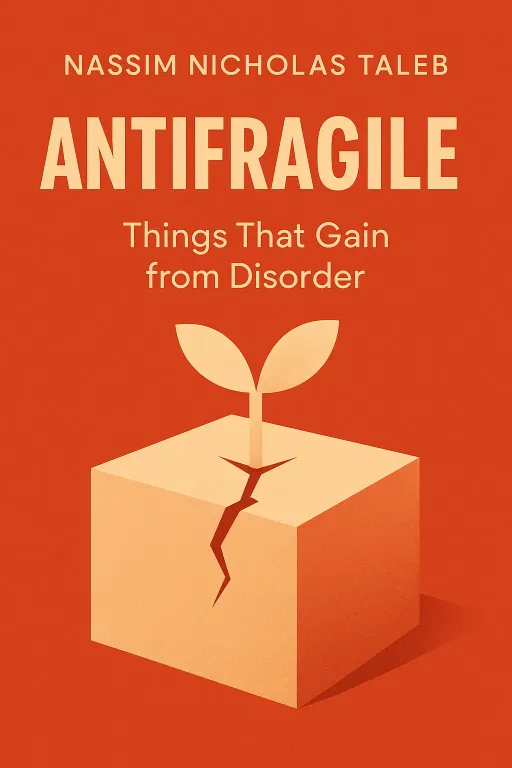
Nova: I know, right? It challenges everything we intuitively think about stability. But today, we're diving into two revolutionary concepts that flip our understanding of stability on its head. We’re talking about ideas from 'Antifragile' by the provocative thinker Nassim Nicholas Taleb, and 'Thinking in Systems' by the brilliant pioneering environmental scientist, Donella H. Meadows.
Atlas: Taleb, with his background as a former options trader and philosopher, really shook up the world, showing us why simply being 'resilient' isn't enough. And Meadows, often called the mother of systems thinking, made these incredibly complex ideas accessible to everyone, influencing generations of thought on how the world truly works.
Nova: Precisely. They both offer lenses that are essential for anyone leading innovation. So, let's unpack this 'antifragility' first, because for anyone trying to build stable, reliable systems, the idea of disruption feels... well, disruptive itself.
Antifragility: Beyond Resilience in Educational AI
SECTION
Nova: Imagine a glass vase. It's fragile, right? Drop it, it shatters. Now, imagine a rubber ball. Drop it, it bounces back. That's resilient. It resists the shock. But what if there was something that, when you dropped it, didn't just resist or bounce back, but actually became? Maybe it sprouted wings and flew away, or developed a thicker skin. That's antifragile.
Atlas: That’s a powerful distinction. So it’s not just about bouncing back, but bouncing? But how does that even work in something as intricate as a learning environment, especially with AI? For our listeners who are trying to cultivate growth and ensure equitable outcomes, 'chaos' usually means setbacks, not superpowers.
Nova: Exactly the point. Our default is to optimize for stability, to create systems that are impervious to shocks. But that often makes them brittle. Think about how open-source software develops. It's constantly exposed to bugs, to unexpected user inputs, to people trying to break it. And what happens? It identifies vulnerabilities, gets patched, improves, and becomes more robust and adaptable. Every 'disruption' is data, a chance to evolve.
Atlas: That's a great example. So, if we apply that to AI in literacy, it's not about making an AI that encounters a diverse learner with an unusual request or an unexpected learning hurdle. It's about designing an AI that learns and improves of those variations, those 'bugs' in its expected input? That feels counterintuitive to the 'perfect algorithm' mindset.
Nova: It absolutely does. The 'perfect algorithm' mindset tries to smooth out all the edges, to optimize for the average. But real learning, especially in diverse environments, is anything but average. When you optimize for the average, you make your system brittle to outliers. An antifragile AI would see those outliers—those unexpected variations in learning styles, language backgrounds, or cognitive processes—not as problems to be smoothed over, but as rich, invaluable data points that force it to innovate and strengthen its adaptive capabilities.
Atlas: I see. So it's not about creating a sterile, predictable learning experience. It’s about building an AI that thrives on the very unpredictable nature of human learning itself. That’s a massive shift in perspective for cultivating educational innovation. It sounds like designing for evolution, rather than just endurance.
Nova: Precisely. It actively embraces volatility. Without that stress, without those challenges, the system wouldn't grow. It’s like a muscle; if you never lift weights, it won't get stronger. An antifragile AI in literacy would, for instance, be designed to dynamically adjust its teaching methods, its content delivery, and its feedback loops to every unique struggle and success it observes, constantly refining its effectiveness across a broader spectrum of learners.
Atlas: So the unexpected input from a student who learns in a completely novel way isn't a failure of the system, but a prompt for the system to become more intelligent and inclusive. That's a powerful idea for equitable outcomes.
Nova: It really is. It moves us beyond just 'withstanding' challenges to 'benefiting' from them.
Systems Thinking: Navigating the Interconnectedness of Educational Innovation
SECTION
Nova: And that leads us perfectly into our second big idea, because to truly build antifragile systems, you need to understand the intricate dance of all its parts. We're talking about Donella Meadows' 'Thinking in Systems'.
Atlas: Meadows is often hailed for making something so abstract feel so real and applicable. What's the core insight here that connects to building AI literacy platforms, especially when we're talking about antifragility?
Nova: Her core message is that everything is connected. When you interact with a system, you're not just touching one isolated part; you're sending ripples through the entire structure. She emphasizes feedback loops, delays, and leverage points. Imagine a complex garden ecosystem. You introduce a new beneficial insect. You might think, 'Great, pest control!' But that insect might eat a plant you didn't intend, or become food for a bird that then decimates another part of your garden.
Atlas: So it's like trying to fix one part of a car without understanding how it affects the engine, the transmission, and even the driver? For someone focused on holistic approaches and equitable outcomes, this is huge. A change in the AI's algorithm to address one learning challenge could unintentionally create new barriers for certain learners, or disengage teachers elsewhere, right?
Nova: Absolutely. A well-intentioned AI literacy tool designed to accelerate reading acquisition might, without systemic thinking, inadvertently create a dependency that hinders deeper critical thinking skills because students aren't grappling with text in the same way. Or it might reduce essential human teacher-student interaction, impacting social-emotional learning across the learning ecosystem. You solve one problem, but you create two others down the line.
Atlas: That’s such an important point. It’s not just about the AI's immediate performance; it’s about how it integrates with the curriculum, the teachers’ roles, the students' cognitive development, their home learning environments... the whole picture. It's about seeing the forest the trees, and how they influence each other, often in non-obvious ways.
Nova: Precisely. Meadows teaches us that the greatest leverage points in a system are often not where you expect. They're not always about adding more resources, but about understanding the underlying structure, the goals of the system, and the information flows. An antifragile AI literacy platform, viewed systemically, wouldn't just be a tool; it would be a dynamic force that understands its place within the broader educational system and anticipates its own ripple effects.
Atlas: So, instead of just building an AI that works, we build an AI that understands its and how it changes that context. That means thinking beyond the immediate task of the AI and considering its long-term impact on learning behaviors, teacher roles, and even the culture of a school or district.
Nova: It's about seeing the bigger picture and designing for positive, systemic evolution, not just isolated improvements. It’s a holistic approach to innovation.
Synthesis & Takeaways
SECTION
Nova: So, the deep question from our content was: How might you design your AI literacy platform to not just tolerate, but benefit from unexpected variations and challenges inherent in diverse learning environments? The answer lies in combining these two powerful ideas.
Atlas: You're saying that by understanding the system's dynamics – all those feedback loops and leverage points – we can then actively design for antifragility, where every 'unexpected variation' becomes an opportunity for the AI to learn and improve, rather than just a problem to fix?
Nova: Exactly. It's about building an AI that embraces the messiness of real learning, constantly evolving, much like a living organism. Instead of aiming for static perfection or mere stability, we aim for dynamic, adaptive strength. The 'blind spot' of optimizing for efficiency over volatility becomes a strategic advantage.
Atlas: For our listeners who are strategic cultivators, empathic innovators, and future-forward leaders, this isn't just about AI; it's a profound mindset shift. It's about trusting the vision that true innovation isn't about avoiding problems, but about designing systems that transform problems into progress. It's a powerful way to cultivate continuous improvement and truly equitable outcomes for every learner.
Nova: And it carves out that space for deep work, that focus on building something truly future-forward and impactful. It’s about building systems that don't just survive, but truly thrive in the face of the unknown.
Atlas: This is Aibrary. Congratulations on your growth!