The Unseen Webs: How Systems Thinking Unlocks Complex Problems
Golden Hook & Introduction
SECTION
Nova: What if the very way you try to solve problems is actually making them worse? Not just ineffective, but actively detrimental to long-term success?
Atlas: Whoa, that's a bold claim, Nova. How can trying to fix something possibly make it worse? That sounds counterintuitive, almost like a paradox.
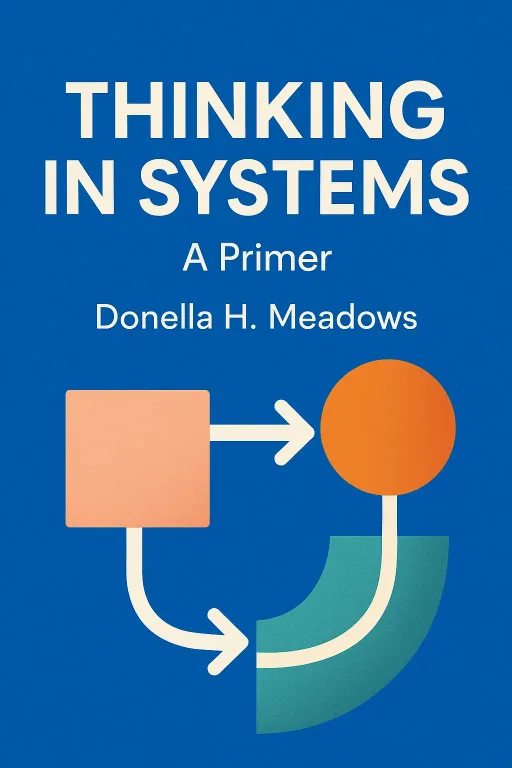
Nova: It absolutely is, Atlas. And it's a paradox that two brilliant minds, Donella H. Meadows and Peter Senge, explored in their seminal works, "Thinking in Systems: A Primer" and "The Fifth Discipline: The Art & Practice of The Learning Organization." Meadows, for instance, wasn't just a theorist; she was a pioneering environmental scientist, a lead author on that seismic 1972 report, "The Limits to Growth." She literally modeled global resource depletion and population growth, showing us the interconnectedness of our planet's systems decades ago.
Atlas: So, she was seeing the big picture long before most people even realized there a big picture. And Senge then took those foundational ideas and applied them directly to how organizations learn and adapt. It feels like they both understood that our conventional approach to problems often misses the forest for the trees.
Nova: Exactly. And that's where we start today: with "The Blind Spot"—why we often fail to see the systems we're operating within.
The Blind Spot: Why We Fail to See Systems
SECTION
Nova: We're wired to simplify, to break things down. It's how we cope with complexity. But when you apply that to, say, a persistent social issue or a recurring problem in your company, you end up treating symptoms, not causes. You pull one lever, and something unexpected pops up somewhere else.
Atlas: Oh, I know that feeling. It's like whack-a-mole, but with real-world consequences. Can you give us an example where a seemingly logical solution backfired spectacularly?
Nova: Absolutely. It's a classic known as the "Cobra Effect." Back in colonial India, the British government was concerned about the number of venomous cobras in Delhi. So, they came up with what seemed like a brilliant solution: offer a bounty for every dead cobra. Simple, right? Less cobras, less danger.
Atlas: Sounds perfectly rational on the surface. People get paid, cobras disappear. What could possibly go wrong?
Nova: Well, people are incredibly adaptive, Atlas. What went wrong was human ingenuity meeting a poorly designed system. Enterprising individuals in Delhi started breeding cobras in their backyards, killing them, and collecting the bounty. They literally turned a public menace into a profitable business.
Atlas: Wait, so the solution literally created a cobra farming industry? That's incredible.
Nova: It gets better. When the government realized what was happening, they cancelled the bounty. And what did the cobra breeders do with their now worthless stock? They released them into the wild. The result? Delhi ended up with wild cobras than before the bounty program began.
Atlas: That's a perfect illustration of how a solution can become the problem. It makes me wonder how many policies or business decisions people make with the best intentions, only to create these runaway positive feedback loops. For anyone in a leadership position, that's a terrifying thought. How do you even begin to identify these kinds of loops when you're in the thick of a problem?
Nova: That's the core challenge. Meadows would explain that our intuition often looks for simple cause-and-effect, linear chains. But systems are full of feedback loops. The cobra effect is a classic example of a "reinforcing" or "positive" feedback loop, where an action feeds back to amplify itself. You get more of what you're trying to reduce. Our blind spot is not seeing that the 'solution' itself became part of the system creating the problem.
Atlas: So, it's not just about what you, but how that action then circles back and changes the very thing you're trying to influence. It's like trying to fix a leaky faucet, but your fix accidentally reroutes the water to spray out of the showerhead instead.
Unlocking Complexity: Feedback Loops, Leverage Points, and Collective Intelligence
SECTION
Nova: That's a great analogy, Atlas. Understanding that blind spot is the first step. The next is learning to see the system as it truly is. And that's where Meadows's concepts of stocks, flows, and especially "leverage points," along with Senge's idea of "collective intelligence," become crucial.
Atlas: Okay, 'stocks' and 'flows' sound like something from a finance class. Can you make that a bit more accessible for our listeners?
Nova: Absolutely. Think of a bathtub. The "stock" is the amount of water currently in the tub. The "flows" are the rate at which water is entering from the faucet and the rate at which it's leaving through the drain. Systems are full of these: a company's inventory is a stock, sales and production are flows. Your knowledge is a stock, learning and forgetting are flows.
Atlas: I get it. So, how does that connect to these "leverage points" you mentioned? Because that sounds like the holy grail – where you can make a small change and get a big impact.
Nova: Exactly. Meadows defined leverage points as places within a system where a small shift in one thing can produce big changes in everything. They're often counter-intuitive. They're not always about pushing harder or spending more, but about understanding the system's structure, its goals, or even the mental models that drive its behavior.
Nova: A fantastic way to illustrate this, and bring in Senge's "The Fifth Discipline," is through a classic management exercise called "The Beer Game." Imagine a simple supply chain: a brewery, a distributor, a wholesaler, and a retailer, all trying to meet customer demand for beer. Each player only sees their immediate upstream and downstream partner.
Atlas: So, a bit like a game of telephone, but with beer.
Nova: Precisely. In the game, a small, sudden increase in customer orders at the retail end cascades up the supply chain. Each player, acting rationally but with limited information and delays in feedback, tends to overreact, ordering more than they need "just in case." The result? Massive oscillations in inventory, huge backlogs, and ultimately, a system that's wildly inefficient, even though everyone is trying their best.
Atlas: That sounds like every supply chain meeting I've ever heard of! It's like everyone is trying to optimize their own little corner, but the whole thing goes haywire. So, how do leaders find these "leverage points" in something as messy as human behavior and organizational culture? It feels like we're always just tweaking the faucet, not understanding the drain.
Nova: That's where Senge's work on "collective intelligence" and "mental models" comes in. The leverage point in the Beer Game isn't about telling people to order less; it's about changing the of information flow, increasing transparency, and, most importantly, shifting the of the players so they see themselves as part of a larger system, not just an isolated link. It’s about fostering a "shared vision" where everyone understands the overarching goal and how their actions contribute to or detract from it.
Atlas: So it's not just about what you, but how you about what you're doing, and crucially, how everyone thinks about it? That's a profound shift. It moves beyond just individual performance to the performance of the entire interconnected network.
Synthesis & Takeaways
SECTION
Nova: Exactly, Atlas. Systems thinking isn't just a set of tools; it's a profound shift in perception. It's about moving from reacting to isolated events to understanding the underlying patterns, the feedback loops, and ultimately, to redesigning the structures and mental models that create those patterns. It's about realizing that every challenge you face is part of a larger, dynamic whole.
Atlas: It feels like it's about embracing the messiness, rather than trying to sanitize it. And for anyone trying to make a real difference, whether in their personal life, their team, or a global issue, that's a game-changer. It means you stop blaming individuals and start looking at the system itself.
Nova: And the beauty of leverage points is that they tell us even small, well-placed changes can have massive, positive ripple effects. You don't have to overhaul everything at once. You just need to understand where to push.
Atlas: So, for our listeners, I want to leave you with this: Think about that persistent challenge you're facing right now. What if, instead of trying to fix just the immediate 'thing,' you looked at the entire system it's embedded in? What fundamental assumptions would you have to challenge about how that system works, and where might the true leverage points be?
Nova: Start observing your own systems this week. Notice the feedback loops in your daily routines, your team dynamics, even your personal habits. It’s the first step to unlocking profound change.
Atlas: This is Aibrary. Congratulations on your growth!