The Unseen Threads: How Systems Thinking Reveals Hidden Influences
Golden Hook & Introduction
SECTION
Nova: Atlas, quick! Give me the first word that pops into your head when I say "problem"!
Atlas: Oh, easy. "Whack-a-mole!" You hit one down, another one pops right up.
Nova: Exactly! Okay, "solution"!
Atlas: Hmm. "More problems, just later." Or maybe, "a temporary pause."
Nova: Oh, I like that! How about "healthcare"?
Atlas: Maze. Definitely a maze. With very confusing signs and lots of dead ends.
Nova: And "education"?
Atlas: Same maze, different colors! Honestly, sometimes it feels like we're constantly running in circles.
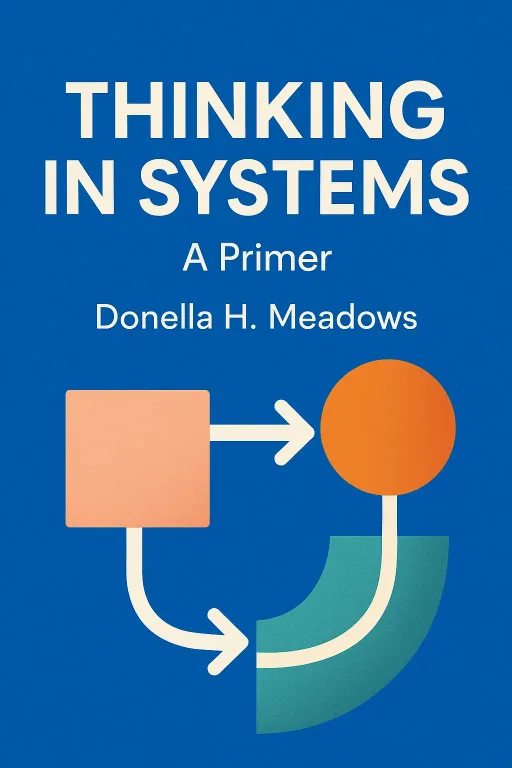
Nova: That feeling, Atlas, of endless whacking, of navigating mazes, of problems that just refuse to stay solved… that's exactly what we're tackling today. We're diving into a book that offers a profound shift in how we even perceive these challenges: by the incredible Donella H. Meadows.
Atlas: Oh, I like that. A shift. Because your "whack-a-mole" analogy really hits home. I imagine a lot of our listeners, especially those in service-oriented fields or looking to inspire through knowledge, feel that constant pressure to fix things, only for them to reappear.
Nova: Absolutely. And what's fascinating about Meadows is she wasn't just an academic. She was a pioneering environmental scientist, a lead author of, which fundamentally shifted global conversations about sustainability decades ago. Her work brought this incredible blend of scientific rigor and an almost poetic understanding of how everything is interconnected. She wasn't just talking about theories; she was showing how the world works.
Atlas: So, she's not just giving us a new hammer; she's telling us to step back and look at the whole workshop.
Nova: Precisely! She's asking us to move beyond that immediate, frustrating whack-a-mole game, and instead, to see the entire system that's producing those moles in the first place. And that's where our first core idea comes in: the blind spot.
The Blind Spot: Moving Beyond Isolated Events
SECTION
Nova: We all have this natural tendency, this blind spot, to see problems as isolated events. Think about it: a patient keeps getting readmitted to the hospital with the same chronic condition. The immediate problem is the flare-up, right? So, we treat the symptoms, stabilize them, and send them home.
Atlas: Right. That's the immediate, urgent need. For anyone in a caregiving role, that's their directive: fix what's broken.
Nova: Exactly. But what if the underlying system is the issue? What if they can't afford their medication consistently, or their housing situation is unstable, or they don't have access to healthy food? If we only treat the medical symptoms, without looking at the broader system of their life, we're essentially just patching a leak in a dam that has a hundred other cracks. The problem will recur, the system gets strained, and the individual suffers.
Atlas: That’s such a powerful image, the dam with a hundred cracks. But isn't it just natural to fix what's broken right in front of you? I mean, for someone trying to provide care, or even in education, when you see a student struggling with a specific concept, your instinct is to teach that concept. You don't immediately jump to "What's their home life like?", "What's the school's funding model?", "What's the broader societal context of this curriculum?"
Nova: You're absolutely right, Atlas. It natural. Our brains are wired for efficiency, for quick cause-and-effect. We see a symptom, we look for an immediate, linear cause. It’s a very practical, often necessary, way to function in the short term. The problem arises when we apply that same linear thinking to complex situations that are, by their very nature, non-linear and interconnected. Like in healthcare, if a patient keeps coming back, it's not because they're 'bad at being healthy.' It's because the system around them isn't supporting their health.
Atlas: I see. So it's not about blaming the individual or even the immediate caregiver, but recognizing that the problem isn't a singular entity; it's a symptom of deeper structures. That makes me wonder, how do you even begin to look beyond the immediate crisis without feeling completely overwhelmed? Because that sounds like a massive undertaking.
Nova: That's where Meadows' work becomes so revolutionary. She gives us the tools to actually those deeper structures without getting lost in the complexity. She teaches us that we can move beyond just treating symptoms to addressing the root causes. It's about shifting from reacting to understanding.
The Shift: Unveiling Hidden Influences with Systems Thinking
SECTION
Nova: So, if we're all playing whack-a-mole, how do we get off the field and change the game itself? Meadows offers us this incredible framework called "systems thinking." It's essentially a different way of seeing the world, recognizing that everything is interconnected. She talks about three key concepts that become our new lenses: interconnections, feedback loops, and leverage points.
Atlas: Okay, so "interconnections" I get. Everything's linked. But "feedback loops" and "leverage points"? What exactly do you mean by those? Are we talking about like, a stereo system with a feedback loop squeal?
Nova: That's a great intuitive start! A feedback loop is exactly that: a process where the output of a system becomes an input that affects future outputs. It's like a thermostat in your house. If it gets too cold, the furnace kicks on, heats the house, and then the thermostat registers that the temperature is right, so the furnace turns off. That's a balancing feedback loop. But there are also reinforcing feedback loops, where something just keeps growing. Think about social media virality, or conversely, a panic attack where anxiety feeds more anxiety.
Atlas: Ah, I see! So a feedback loop is like a constant conversation within the system, constantly adjusting or amplifying. That makes sense. So, how does this apply to, say, an educational system struggling with student engagement?
Nova: Perfect example! Let's say a school is seeing declining student engagement and high teacher turnover. A linear approach might blame the students for being unmotivated or the teachers for not being 'good enough.' But a systems thinker looks for the loops. Perhaps a lack of resources leads to overcrowded classrooms, which leads to teacher burnout and less individualized attention. That lower attention leads to less student engagement, which might lead to lower test scores, which in turn leads to less funding for the school, further exacerbating the resource problem.
Atlas: Wow. So it's not just a straight line from 'no resources' to 'bad outcome.' It's a spiral. A reinforcing feedback loop, like you said, where everything makes everything else worse. That sounds rough.
Nova: It can be. But here's the powerful part: once you these loops, you can identify 'leverage points.' These are places in the system where a small shift can lead to big changes. It's like finding the fulcrum to move a giant rock, as you hinted earlier. In our school example, a leverage point might not be more funding for every single thing, but perhaps investing specifically in high-quality professional development and mentorship for teachers.
Atlas: Investing in new teachers? How is that a leverage point? It sounds like a good idea, but how does it break the loop?
Nova: Well, if new teachers feel supported and effective, they're more likely to stay. Lower teacher turnover means more stability for students. Supported teachers are more engaged, which leads to higher student engagement. Higher engagement can lead to better outcomes, which can attract more resources or positive community support, breaking that negative spiral and potentially creating a positive reinforcing loop instead. It's not about fixing symptoms; it's about altering the fundamental dynamics of the system.
Atlas: That’s a great way to put it, "altering the fundamental dynamics." For someone looking to inspire through knowledge, like an aspiring educator, understanding these loops and leverage points is crucial. It means you're not just trying to teach a concept; you're trying to design an where learning flourishes by identifying what's feeding what. It sounds incredibly empowering, but also… complex. Where do you even start to identify these intricate loops in a real-world setting?
Nova: Meadows would say you start by asking questions. Deep, curious questions. "Who benefits from this current situation?" "What are the delays in this system?" "What are the rules, and who made them?" It's about stepping back, observing, drawing boundaries around what you're studying, and then looking for those cause-and-effect arrows that aren't always obvious. It demands a different kind of patience, a different kind of wisdom.
Synthesis & Takeaways
SECTION
Nova: So, what Meadows ultimately gives us is not just a theory, but a profound lens through which to view the world. It shifts us from feeling like victims of circumstances to understanding that we are, in fact, participants in complex dances of interconnections and feedback loops. It's about recognizing that every problem, from a personal challenge to a global crisis, is part of a larger system.
Atlas: That’s actually really inspiring. It’s not just about fixing problems, but about understanding the dynamic dance of life itself, as you said. It empowers us to be more effective actors within the systems we inhabit, whether that's in our own lives, our communities, or even on a larger scale. It takes us beyond that initial "whack-a-mole" frustration and into a space of genuine understanding.
Nova: Exactly. It's a call to move from treating symptoms to designing healthier systems. And it's a journey that starts with simply choosing to see the unseen threads that connect everything.
Atlas: That gives me chills. It's a shift from 'what's wrong?' to 'how does this work?' And that is a fundamental difference. So, for all our listeners out there, we'd love for you to consider: think about a challenging situation you've faced recently. How might viewing it as a system, rather than a single event, change your approach?
Nova: This is Aibrary. Congratulations on your growth!