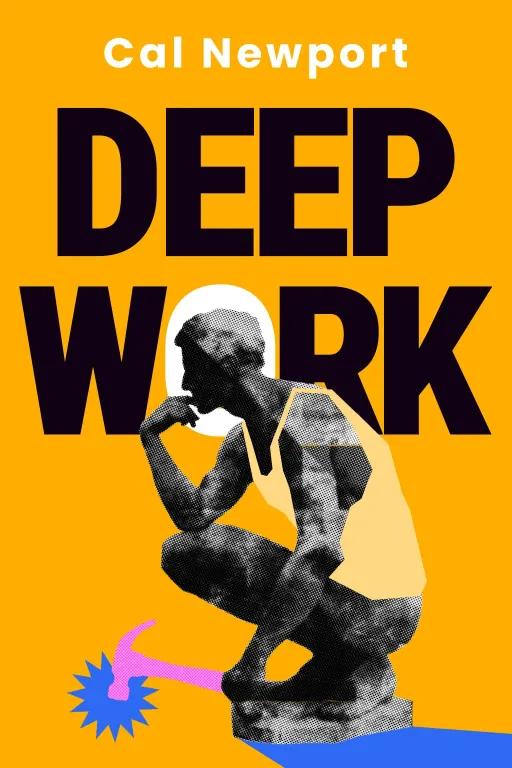
The 'Too Busy to Think' Blind Spot: Why Solitude Fuels Innovation.
Golden Hook & Introduction
SECTION
Nova: What if the very thing you think makes you productive – that constant, always-on hustle – is actually the biggest obstacle to your greatest breakthroughs?
Atlas: Wait, are you saying my inbox is secretly my archenemy? Because honestly, sometimes it feels like a digital hydra, every email I answer spawns two more.
Nova: Exactly! That feeling of being perpetually busy, of constantly reacting, it often masks a deeper problem. Today, we're unmasking what we call the 'Too Busy to Think' blind spot. We're diving into two brilliant minds who help us see past the superficial: Cal Newport, with his groundbreaking work, "Deep Work," and Donella H. Meadows, the visionary behind "Thinking in Systems."
Atlas: Oh, I like that. Newport is that computer science professor who famously doesn't use social media, right? He really walks the talk.
Nova: He absolutely does. He’s a tenured professor at Georgetown, publishing prolifically, and he attributes much of his success to his rigorous deep work practices. And Meadows, what a legend. She was a pioneer in environmental science and systems dynamics, literally shaping how we understand complex interconnectedness long before it was a buzzword. These aren't just theorists; they're practitioners. And for anyone out there building complex systems, designing architectures, or just trying to navigate an increasingly overwhelming world, understanding their insights isn't just helpful, it’s essential.
Atlas: So, for all the architects and independent builders listening, this isn’t just about getting more done, it’s about doing the kind of work to build something truly resilient and impactful.
Unmasking the ‘Too Busy to Think’ Blind Spot: The Imperative of Deep Work
SECTION
Nova: Precisely. Let's start with this 'blind spot.' We live in a world that rewards visibility, quick responses, and constant availability. We mistakenly equate busyness with impact. But true innovation, truly robust design, the kind of problem-solving that leads to breakthroughs – it demands uninterrupted, deep thinking. Imagine a software architect, let's call her Sarah, tasked with designing a new, highly secure financial transaction system.
Atlas: Oh man, high stakes. One tiny flaw could be catastrophic.
Nova: Exactly. Now, picture Sarah at her desk. She’s trying to map out intricate data flows, predict edge cases, and build in redundancy. But every five minutes, there’s a Slack notification, an email about a team meeting, a colleague popping over with a "quick question." Her attention is constantly fragmented. She's "busy," but is she truly?
Atlas: I still struggle with that myself. I mean, you feel productive firing off emails and clearing notifications, but then you look back at the end of the day and wonder what truly meaningful work got done.
Nova: That’s the illusion. Cal Newport argues that this constant context-switching prevents us from entering a state of "deep work" – the ability to focus without distraction on a cognitively demanding task. It’s a rare and valuable skill. Sarah, in our example, might end up with a system that functional on the surface, but has subtle vulnerabilities or isn't optimized because she never had the sustained mental bandwidth to truly grapple with its complexities.
Atlas: So you're saying her busy work is actually creating errors, not fewer? That sounds like a terrifying feedback loop for an architect. But how does she, or anyone in a high-pressure, collaborative environment, actually carve out this deep work time? It sounds like a luxury, not a reality, for someone building complex systems, especially when there are critical bugs that need QA'd.
Nova: That’s a crucial point, and Newport addresses it head-on. He doesn't advocate for isolation; he advocates for isolation. He suggests methods like scheduling deep work blocks, creating specific rituals around intense focus, and even practicing "productive meditation" to train your mind to concentrate. For Sarah, it might mean blocking out two hours every morning specifically for architecture design, turning off all notifications, and communicating this boundary to her team. It's about designing, just like you design systems for software.
Atlas: Okay, so it’s not about being unreachable forever, but about intentionally creating a space and time where you unreachable for specific, high-value tasks. That resonates with anyone who's ever tried to untangle a complex codebase or diagram a distributed system. You need that uninterrupted flow state.
Beyond the Components: 'Thinking in Systems' for Resilient Architectures
SECTION
Nova: Absolutely. And once we've cultivated that ability to engage in deep work, we can apply that focused energy to seeing the bigger picture, which brings us to Donella Meadows and "Thinking in Systems." Her work reveals how to understand and manage complexity, emphasizing the importance of stepping back.
Atlas: I’m curious, how does that differ from just breaking down a problem into smaller parts and solving them? Because that's often the default approach in design.
Nova: That's a great question, and it highlights a common pitfall. Imagine a city planner, let's call him David, whose goal is to reduce traffic congestion. His initial approach might be to optimize each individual traffic light intersection for maximum throughput. He tweaks the timing, adds sensors, and each intersection flows better.
Atlas: Sounds logical at first glance.
Nova: It does. But what often happens is that optimizing one part of the system creates bottlenecks elsewhere. The smooth flow at one intersection just pushes the problem downstream, or it encourages more cars to take that route, ultimately making overall congestion worse. David was only seeing the components, not the entire urban transportation system – the feedback loops, the incentives for drivers, the public transport options, the city's growth patterns.
Atlas: Oh, I see. So for someone building a new microservices architecture, this means not just optimizing each service in isolation, but understanding the entire data flow, the dependencies, and potential feedback loops between them. It’s about how the services and the emergent properties of that interaction.
Nova: Exactly. Meadows teaches us to look for the "systemness" – the interconnections, the feedback loops, the delays, the leverage points. An architect who thinks in systems will design for resilience, not just efficiency. They'll anticipate unintended consequences, understand how changes in one part of the system will ripple through others, and build in adaptability. Instead of just optimizing each service, they might design for graceful degradation, anticipate cascading failures, or build monitoring that reveals systemic health, not just individual component status.
Atlas: That’s a critical distinction. It prevents you from building something that looks perfect on paper but crumbles under real-world stress. What are some common architectural mistakes that stem from a lack of this systemic thinking?
Nova: Many, actually. One common one is "solutionism" – applying a known solution to a problem without understanding the broader context, creating new, unforeseen problems. Another is optimizing for a single metric, like speed, without considering other non-linear impacts, like security or maintainability. Meadows' work encourages us to identify the high-leverage points within a system – those places where a small shift can lead to big changes. For an architect, it might be about designing the right communication protocols between services, or establishing clear data governance, rather than just endlessly optimizing individual code blocks.
Synthesis & Takeaways
SECTION
Nova: So, when you combine Newport's call for deep work with Meadows' framework for systemic thinking, you get a powerful synergy. Deep work you to do the complex, reflective thinking required to understand systems. And understanding systems allows you to apply that deep work to problems that truly matter, building solutions that are not just functional, but profoundly resilient and effective. It's about moving from being a component-level builder to a true architect of holistic, robust systems.
Atlas: That’s actually really inspiring. It’s like, ultimately, it's about building into a more resilient and effective architect by cultivating these habits, not just building better systems. It's self-sufficiency for the mind.
Nova: Precisely. It’s about intellectual integrity and creating lasting value, whether that’s in code, in a business model, or in your own understanding of the world.
Atlas: So, for our listeners who are navigating their own complex projects and environments, what’s one concrete first step? What is one significant distraction you can eliminate or minimize in your daily routine to create more space for deep, focused work?
Nova: That's the challenge. Just pick one. Maybe it's turning off notifications for the first hour of your workday. Maybe it's dedicating 30 minutes to truly thinking through a problem without opening a single new tab. Small changes can create profound shifts.
Atlas: That’s a great way to put it. Start small, build the habit, and watch your ability to create and innovate grow.
Nova: Absolutely. Take that step today.
Atlas: This is Aibrary. Congratulations on your growth!