The Strategic Integrator: Connecting Disparate Ideas for Masterful Impact.
Golden Hook & Introduction
SECTION
Nova: What if I told you that sometimes, the harder you work to solve a problem, the worse you actually make it?
Atlas: Whoa, hold on. That sounds incredibly frustrating, and frankly, a bit counterintuitive. How on earth is that possible? Isn't effort usually the key?
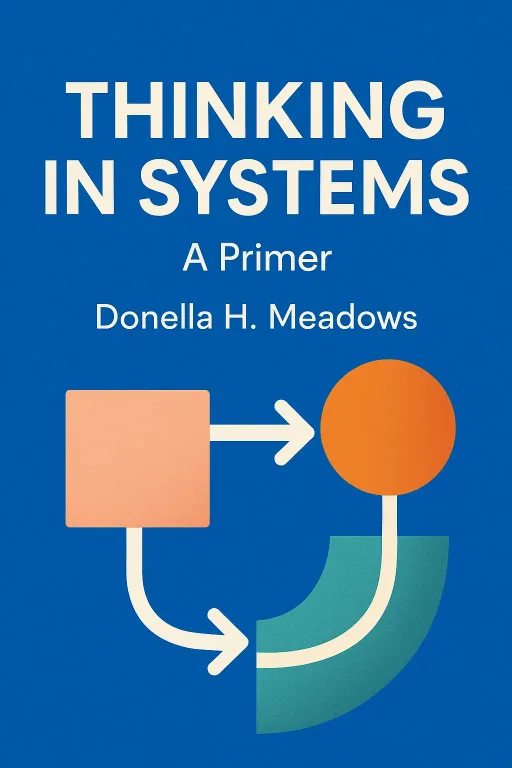
Nova: It is, but only if that effort is directed at the right place. Today, we're unraveling that paradox through the wisdom of two titans: Donella H. Meadows, with her seminal, and Peter Senge's transformative. Meadows, a pioneering environmental scientist, brought a profound ecological perspective to understanding how everything is connected. Her work was born from a deep concern for environmental sustainability and how human systems interact with natural ones. Senge then took those systemic insights and showed how they could revolutionize organizations, helping teams collectively learn and adapt for sustainable growth.
Atlas: So, we’re talking about going beyond the obvious fix and really digging into the underlying structures. That's a huge shift in perspective.
Nova: Exactly. And that brings us to what we call 'The Blind Spot.' It’s this incredibly common tendency we all have to see individual problems in isolation, without understanding the intricate web that connects them.
The Blind Spot & The Shift to Systemic Vision
SECTION
Atlas: Oh, I know that feeling. You're tackling one issue, and it feels like whack-a-mole; another one pops up somewhere else. For our listeners who are constantly trying to connect disparate ideas, this resonates deeply. But you're saying that approach can actually be detrimental?
Nova: Absolutely. Think of it like this: your kitchen sink is leaking. Your immediate reaction is to grab a bucket and start bailing water. That's fixing a symptom. But what if the leak is actually caused by a rusted pipe behind the wall, or even worse, a blocked drainage system further down the line? Bailing water endlessly won't solve the root cause, and you'll be constantly reacting.
Atlas: That makes sense. But in the heat of the moment, when deadlines are looming, and the pressure is on, isn't it incredibly natural to just patch the leak? To go for the quick win, even if it's temporary? It feels like the path of least resistance.
Nova: It is, Atlas. And that's precisely where Donella Meadows comes in. Her work reveals how systems actually work, from feedback loops to powerful leverage points. It helps you understand why some efforts fail and others succeed, showing you where to intervene for maximum impact. Meadows, as an environmental scientist, saw this played out on a global scale—how seemingly isolated environmental issues were deeply intertwined with economic and social policies. Her insights are about understanding these hidden dynamics.
Atlas: So, how do we even begin to ‘think in systems’? It sounds like a complete re-wiring of how we perceive problems. Can you give us a concrete example?
Nova: Of course. Let's take urban traffic congestion. The symptomatic fix, the "bailing water" approach, is often to build more roads, widen highways. But what happens? More roads often induce more demand, leading to more cars, and eventually, the congestion returns, sometimes worse than before. That's a reinforcing feedback loop.
Atlas: Right, like trying to solve a weight problem by just buying bigger clothes. You're not addressing the underlying diet and exercise.
Nova: Exactly! A systemic view, as Meadows would advocate, would look at the entire urban ecosystem. It would consider public transportation infrastructure, urban planning, housing density, remote work policies, even how people perceive commuting. You might find that investing in a robust public transit system, or creating walkable, mixed-use neighborhoods, is a far more effective leverage point than simply adding more lanes. That’s the foresight a systemic view provides.
Atlas: That’s a powerful distinction. For our listeners who are deep thinkers, trying to integrate complex information, this shift from symptom-fixing to systemic understanding is critical. How can someone start applying this today? What's the simplest way to begin this systemic thinking?
Nova: The simplest way to start, as Meadows often suggested, is to ask 'and then what?' repeatedly. When you identify a problem or propose a solution, don't stop there. Ask: 'And then what happens?' 'What are the consequences of that consequence?' 'Who else is affected?' It forces you to trace the interconnectedness.
Leverage Points & Learning Organizations: Applying Systemic Impact
SECTION
Atlas: 'And then what?' I love that. It’s such a simple, yet profound, way to break free from linear thinking. That 'and then what' leads us directly to the power of leverage points – the places in a system where a small change can lead to a large shift.
Nova: Precisely. Meadows identified twelve types of leverage points, ranging from the least effective, like simply changing parameters—think adjusting speed limits—to the most powerful, which involve changing the very mindset or paradigm from which the system arises.
Atlas: Leverage points? That sounds like the holy grail for anyone looking for meaningful impact. For someone who's driven by a quest for mastery, finding those high-impact points is everything. How do we find these magical spots? Is it always about changing mindsets?
Nova: Not always, but it's often more effective than just tweaking numbers. Consider a struggling company. The symptomatic fixes might be cutting costs, laying off staff, or pushing for more sales without understanding why sales are down. Those are low-leverage interventions. A higher leverage point might involve re-evaluating the company's core mission, changing its incentive structures, or fostering a culture of open communication and experimentation.
Atlas: So, if you're just focused on the short-term numbers, you might miss the opportunity to fundamentally transform the entire system. That’s a crucial insight. And this is where Peter Senge's work in comes into play, isn't it?
Nova: Absolutely. Senge took Meadows' insights and applied them directly to organizations, introducing the concept of the 'learning organization.' He argued that in a rapidly changing world, the only sustainable competitive advantage is an organization's ability to learn faster than its competitors. He illustrates how teams can collectively learn and adapt, fostering sustainable growth by embracing systems thinking as a core practice. His book was a groundbreaking text for leaders and managers, shifting the focus from individual heroism to collective intelligence.
Atlas: A learning organization. That sounds great in theory, but for our listeners in high-stakes tech environments, or complex, fast-moving industries, what does this look like day-to-day? Is it just more meetings where everyone tries to think systemically?
Nova: Not at all. Senge's work is far more nuanced. He outlines five disciplines, but the core idea is about shifting how people think and interact. It’s about personal mastery, where individuals commit to continuous learning; mental models, which are about surfacing our deeply held assumptions; building shared vision; team learning through dialogue; and finally, systems thinking, which integrates all of them. It's about creating an environment where people are encouraged to question, to experiment, to see the bigger picture, and to understand cause-and-effect beyond their immediate roles.
Atlas: So it's about creating an environment where everyone isn't just solving their own piece of the puzzle, but seeing the whole picture and adapting together? That sounds incredibly powerful for fostering sustainable growth and true innovation. It’s about moving from a reactive stance to a truly proactive, adaptive one.
Synthesis & Takeaways
SECTION
Nova: Precisely, Atlas. The journey from fragmented thinking to a systemic vision, and then applying that vision to identify leverage points and build learning organizations, isn't just about problem-solving. It's about achieving masterful impact. It's about understanding the underlying structures that drive outcomes, giving you greater foresight and the ability to act with genuine wisdom.
Atlas: This isn't just about tactical fixes; it's about strategic foresight and building resilience into every part of your work and life. It's about seeing the forest, the trees, and the entire ecosystem. It urges us to dedicate specific time for reflection, to journal our insights, and integrate this wisdom.
Nova: It’s about asking that deep question: How might viewing your current challenges as interconnected systems change your approach to problem-solving and strategy? The answer, as Meadows and Senge show us, is profound.
Atlas: And that's a question worth sitting with. For anyone who feels like they're constantly fighting fires, shifting to a systemic view might be the most impactful change they make this year.
Nova: Absolutely. Trust your instincts, dedicate time for reflection, and keep integrating those disparate ideas.
Atlas: It’s a continuous journey of growth and impact.
Nova: This is Aibrary. Congratulations on your growth!