The Simulation Trap: Why Your Models Need Reality Checks
Golden Hook & Introduction
SECTION
Nova: Atlas, if I say "The Simulation Trap," what's the first thing that pops into your head?
Atlas: Oh, that's just my Monday morning meeting schedule, perfectly designed to look productive while achieving absolutely nothing.
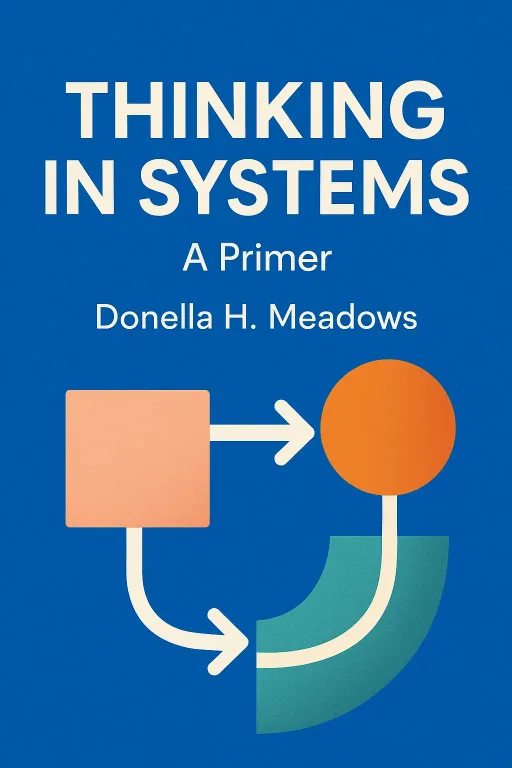
Nova: You know, for some, that might actually be the simulation trap in action! But today, we're diving into a concept a little more profound, though your meetings might indeed be a symptom. We're dissecting the core ideas behind 'The Simulation Trap: Why Your Models Need Reality Checks' – a powerful concept that, while not a single book, draws heavily from foundational works like Donella H. Meadows' 'Thinking in Systems' and Thomas S. Kuhn's 'The Structure of Scientific Revolutions.'
Atlas: Meadows and Kuhn – that’s a power duo!
Nova: Absolutely. Donella Meadows, for instance, wasn't just an environmental scientist; she was a pioneering systems thinker instrumental in the 'Limits to Growth' report. That report, published back in the 70s, profoundly challenged global assumptions about endless resources and growth, making her insights incredibly relevant to understanding interconnectedness even today. What she and Kuhn illuminate is how easy it is to build these perfectly logical, self-contained models in our heads or our spreadsheets, that then completely miss the messy, dynamic reality they're supposed to represent.
Atlas: So, we're talking about the difference between the map and the territory, but with higher stakes?
Nova: Precisely. And that brings us directly to our first core idea: the blind spot.
The Blind Spot: Why Our Mental Models Fail Reality
SECTION
Nova: The blind spot is this inherent disconnect between our simplified internal models and the complex, often unpredictable real world. It’s a huge gap that can lead to some pretty spectacular failures, whether you’re planning a perfect road trip or designing a groundbreaking scientific experiment.
Atlas: But isn't some simplification necessary? How do we even function without models? We can't process every single piece of data in the universe.
Nova: You’re absolutely right, Atlas. Our brains are wired to simplify. That's how we make sense of an overwhelming world. Imagine trying to navigate a city street if you had to consciously process every single leaf on every tree, every brick on every building, every single sound. You’d be paralyzed. So, we create mental models – shortcuts, assumptions, frameworks – that allow us to operate efficiently.
Atlas: Okay, so simplification isn’t the enemy. What’s the trap then?
Nova: The trap is when those simplified models become so ingrained, so 'perfect' in our minds, that we stop questioning them. We start mistaking our internal map for the actual territory. It's like a pilot who trains for years in a flight simulator – a perfect model – but then gets into a real cockpit and faces unexpected turbulence, crosswinds, or a sudden system failure that the simulator never quite replicated. Their 'perfect' mental model of flight suddenly has a glaring blind spot.
Atlas: So, it’s about unquestioned assumptions. For our listeners who are, say, architects or engineers, that could be catastrophic. You can’t build a skyscraper based on a perfect theoretical model if you haven’t accounted for the actual soil composition or seismic activity.
Nova: Exactly! Or even in something as seemingly simple as a business strategy. A company might have a beautifully crafted strategic plan, a 'perfect model' for market dominance. But if that model doesn't account for unpredictable consumer behavior, or a sudden technological disruption, or the messy human element within their own organization, it's just a simulation. A very elegant, very expensive simulation that’s completely detached from dynamic reality.
Atlas: So, it's about humility then? Recognizing our models are just that – models, not reality itself? And always having a 'reality check' button.
Nova: That’s a brilliant way to put it, Atlas. It's about maintaining a healthy skepticism towards our own understanding. Because once we forget that our models are merely representations, that's when the blind spots become dangerous. It leads to this false sense of certainty, where we believe we fully grasp something, when in fact, we're only seeing a fraction of the picture. And that leads us to our next big idea.
The Dynamic Nature of Systems and Knowledge
SECTION
Nova: Exactly, Atlas. And that humility opens the door to understanding that reality isn't static, nor is our understanding of it. This is where Donella Meadows and Thomas Kuhn truly shine, showing us that the world is a constantly shifting landscape, not a fixed blueprint.
Atlas: So, it’s not just about tweaking our models, but understanding that the very rules of the game can change?
Nova: Precisely. Meadows, in 'Thinking in Systems,' teaches us that systems are dynamic entities, not static machines. They're full of feedback loops and delays. Our mental models often simplify these incredibly complex interactions, leading to unexpected, and sometimes disastrous, outcomes. Think about a simple thermostat in your house. It's a feedback loop: if it gets too cold, the heater turns on; if it gets too hot, it turns off. But what if there's a delay in the sensor, or the heater takes a long time to warm up the room? Suddenly, your 'perfect' mental model of how your house stays warm is out of sync with reality, leading to overshooting and undershooting.
Atlas: Wait, so our simplified models are like trying to manage a complex symphony with just a single drum beat? How does Meadows suggest we actually the whole system, especially when it comes to something like managing a team or a project, where there are so many moving parts? It feels almost impossible to grasp all the feedback loops.
Nova: She encourages us to look for those loops, Atlas – the reinforcing loops that accelerate change, and the balancing loops that try to stabilize things. We need to identify the 'stocks' and 'flows'. And crucially, she points us to 'leverage points' – small changes in a system that can create large effects. It's about understanding the that generates the behavior, rather than just reacting to the symptoms.
Atlas: That sounds like a profound shift in perspective. Instead of just fixing problems, you’re looking at why the problems keep recurring.
Nova: Exactly. And then, we layer Thomas Kuhn's 'The Structure of Scientific Revolutions' on top of that. Kuhn argues that science doesn't progress linearly, like adding bricks to a wall. It moves through paradigms – fundamental frameworks of understanding that guide research and define what's considered 'truth.'
Atlas: So, a paradigm is like a widely accepted operating system for how we see the world?
Nova: A perfect analogy! And normal science operates within that operating system, solving puzzles. But anomalies, things that don't fit the current framework, begin to build up. Eventually, enough anomalies accumulate that the old operating system can't cope, leading to a revolutionary shift – a paradigm shift. Think of the shift from the geocentric model of the universe, where Earth was the center, to the heliocentric model, with the sun at the center. That wasn't just a tweak; it was a complete overthrow of a deeply embedded assumption.
Atlas: That's fascinating! So, it's not just about improving our current models, but being ready for those models to be completely? Like tectonic plates shifting beneath our feet? How does someone in a structured field, say, an architect or a planner, reconcile that constant flux with the need for stable foundations?
Nova: It’s a tension, for sure. But Kuhn's insight isn't about promoting chaos. It's about recognizing that our understanding is always evolving, always provisional. For an architect, it means designing not just for today's needs but for future adaptations, for unforeseen stresses, for changes in how people live and work. It means embracing continuous learning and being open to the possibility that even our most fundamental 'truths' might be redefined. It’s about building resilience into our thinking.
Synthesis & Takeaways
SECTION
Nova: So, when we put these ideas together, the Simulation Trap is precisely when we forget these two fundamental truths: that our mental models are always simplifications, and that reality, and our understanding of it, are inherently dynamic. It’s about questioning the stability of our current understanding and embracing continuous learning.
Atlas: So, it's about building models, but always having a 'reality check' button, knowing that the 'rules' can change. For someone trying to build a career or craft a demanding schedule, that sounds both liberating and a little terrifying. How do you plan for a future that might fundamentally shift its own rules?
Nova: It can feel daunting, but it's ultimately empowering. It means your growth isn't about perfecting a single, rigid plan, but about developing the capacity to learn, adapt, and even thrive amidst change. It’s about building mental agility.
Atlas: So, what’s a concrete step our listeners can take to start avoiding this simulation trap in their own lives? How do we apply this profound insight?
Nova: Here’s a powerful question to ask yourself regularly: "What core assumption in my current work or life feels most vulnerable to a real-world challenge right now?" It could be an assumption about your career path, a relationship, a project you're working on, or even how you manage your time. Just identifying that assumption is the first step out of the trap.
Atlas: That’s a powerful question to sit with. And a great way to avoid getting trapped in our own perfect simulations, thinking we have all the answers when reality is just waiting to throw a wrench in the gears. Thanks for that, Nova.
Nova: My pleasure, Atlas. It’s all about staying curious and humble.
Nova: This is Aibrary. Congratulations on your growth!