The Polymath's Paradox: Unifying Your Diverse Genius Without Overwhelm
Golden Hook & Introduction
SECTION
Nova: We've been told our entire lives that to succeed, you have to specialize. Pick a lane, dig deep, become the expert. But what if that conventional wisdom is actually holding you back? What if your greatest strength lies in picking a lane, but in navigating the entire highway?
Atlas: Whoa, Nova, that's a bold claim right out of the gate. For anyone out there juggling multiple passions—maybe they're a software architect who also dives into 3D animation, and helps brand startups on the side—that sounds almost too good to be true. I mean, the world seems to reward the laser-focused specialist, doesn't it?
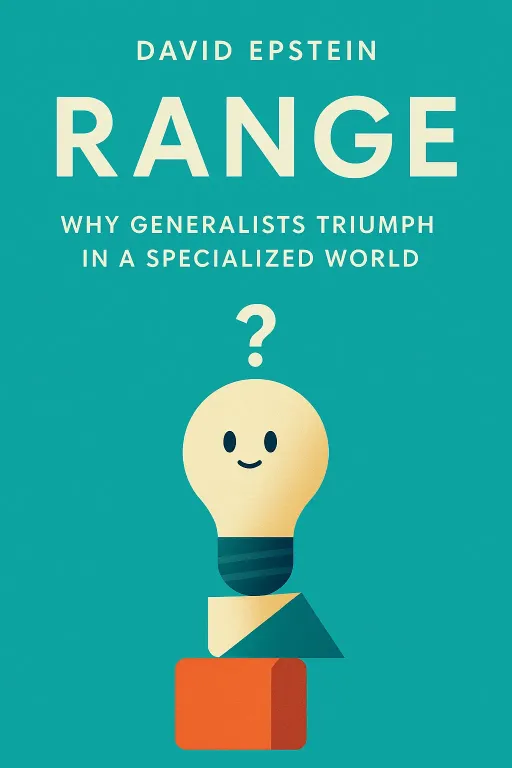
Nova: It absolutely does, Atlas, but that's a narrative we need to challenge, especially for our polymath listeners. Today, we're diving into a book that fundamentally reframes this idea: "Range: Why Generalists Triumph in a Specialized World" by David Epstein. What's fascinating about Epstein is that he's not just theorizing; he’s lived this. He was a science writer, a journalist, even a former collegiate athlete. His own diverse background makes him uniquely positioned to argue the power of breadth.
Atlas: So he’s basically saying, "Hey, all you multi-talented folks who feel like you're scattered, you're actually ahead of the curve." I can definitely see how that would resonate with our audience, who are constantly trying to connect their varied interests. But how does that "range" actually translate into an advantage? Because sometimes, it just feels like a lot of half-finished projects.
Embracing Your Polymathic Range: From Scattered to Strategic
SECTION
Nova: Precisely. Epstein argues that in a world increasingly dominated by complex, unpredictable problems—what he calls "wicked problems"—generalists don't just survive, they often. Think about it: a specialist is brilliant at solving a problem their domain. But what if the problem itself crosses domains? What if the solution requires insights from seemingly unrelated fields?
Atlas: That's a great way to put it. I imagine a lot of our listeners, who are often leading creative teams or optimizing complex systems, encounter those "wicked problems" daily. They can’t just stay in one silo.
Nova: Exactly. Epstein illustrates this beautifully with examples like Charles Darwin. Darwin wasn't just a botanist or a geologist; he was a polymath who studied everything from barnacles to geology, from pigeons to economics. It was this vast, seemingly disconnected range of interests that allowed him to connect dots no one else saw and formulate the theory of evolution. A hyper-specialized naturalist might have spent their life cataloging a single species, missing the bigger picture entirely.
Atlas: That’s actually really inspiring. So, it's not about being a dilettante, it's about having a vast mental library of diverse experiences and knowledge that you can draw from. But hold on, Nova, for someone in, say, software architecture, where deep technical expertise is paramount, how does this 'range' help if you're trying to build a specific, high-performance system? Isn't that where specialization truly shines?
Nova: That’s a fair question, and it gets to the heart of the "Polymath's Paradox." Epstein isn't saying specialization is bad; he's saying specialization can be limiting, especially in fields that are rapidly evolving or inherently multidisciplinary. For your software architect, range might mean understanding user psychology from a design background, or grasping the business implications from an entrepreneurial venture. This allows them to build systems that aren't just technically sound, but also intuitive, market-aligned, and innovative. They see the entire ecosystem, not just the code.
Atlas: I see. So it's about seeing the forest the trees, but with a unique perspective because you've explored so many different forests. It connects back to that idea in our user profile: "Trust your diverse instincts. They are your superpower." It's almost like your varied experiences give you a unique operating system for problem-solving.
Nova: Precisely. Your 'switching,' as you might perceive it, is actually a form of 'integrating,' building a unique, resilient perspective that others often miss. And that leads us perfectly into the next crucial question: how do you actually that integration? How do you take that broad range and weave it into a cohesive, powerful whole?
The Art of Integrated Design: Connecting Your Diverse Genius
SECTION
Nova: This is where we turn to another foundational text, "Thinking in Systems" by Donella H. Meadows. Meadows was a brilliant environmental scientist and pioneer in the field of system dynamics. Her work is all about understanding how different parts of a system interact and influence each other, and crucially, how to identify "leverage points" for change.
Atlas: Okay, 'thinking in systems' sounds like something a strategist or creative leader would intuitively be drawn to, but it also sounds incredibly abstract. For someone juggling 3D animation, software architecture, and entrepreneurial branding, how do you actually those connections? It feels more like juggling three different balls than finding one big system.
Nova: That's a common misconception, Atlas. It’s not about making everything the same; it's about understanding the underlying that govern seemingly disparate elements. Think of it like a master chef. They don't just know how to cook one dish; they understand the fundamental principles of flavor, texture, heat, and presentation. They can combine ingredients from different cuisines to create something entirely new and delicious because they understand the of cooking.
Atlas: That’s a great analogy! So, it’s about identifying those 'master keys' or core principles that apply across your diverse domains. Like how storytelling principles might apply equally to animating a character, pitching a startup, or even explaining a complex software architecture to a non-technical team.
Nova: Exactly! Meadows helps us move beyond seeing isolated events to understanding the patterns, structures, and mental models that create those events. For our polymaths, this means recognizing that the iterative design process in 3D animation might have direct parallels to agile development in software, or the strategic market positioning in branding. These aren't separate skills; they're different manifestations of the same underlying systemic principles. It allows for what we call "integrated design."
Atlas: This is incredible. So, it's not about forcing connections, but realizing they're already there, waiting to be identified. And once you see them, you can apply lessons from one domain to another, making you more effective and innovative. This is huge for someone looking to optimize their creative leadership or strategic portfolio. It’s moving from just switching between roles to having a unified, strategic approach to everything you do.
Nova: It truly is. Your diverse genius isn't a collection of disparate pieces; it's a rich ecosystem. And systems thinking gives you the lens to understand how that ecosystem functions, how to nurture it, and how to make it incredibly powerful.
Synthesis & Takeaways
SECTION
Nova: So, to bring it all together: David Epstein shows us your broad range is a superpower in a complex world, validating your diverse instincts. And Donella Meadows gives us the framework for to take that powerful range and integrate it, turning seemingly scattered efforts into a cohesive, strategic force. It’s about understanding that your 'switching' is actually 'integrating,' building a unique, resilient perspective that others often miss.
Atlas: That makes so much sense. For our listeners who are polymaths, creators, and strategists, feeling pulled in a million directions, it's not about choosing one path, but about finding the 'operating system' for all of them. It's about designing a life and career that honors your breadth while maximizing your impact.
Nova: Absolutely. And if you're wondering where to start, our tiny step for you this week is powerful: Map out the core principles shared between two of your seemingly unrelated interests. Find one common thread or method. Maybe it's problem-solving, maybe it's aesthetic design, maybe it's communication. You'll be amazed at the connections you uncover, and how that one thread can begin to weave your diverse genius into a truly integrated system.
Atlas: That's such a practical way to begin unlocking this potential. It moves beyond just thinking about it to actively the connections. I can already imagine how that would revolutionize someone's approach to their next big project, whether it's a new software build, an animation sequence, or a whole new business venture. It’s about building a better, more unified you.
Nova: Indeed. This is Aibrary. Congratulations on your growth!