The Network Effect of Ideas: How Mental Models Compound Your Knowledge
Golden Hook & Introduction
SECTION
Nova: Atlas, quick game for you. I’ll throw out a word, you give me the first thing that pops into your head, no filters. Ready?
Atlas: Oh, I love a good mental sprint! Hit me.
Nova: "Problem-solving."
Atlas: Headaches. Definitely headaches. Or maybe a really strong cup of coffee.
Nova: Perfect. Okay, next one: "Knowledge."
Atlas: Libraries. Or that slightly smug feeling you get when you finally understand something really complex. The good kind of smug.
Nova: The kind of smug. I like that. What about "strategic vision"?
Atlas: Chessboard. Or a really, really long to-do list that actually makes sense for once.
Nova: Fantastic. And that, my friend, is exactly what we're talking about today: how to connect those seemingly disparate ideas – the headaches, the libraries, the chessboards – into something far more powerful than the sum of their parts. We're diving into what we call 'The Network Effect of Ideas,' and how mental models can radically compound your knowledge.
Atlas: Oh, I like that. "Compound your knowledge." That’s going to resonate with anyone who’s trying to build something lasting, whether it’s a business, a career, or even just a better understanding of the world. So, where are we starting this intellectual journey?
Nova: We're starting with a foundational text that's almost legendary in its impact on how smart people think: "Poor Charlie's Almanack." This isn't just a book; it's a collection of wisdom from the brilliant mind of Charles T. Munger, Warren Buffett’s long-time business partner. Munger, an investor and polymath, famously advocated for a "latticework of mental models," arguing that true wisdom comes from multidisciplinary learning, not just deep dives into one area.
Atlas: Oh, I know that feeling of getting stuck in your own lane. It sounds like Munger was saying, "Hey, step out of your echo chamber and borrow some tools from the neighbors." What exactly a mental model in this context, though? I imagine a lot of our listeners hear "mental model" and think it sounds a bit academic.
The Latticework of Mental Models
SECTION
Nova: That’s a great question, and it's less academic than it sounds. Think of a mental model as a fundamental concept from a discipline – like physics, psychology, economics, or biology – that helps you understand how the world works. It's a lens, a framework, a specific way of seeing and interpreting reality. So, if you're trying to solve a complex business problem, instead of just looking at it through a business lens, you might ask: "What does biology tell me about competition here? What does psychology say about team dynamics? What does physics teach me about leverage?"
Atlas: So you're saying it's like having a diverse toolbox, where each tool is a concept from a different field? For someone looking to grow their strategic vision, how does this apply beyond just finance? I mean, Munger was a legendary investor, but what about the rest of us?
Nova: Exactly! Imagine you’re trying to understand why a new product launch failed. If you only look at marketing data, you might see poor ad spend. That’s one tool. But if you also apply a psychological model, like 'confirmation bias,' you might realize the team was so invested in the idea that they ignored negative market signals early on. Or if you use an economic model, like 'opportunity cost,' you might see that developing this product diverted resources from a more promising venture.
Atlas: Wow. That's a good example. It’s like you’re not just seeing the surface-level problem, but the underlying mechanisms at play. So, instead of just fixing the ad spend, you’re looking at the decision-making process itself.
Nova: Precisely. Munger often used the example of 'incentive-caused bias' from psychology. He observed how powerful incentives could distort judgment, even for highly intelligent people. His insight was that if you want to understand human behavior, you need to understand the incentives driving it, regardless of whether you're in business, politics, or personal relationships. He applied this psychological model to every investment decision, asking, "What are the incentives here, and how might they be subtly distorting my, or others', judgment?" This allowed him to identify risks and opportunities others missed because they were only looking at the financial spreadsheets.
Atlas: That makes me wonder, isn't it overwhelming to try and learn so much? For a practical strategist who's already juggling a thousand things, how does one even begin to build this 'latticework' without just feeling like they're drowning in information? It sounds daunting.
Nova: It’s not about becoming an expert in every single field. It's about understanding the from each one. Munger himself said you only need about 80 to 90 key models. The tiny step is to start consciously seeking out these foundational concepts from different disciplines. Read broadly, listen to podcasts outside your niche, talk to people from different professions. It’s about cultivating a mindset of cross-disciplinary curiosity, actively looking for how a concept from biology, for example, might illuminate a problem in your marketing strategy.
Systems Thinking for Leverage Points
SECTION
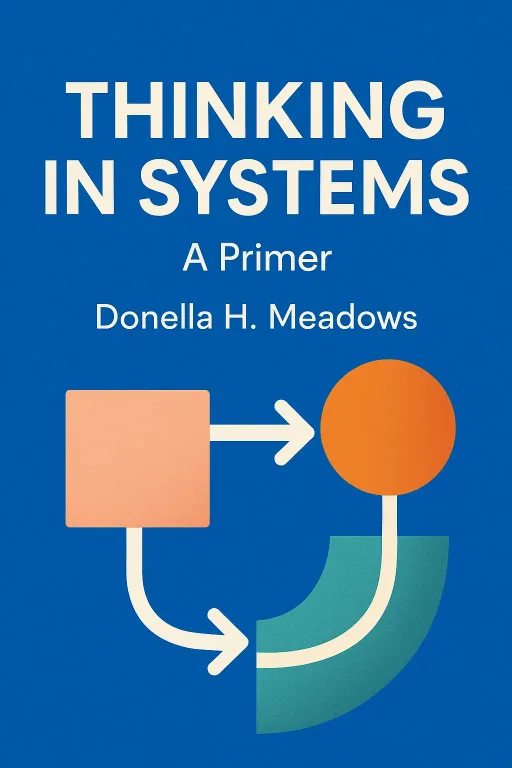
Nova: And that naturally leads us to the second key idea we need to talk about, which often acts as a counterpoint to what we just discussed. Once you have these diverse models, how do they actually? That’s where "Thinking in Systems" by Donella H. Meadows comes in. Meadows teaches us how to see the interconnectedness of elements within any given system, and crucially, how to identify "leverage points" for change.
Atlas: So you’re saying it’s not just ideas you have, but and influence each other? That makes sense. But what exactly is a "system" in this context, and what's a "leverage point"? Can you give an example that helps it click for someone who's used to seeing problems as isolated incidents?
Nova: Absolutely. Think of a city’s public transportation. That’s a system. It has components: buses, trains, schedules, passengers, drivers, funding, infrastructure. They all interact. An "obvious solution" to overcrowding might be to buy more buses. You’re solving a symptom. A "leverage point," however, is a place in the system where a small shift can lead to a large, lasting change.
Atlas: Okay, so what would be a leverage point in that public transport example?
Nova: Instead of just adding more buses, a leverage point might be to change the fare structure to incentivize off-peak travel, or to invest in a real-time information system that reduces passenger anxiety and makes waiting more tolerable. Or, even more profoundly, to redesign urban planning to reduce the need for commuting in the first place. You're not just adding more of the same; you're changing the or of the system itself. Meadows emphasizes that the highest leverage points are often the least obvious, involving shifts in mindsets and paradigms, not just physical components.
Atlas: That makes me wonder, for leaders focused on future growth and planning, how do you spot these leverage points without getting lost in the sheer complexity? It sounds like a lot of moving parts and feedback loops to track.
Nova: It can be. Meadows teaches us to look for things like feedback loops – how an action circles back to affect itself. For instance, if you cut funding for a public health program, it might lead to more illness, which then costs the system more in emergency care, making the initial cut counterproductive. Spotting these loops, and understanding delays within them, helps you see where a small intervention can have a magnified effect. It's about moving from reacting to symptoms to truly understanding the underlying structure that generates those symptoms.
Atlas: So, it's about seeing the forest the trees, but also understanding the ecosystem that connects them. That’s a fundamentally different way of approaching problem-solving than just tackling individual issues as they arise.
Synthesis & Takeaways
SECTION
Nova: Exactly. When you combine Munger's "latticework of mental models" with Meadows' "systems thinking," you get an incredibly powerful toolkit. Munger gives you the diverse lenses to look at a problem, and Meadows helps you understand how those lenses interact within a dynamic, interconnected reality. You stop seeing isolated facts and start seeing patterns, relationships, and hidden opportunities. As we noted, cultivating a diverse set of mental models allows you to approach challenges from multiple angles and uncover hidden opportunities that single-discipline thinking would completely miss.
Atlas: That’s actually really inspiring. For anyone who seeks understanding, who values real-world impact, and who is driven by growth – which I imagine is a lot of our listeners – this isn't just theory. It's a strategic imperative. So, what's a tiny step our listeners can take to start applying this? Something concrete.
Nova: The tiny step is deceptively simple but incredibly powerful. Choose one problem you are currently facing – it could be at work, at home, or even a personal challenge. Now, try to analyze it not through your usual lens, but through the lens of a mental model from a field you rarely consider. Like biology: "What does natural selection tell me about this competitive situation?" Or physics: "What's the force or inertia at play here?" It forces your brain to make new connections.
Atlas: I love that. It trusts our inner compass to experiment, and it protects that time for diverse learning. It’s about building those neural pathways, one new model at a time. This isn't just about solving problems; it's about fundamentally upgrading your operating system for how you see the world.
Nova: And that upgrade, that compounding of knowledge, is truly where profound insights and lasting strategic advantage come from. It’s the difference between patching a leaky roof and redesigning your entire home to withstand any storm.
Atlas: Absolutely. You're not just getting smarter, you're getting wiser.
Nova: This is Aibrary. Congratulations on your growth!