The Historian's Dilemma: How to Shape the Future, Not Just Chronicle the Past
Golden Hook & Introduction
SECTION
Nova: What if everything you thought you knew about history was fundamentally incomplete? What if the past isn't just a story we tell, but a complex instruction manual for designing tomorrow, if only you knew how to read it?
Atlas: Whoa, that's a bold claim, Nova. Most of us are taught history as a series of names, dates, and big events. Are you saying we've been missing something crucial in our understanding?
Nova: Absolutely, Atlas. We often look at history like a highlight reel, a collection of significant moments. But the real power, the ability to shape the future, comes from seeing beyond those surface-level occurrences to the deeper patterns, the interconnected systems at play.
Atlas: Okay, so it’s not just happened, but it happened, and how that keeps repeating itself? That sounds like a profound shift from chronicler to something more... active.
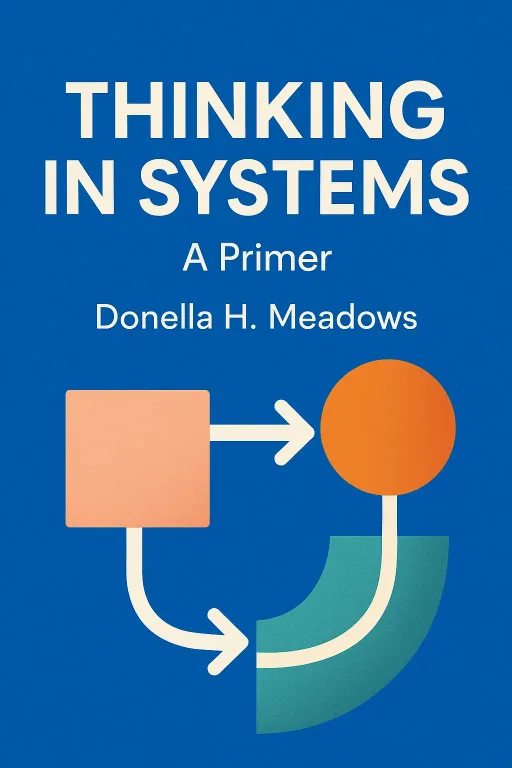
Nova: Precisely. And two foundational works really illuminate this path for us: "Thinking in Systems" by Donella H. Meadows and "The Fifth Discipline" by Peter Senge. Meadows, an environmental scientist, brought this incredibly practical and urgent perspective to understanding complex interconnectedness. Her work wasn’t just academic; it was driven by the imperative to solve pressing global issues.
Atlas: That's fascinating. So, it's about making history a living, breathing guide for strategy, not just dusty archives. But how do these books bridge that gap from just observing to actually influencing?
The Blind Spot: Beyond Events to Underlying Systems
SECTION
Nova: That’s where we hit what I call "the blind spot." It's our natural inclination to focus on the immediate, the dramatic, the "event." Think about it: if someone has a fever, the fever is the event. It’s what you see. But the fever isn't the problem itself, is it?
Atlas: No, the fever is a symptom. The problem is the underlying infection.
Nova: Exactly! And history is full of fevers. A stock market crash, a political upheaval, a social movement gaining traction – these are all events. But if we only focus on the crash, the protest, the election, we miss the infection, the underlying system of financial regulations, social inequalities, or power dynamics that produced those visible outcomes.
Atlas: But when you're in the thick of it, dealing with a crisis or a major historical moment, how do you even pull back to see the system? Events are so immediate and demanding of our attention.
Nova: It takes a conscious effort, a shift in perspective. Meadows argues that these seemingly disparate events are often just symptoms of the same structural issues. For instance, in the 2008 financial crisis, many initially pointed fingers at individual greed or bad actors. Those were events. But the deeper diagnosis, which Meadows’ work helps us see, reveals systemic feedback loops in housing markets, regulatory structures, and interconnected global finance that created the conditions for that bubble to burst.
Atlas: So it's like, where in our own work, are we just seeing the ripples but not the rock that was dropped? Can you give another example that’s a bit more relatable to everyday life or business?
Nova: Of course. Consider a company struggling with high employee turnover. The turnover itself is an event. Management might react by increasing salaries or offering more perks – addressing the symptom. But if the underlying system involves a toxic work culture, a lack of professional development opportunities, or a dysfunctional communication structure, those perks are just a band-aid. The system will continue to produce turnover.
Atlas: That hits home for a lot of people. It’s easy to get caught up in the daily fire drills, isn’t it? We're so focused on putting out the fires, we don't even realize we're standing in a forest where the conditions for fire are constantly being created.
The Strategist's Shift: Applying Systems Thinking to Shape the Future
SECTION
Nova: And that naturally leads us to the second key idea we need to talk about, which is the shift from seeing that blind spot to actually doing something about it. Once we identify that blind spot, the real power comes from making the shift. This is where Meadows' "Thinking in Systems" and Senge's "The Fifth Discipline" truly shine. Meadows introduces us to "leverage points."
Atlas: Leverage points. Sounds like a judo move for reality.
Nova: It is! It's about identifying small changes in a system that can produce big results. Think of a simple thermostat in your home. The temperature dropping is an event. The furnace kicking on is another event. But the system is the thermostat setting, the sensor, the furnace, and the insulation. If you understand that system, you know that a tiny adjustment to the thermostat setting – a leverage point – can control the entire temperature of your home. It's not about pushing harder, but pushing smarter, in the right place.
Atlas: So, it's not about just pushing harder, but pushing smarter, in the right place? That makes sense. How does Senge build on this, especially with "mental models"?
Nova: Senge takes Meadows' insights and applies them directly to human organizations, emphasizing that our "mental models" – our deeply ingrained assumptions, beliefs, and even prejudices – actually shape the systems we create and perpetuate. Imagine a business leader who believes that employees are inherently lazy and need constant supervision. That mental model will lead them to design a rigid, top-down system with little autonomy, which then, ironically, often disengaged employees.
Atlas: So, the system they built then reinforces their original, flawed belief. That's a vicious cycle.
Nova: Absolutely. Senge’s work, which received widespread acclaim for its revolutionary approach to organizational learning, highlights that changing these mental models is one of the most powerful leverage points. It's incredibly challenging because these models are often subconscious, but when you shift them, you can fundamentally transform a system. Some critics initially found Senge's emphasis on deep personal and organizational change challenging to implement within existing corporate structures, highlighting the human element and resistance to change.
Atlas: So, the historian's dilemma isn't just about understanding the past, but about understanding our understanding of the past, and how that shapes the future? That's a profound shift. Can you give a real-world strategic application of this, beyond just a company?
Nova: Consider a community facing a persistent social issue, like homelessness. An event-focused approach would be to open more shelters. While necessary, a systems thinker would ask: What are the underlying mental models about poverty? What economic, housing, and support systems are creating and perpetuating homelessness? Then, they might identify leverage points like policy changes, educational initiatives to shift public perception, or integrated support services that address the root causes, not just the symptoms.
Atlas: That’s a tangible way to see it. It's about designing the conditions for success, rather than just reacting to outcomes. It's about moving from being a passive observer of history to an active architect of the future.
Synthesis & Takeaways
SECTION
Nova: Precisely, Atlas. The journey from chronicler to strategist is about cultivating the ability to see systems, to understand their dynamics, and to identify those crucial leverage points. Both Meadows and Senge empower us to move beyond simply reacting to the world, to actively participating in its design. They remind us that we are not just observers but active participants in the systems we inhabit, and that our understanding – or lack thereof – directly impacts the future we create.
Atlas: For anyone who wants to not just understand where we've been, but genuinely influence where we're going, this isn't just theory, it's a toolkit. It's about making history a living, breathing guide for strategy, not just dusty archives. It challenges us to look deeper, to question our assumptions, and to find those hidden levers for change. And honestly, that’s incredibly empowering.
Nova: It truly is. It shifts the entire conversation from "What happened?" to "How can we design a better future?"
Atlas: So, where in your own work, or even your own life, are you observing events but not yet seeing the system that produces them? That's the question we want to leave you with today.
Nova: Think about it, dig into it. The answers might surprise you.
Atlas: Thanks for joining us for this deep dive into shaping the future.
Nova: This is Aibrary. Congratulations on your growth!