The Architect of Change: Building Resilient Systems in a VUCA World
Golden Hook & Introduction
SECTION
Nova: What if everything you thought about being 'strong' was actually making you weaker? What if the very act of trying to prevent failure was guaranteeing it?
Atlas: Whoa, that's a bold claim, Nova. My initial reaction is, 'Wait, isn't strength always good?' You're flipping the script on something most of us instinctively believe. Are you saying we've been building our castles wrong all along?
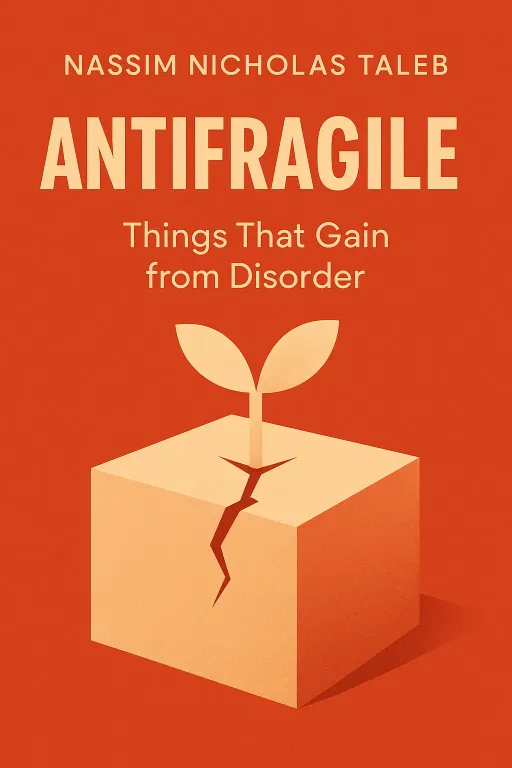
Nova: Well, in a way, yes! And that's exactly what we're diving into today, inspired by two profound thinkers. First, Nassim Nicholas Taleb, with his groundbreaking book,. Taleb, a former options trader and statistician, brings a uniquely street-smart perspective to risk and uncertainty, forged in the crucible of financial markets, not just ivory towers.
Atlas: And we're pairing that with the foundational wisdom of Donella H. Meadows'. Meadows was a true pioneer, famous for her influential work on "The Limits to Growth," which brought the interconnectedness of global challenges into sharp focus long before it was common discourse. She really showed us how to map the invisible forces at play.
Nova: Together, these books don't just ask us to rethink resilience; they challenge us to fundamentally redesign our world, our businesses, and even our personal lives. They're urging us to move beyond simply surviving shocks to actually thriving because of them.
From Robust to Antifragile: The Paradigm Shift
SECTION
Nova: Most of us design systems to be robust. We want our bridges to withstand floods, our software to be crash-proof, our plans to be foolproof. We build them to resist. But here's the blind spot: sometimes, the very act of making something 'robust' can make it brittle.
Atlas: But wait, isn't robustness? For someone managing high-stakes projects or designing mission-critical systems, 'fail-safe' is the ultimate goal. You don't want your bridge to from a flood; you want it to just... stay a bridge!
Nova: Exactly! That's the conventional wisdom. But think about a perfectly engineered, rigid bridge designed to withstand a specific maximum load. It's incredibly robust against stresses. But what happens when an entirely unforeseen type of stress hits it—a resonant vibration, an unexpected seismic frequency, or even a novel biological attack? Its rigidity, its very robustness, can lead to catastrophic failure. It has no way to adapt or learn.
Atlas: That makes me wonder, if you're building solutions, is 'perfect' actually the enemy of 'durable' in the long run?
Nova: Precisely. Now, contrast that with something antifragile. Taleb defines antifragility as things that don't just survive disorder, but from it. Think of the human immune system. It doesn't become robust by avoiding all germs; it becomes stronger by being exposed to them, learning, and adapting. Or a small, agile business that, after a local crisis, actually thrives because it learned faster, diversified, and adapted more quickly than its larger, more 'robust' competitors.
Atlas: So, it's not about avoiding all stress, but about how you're built to to it? Like a muscle that tears to grow stronger through resistance training? For our listeners who are constantly building and refining organizational structures, how does this apply beyond biological systems?
Nova: It applies directly to how we structure everything. Taleb talks about 'optionality' and 'convexity of outcomes.' Essentially, it's about having many small bets with limited downside but large potential upside. This is inherently antifragile. A system that has many small, independent components, each capable of failing safely and providing feedback, is far more antifragile than a single, centralized, 'robust' system where a single point of failure can bring the whole thing down. Think of decentralized networks versus single, massive data centers. When one small part of a decentralized network goes down, the rest routes around it and learns. A single point of failure in a centralized system can be catastrophic.
Leverage Points in Complex Systems: Engineering for Antifragility
SECTION
Nova: And understanding how to build that kind of adaptable, learning system brings us directly to Donella Meadows and her genius for 'Thinking in Systems'. If antifragility is the goal – gaining from disorder – Meadows gives us the map to actually engineer it.
Atlas: Leverage points. That sounds like the sweet spot for an 'architect of change' – where you can push a little and get a lot of impact. For someone who connects past to present and seeks lasting contributions, this is gold. But how do you them in a messy, real-world system? They can't be obvious, can they?
Nova: They are often counter-intuitive. Meadows defines leverage points as places within a system where a small shift can lead to large changes in behavior, often disproportionately. Imagine a city with terrible traffic. A low-leverage solution is to add more lanes or hire more traffic cops. It might help for a bit, but the problem usually returns. A higher-leverage solution might be to significantly invest in public transport, redesigning urban planning to reduce commute distances, or even implementing congestion pricing. These changes fundamentally alter the system's incentives and behaviors.
Atlas: So, for someone trying to shift an entrenched organizational culture, it's not about mandating new rules, but finding the hidden 'rules of the game' or the 'mindset' that drives decisions? Like, instead of telling people to collaborate more, you change the reward structure so collaboration is inherently beneficial?
Nova: Exactly! Meadows outlines a hierarchy of leverage points. At the lowest level are parameters – things like taxes or regulations. Higher up, you have feedback loops – how information flows and influences decisions. But the very highest leverage points are often the hardest to change: the goals of the system, and even more profoundly, the paradigms or mindsets from which the system arises.
Atlas: The underlying beliefs. That's a powerful idea. It means the biggest impact isn't always where we're looking. It's about seeing the invisible structures. For our listeners who are building solutions, this really redefines 'problem-solving' from just fixing symptoms to fundamentally altering the system's DNA.
Nova: It is. Consider a company that's struggling with innovation. You could implement a new "innovation process", but if the underlying paradigm is "don't fail at all costs," then no process will help. The leverage point is shifting that paradigm to "fail fast, learn faster." Or redesigning a performance review system not just to measure, but to foster continuous learning and growth, changing the very goal of evaluation. That's true architectural change.
Synthesis & Takeaways
SECTION
Nova: So, when we combine Taleb's antifragility with Meadows' systems thinking, we get a profound new lens. It's not just about surviving; it's about designing systems—whether they're personal habits, business models, or even national policies—that actually and from the inevitable disruptions. It’s about cultivating the capacity to gain from volatility.
Atlas: Which brings us to the deep question posed by these insights: What system do manage that could be redesigned to be more antifragile, and where are its key leverage points? For anyone who connects the past to the present, building lasting contributions, this is an invitation to truly architect change, not just react to it.
Nova: Exactly. Start small. Look for those hidden feedback loops, those unspoken goals that might be making your system brittle. Instead of bracing for impact, ask how you can create optionality, how you can let small, controlled failures make the whole stronger. It's a mindset shift that empowers you to trust your vision, as our user profile suggests, and build solutions that truly endure.
Atlas: It’s about seeing the world not as a fragile thing to be protected, but as a dynamic entity capable of self-improvement through intelligent design. A powerful challenge for any strategist looking to make a lasting impact.
Nova: Absolutely. This is Aibrary. Congratulations on your growth!