The 'Adaptive' Trap: Why You Need Systems Thinking for Product Evolution.
Golden Hook & Introduction
SECTION
Nova: What if I told you that trying harder, optimizing more, and tirelessly fixing what's broken in your product is precisely what's holding it back from true, sustainable evolution?
Atlas: Wait, that sounds completely counterintuitive, Nova! Isn't 'fixing things' and 'making them better' what we're literally paid to do in product development? That feels like saying the cure is the disease.
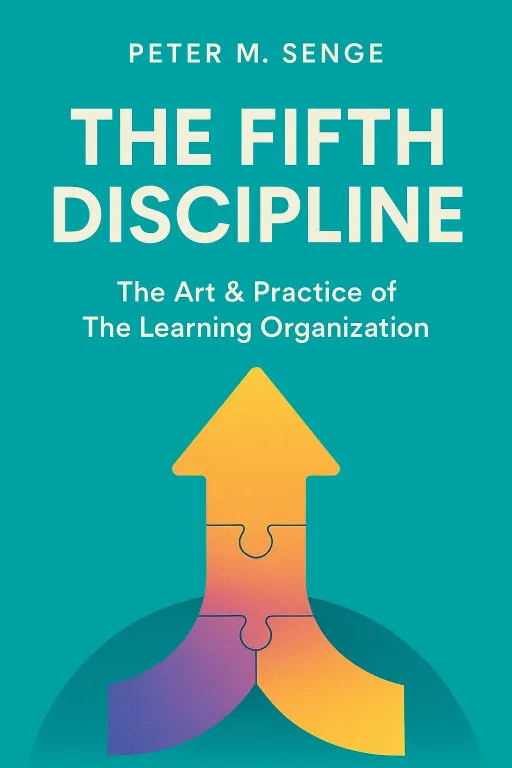
Nova: It's a paradox, isn't it? But today, Atlas, we're unpacking that very conundrum by diving into the profound wisdom of systems thinking. We're specifically drawing from two intellectual giants: Donella H. Meadows' seminal book, "Thinking in Systems," and Peter Senge's transformative work, "The Fifth Discipline." Meadows, a true pioneer, helped birth the entire field of system dynamics, showing us the unseen architecture of our world, while Senge translated these complex ideas into a practical blueprint for organizations to truly learn and adapt.
Atlas: So, we're talking about looking at the entire forest, not just the individual trees, when it comes to product development. It sounds like a necessary shift from a purely reactive mindset.
The 'Adaptive' Trap: Why Component-Level Thinking Fails Product Evolution
SECTION
Nova: Exactly. Many product strategies today fall into what we're calling the 'adaptive trap.' It's this blind spot where we hyper-focus on optimizing individual components or features, believing that if every part is perfect, the whole will magically be perfect too. But this overlooks the deep, interconnected dynamics, the invisible forces, that truly drive market shifts and product lifecycles. It’s like playing a game of whack-a-mole; you fix one problem, and two more pop up elsewhere because you're not addressing the underlying system.
Atlas: That sounds like a lot of product teams I've seen. We chase individual metrics, optimize specific features, and then wonder why the overall user experience feels... fragmented, or why our retention isn't improving despite all the 'fixes.' Give me an example, Nova. Where does this 'adaptive trap' manifest most clearly in the wild?
Nova: Let's consider what I call "The Feature Factory Paradox." Imagine a tech company, let's call them 'InnovateNow.' InnovateNow is under immense pressure to deliver. Their product managers are constantly gathering individual user feedback—"I wish it had X," "Competitor Y has Z"—and their sales team is asking for specific features to close deals. So, they relentlessly add new features. Each new feature is a 'fix' for a perceived gap or a response to a specific request.
Atlas: So far, this sounds like good product management, right? Responding to user needs, staying competitive.
Nova: On the surface, yes. But here's the insidious part: InnovateNow focuses solely on the individual feature's success metrics. Is this new button being clicked? Is this new flow being used? What they miss is how each new feature interacts with the existing ones, how it impacts the overall user journey, and the underlying architecture. Each addition requires more maintenance, clutters the user interface, slows down performance, and significantly increases the cognitive load for users.
Atlas: Oh, I see where this is going. It's like trying to build a better car by just adding more cup holders, better infotainment, and a fancier horn, without ever looking at the engine's efficiency, the suspension's balance, or the overall weight distribution. You end up with a car that has everything, but drives terribly.
Nova: Precisely! The outcome is that user satisfaction paradoxically declines. Onboarding becomes a nightmare because there are too many options, and the product becomes a bloated, unsustainable mess. This happens despite each individual feature, in isolation, being 'good.' For someone who's spent their career optimizing specific parts, this feels... threatening. Are you saying optimization is bad, Nova?
Atlas: That sounds a bit out there, honestly. Optimization is literally the goal for so many of us.
Nova: Not at all, Atlas! Optimization is absolutely crucial, but it's and we optimize that matters. The trap isn't adaptation itself; it's adapting. It’s a reactive fix, a band-aid solution that often creates new problems down the line, instead of a proactive evolution driven by systemic understanding.
Systems Thinking: The Antidote for Proactive Product Evolution
SECTION
Nova: And that distinction, Atlas, between reactive fixes and proactive evolution, is precisely where systems thinking comes in. It's not just about identifying the problem; it's about understanding the that generates the problem. Meadows famously said that "the greatest leverage often lies in changing paradigms," and systems thinking gives us that new paradigm.
Atlas: So, how do Meadows and Senge help us here? What's the secret sauce they bring to the table for product teams who are stuck in that feature factory paradox? How do we break free from the whack-a-mole?
Nova: Meadows introduces us to the concepts of "feedback loops," "stocks," and "flows." Think of a bathtub: the water in it is the 'stock' – say, your active user base. The water flowing in from the faucet is an 'inflow' – new user acquisition. And the water draining out is an 'outflow' – user churn. A feedback loop is when the stock itself influences the flows. For example, a larger, more engaged user base might create a reinforcing loop where word-of-mouth attracts even more new users. But if the stock gets too large or too complex, it might create a balancing loop where performance degrades, leading to more churn.
Atlas: That makes perfect sense. So, instead of just trying to plug the leak in the bathtub, we're looking at why the faucet is running too slowly, or why the drain is wide open, or how the water level itself is affecting the pressure. And Senge?
Nova: Senge takes these principles and applies them to organizations, emphasizing the importance of a "learning organization" – one that can adapt to changing environments by understanding these underlying systemic structures. It's about fostering a culture where teams can see these patterns, challenge mental models, and truly innovate by working the system, not just reacting to its symptoms.
Atlas: Okay, so this sounds like a powerful framework. Can you give me an example of a product team successfully applying this, moving beyond the 'adaptive trap' to become an 'ecosystem harmonizer?'
Nova: Absolutely. Let's take 'ConnectCo,' a social platform. They were experiencing a similar problem to InnovateNow – user engagement was dropping despite continuous feature releases. Instead of pushing more features, they paused. They applied systems thinking. They mapped out their entire user journey, identifying key feedback loops between different product modules. They observed how changes in one area—say, an increase in notification frequency—impacted seemingly unrelated areas, like support tickets or even feature discovery. They realized their product was inadvertently creating 'balancing loops' that suppressed engagement by overwhelming users.
Atlas: So they didn't just look at the notification feature in isolation; they looked at its ripple effect across the entire user ecosystem.
Nova: Exactly. Their action wasn't to add or remove features, but to optimize the between components. They simplified workflows, clarified information hierarchy, and redesigned for positive reinforcing loops. For instance, they focused on making successful user actions lead to immediate, relevant value and social affirmation, which in turn encouraged more positive interaction.
Atlas: Wow. So they moved from just adding ingredients to actually understanding the recipe and how the flavors combine. The outcome must have been transformative.
Nova: It was. They saw reduced complexity, a significant increase in organic engagement, and a more sustainable development roadmap. They were working the system's natural dynamics, not against them. It was a profound shift in mindset, moving from building discrete parts to designing for a dynamic, evolving whole.
Synthesis & Takeaways
SECTION
Nova: So, what we've really explored today, Atlas, is that the 'adaptive trap' is a natural outcome of viewing products as static collections of parts. Systems thinking, as championed by Meadows and Senge, provides us with the lens to see the hidden levers, the feedback loops, and the true interconnectedness that governs product evolution. It empowers us to move from endless reactive fixes to proactive, sustainable development.
Atlas: For our listeners who are constantly trying to evolve their products, who see patterns and seek deep causal links, this isn't just theory; it's a fundamental shift in how you lead, how you strategize, and how you build. It's about realizing that every intervention has consequences, often far from the point of application.
Nova: As Donella Meadows once reminded us, "The world is a complex, interconnected, finite, and astonishing place. We are an integral part of it, and we forget that at our peril." The biggest leverage point, she argued, is in changing paradigms, changing our mindset.
Atlas: So, for our listeners, the deep question isn't just 'what's broken,' but 'what larger, unaddressed system dynamic is causing these symptoms?' That's where real change, real evolution, begins.
Nova: This is Aibrary. Congratulations on your growth!