Stop Guessing, Start Seeing: The Guide to Systems Thinking.
Golden Hook & Introduction
SECTION
Nova: We've all been taught to fix problems, right? See a broken thing, fix the broken thing. But what if I told you that approach is often the very reason our biggest, most persistent challenges never truly get solved?
Atlas: Oh, I like that. That’s going to resonate with anyone who’s ever tried to patch a leak only to have another one spring up right next to it, or worse, in a completely different part of the house.
Nova: Exactly! It’s this deep, almost instinctive human tendency to treat symptoms, to react to the immediate fire, without ever looking at the entire forest that’s burning. And that’s precisely what makes systems thinking so profoundly revolutionary.
Atlas: So, we’re not just talking about theory here. You're saying these are the texts that redefine how we understand the very fabric of our world, from ecology to corporations?
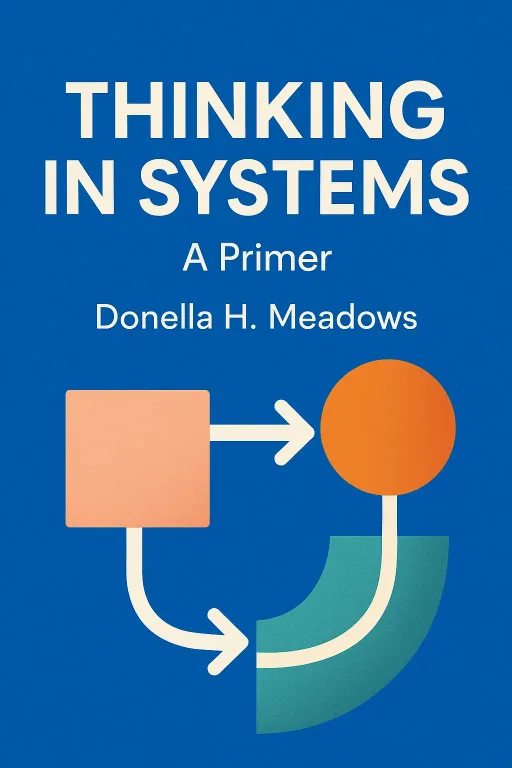
Nova: Absolutely. Today, we’re diving into the profound world of systems thinking, guided by two towering figures: Donella H. Meadows' seminal work, "Thinking in Systems," a book compiled from her groundbreaking lectures and writings after her passing, truly a capstone of her life’s work. And then, Peter Senge's transformative "The Fifth Discipline," which brought these ideas into the heart of organizational change, making 'learning organizations' a household term in the business world.
Atlas: Wow. That’s a powerful combination. It sounds like we’re about to unpack some seriously fundamental ways of seeing the world. So where do we even begin to unmask these invisible forces?
Unmasking the System: Seeing Beyond the Symptoms
SECTION
Nova: We begin by challenging that very instinct we just talked about. Meadows’ core insight in "Thinking in Systems" is this: many problems we face aren't isolated events; they're symptoms of deeper systemic structures. Think about a recurring headache. You can take a painkiller, and it goes away for a bit. But if that headache is caused by chronic dehydration or poor posture, the painkiller only addresses the symptom. The underlying system—your body’s water balance or ergonomic setup—is still producing the problem.
Atlas: Right, like trying to pick individual weeds in a garden without ever understanding the soil, the water, the sunlight, and how they all contribute to the weed problem. You’re just going to get more weeds.
Nova: Precisely! Meadows urges us to look beyond those individual events—the headache, the weed—to see the loops and feedback mechanisms driving outcomes. She talks about "stocks and flows." The stock is the accumulation, like the amount of water in a bathtub. The flows are what change the stock—the faucet filling it, the drain emptying it. In our headache example, the stock is your level of hydration. The flows are how much water you drink versus how much you expel. If your inflow is consistently less than your outflow, your stock of hydration will dwindle, and the headache is a symptom.
Atlas: That makes perfect sense. I’m curious, for someone who likes to break down processes, how do we start to map this out? Because it sounds like you’re saying the real work is in understanding these hidden connections, not just reacting to the obvious.
Nova: That’s the analytical heart of it. Meadows teaches us to identify these interconnected parts. Who are the actors? What are the resources? What information flows between them? And critically, what are the feedback loops? A positive feedback loop amplifies change—more people get sick, so more people avoid public transport, which makes public transport less viable, leading to even more people avoiding it. A negative feedback loop stabilizes a system—a thermostat turns off the heater when it gets too hot, bringing the temperature back down.
Atlas: Okay, so the "feedback loop" is that crucial piece where the output of a system circles back and influences its own input. It’s not just A causes B; it’s A causes B, which then affects A.
Nova: Exactly! And often, those loops are where the leverage points are, where a small change can have a big impact. But you can't find the leverage points if you're only focused on the headache, not the dehydration.
Atlas: That’s fascinating. It shifts the entire conversation from blame to design. So, if we’re constantly reacting to problems, it’s because we’re caught in a feedback loop ourselves, just seeing the surface.
The Architect's Mindset: Designing for Lasting Change
SECTION
Nova: And once we can the system, the next logical step, as Peter Senge shows us in "The Fifth Discipline," is to become its architect. Senge emphasizes that learning organizations embrace systems thinking to see the 'whole' rather than just the 'parts.' He moves us from simply analyzing what to actively designing what.
Atlas: Hold on, so it’s not just about understanding the machine, but about re-engineering it? That sounds like a massive undertaking, especially when you’re dealing with things like organizational culture or even just ingrained personal habits.
Nova: It is, but Senge gives us tools. One of his key concepts is "mental models." These are the deeply ingrained assumptions, generalizations, or even pictures and images that influence how we understand the world and how we take action. They’re often unconscious, but they powerfully shape our behavior and, by extension, the systems we create and inhabit.
Atlas: So, you’re saying our internal operating system, our beliefs, actually dictates the external system’s behavior? That’s a bit out there. How do you even begin to shift something so ingrained, especially in a complex organization, or even your own daily life?
Nova: It starts with making them explicit. Imagine a company where the mental model is "our customers only care about the lowest price." Every decision, every system—from production to sales—will be built around that assumption. But what if that mental model is outdated or simply wrong? What if customers actually value reliability and service more? The system, driven by that old mental model, will keep producing the "lowest price" outcome, even if it's no longer effective. Senge advocates for shared vision and dialogue, making these implicit assumptions explicit so they can be examined and collectively reformed.
Atlas: Oh, I see. So it's like a team collectively realizing their "mental model" of success was actually driving burnout, because they equated long hours with productivity, when in reality, it was just leading to mistakes and turnover.
Nova: Exactly! It’s about shifting from "we must push harder" to "what if our definition of 'harder' is flawed?" This shift, enabled by systems thinking, allows for true learning and adaptation. It moves us from merely reacting to problems to proactively designing better systems that align with a shared, evolving understanding of reality.
Atlas: That makes me wonder, for someone who’s trying to unravel intricate processes in their own life or work, what’s the first step to becoming this "architect" of their own personal or professional systems? Because "changing mental models" sounds like a PhD program.
Nova: It doesn't have to be. The tiny step we can all take, building on both Meadows and Senge, is to pick one recurring problem in your daily life—a persistent frustration, a goal you keep failing to reach. Then, try to map its interconnected elements and feedback loops. But here's the Senge twist: as you map it, also ask yourself, "What are my own underlying assumptions or beliefs about this problem? What mental model am I operating from that might be contributing to this outcome?"
Synthesis & Takeaways
SECTION
Nova: So, by combining Meadows’ clarity on seeing the system with Senge’s emphasis on our mental models, we’re not just understanding things work, but we build them that way in the first place. It’s a powerful one-two punch.
Atlas: Absolutely. It’s not just about solving problems; it’s about fundamentally changing we approach them, seeing the puzzle pieces and then building a better puzzle. It moves you from being a victim of circumstance to being a designer of your own reality.
Nova: And that’s the profound insight, isn't it? That deep understanding of interconnectedness and our own role within it. It’s an empowering shift from constant reaction to thoughtful, proactive creation.
Atlas: It really is. It gives you this incredible sense of agency, knowing that even the most complex processes can be unraveled and redesigned. This isn't just a book club; it's a guide to seeing the world with new eyes.
Nova: Indeed. And it starts with that tiny step. Pick one problem, map its loops, question your own assumptions. It’s how "The Seeker" and "The Analyst" truly become "The Philosopher" of their own complex world.
Atlas: What a journey. That’s a fantastic call to action for anyone who’s ever felt stuck in a loop.
Nova: This is Aibrary. Congratulations on your growth!