Stop Guessing, Start Modeling: The Guide to Predicting Complex Systems.
Golden Hook & Introduction
SECTION
Nova: Atlas, I want you to give me a five-word review of what it feels like to constantly solve the same problem over and over again.
Atlas: Oh, I know that feeling. It's like... "Whac-A-Mole, but with spreadsheets."
Nova: Oh, that's good! That's really good. And it perfectly encapsulates why we're diving into today. This isn't just another self-help book; it's a profound shift in perspective, drawing heavily from giants like Donella Meadows and Peter Senge. Meadows, for instance, was this incredible pioneering environmental scientist and systems thinker at MIT, whose groundbreaking work helped us see global sustainability challenges not as isolated incidents, but as interconnected systems.
Atlas: That's a great way to put it. So, we're talking about moving beyond just hitting the mole, to understanding why the mole keeps popping up in the first place?
Nova: Exactly. Because what we often find is that the problems we keep solving, they're not actually problems in isolation. They're symptoms. And our natural, intuitive approach to fixing them often makes things worse.
The Inadequacy of Intuition in Complex Systems
SECTION
Nova: This is "The Cold Fact" the book starts with: complex systems often behave counter-intuitively. Our simple solutions are, frankly, ineffective. Imagine you have a leaky faucet in your bathtub. Your first instinct is to tighten it, right? What if tightening it just shifted the leak to another pipe, or worse, increased the water pressure somewhere else, causing a bigger burst later?
Atlas: Wait, but isn't intuition what got us here? As problem-solvers, we're trained to spot an issue and attack it head-on. That sounds a bit out there, that our gut feeling is wrong.
Nova: That's the crux of it! Our brains are brilliant, but they're wired for linear cause-and-effect. Problem A leads to Solution B. But complex systems are filled with feedback loops, delays, and hidden interdependencies. The book highlights a classic systems archetype called "Fixes That Fail." You implement a short-term solution, it seems to work for a bit, but then the underlying problem resurfaces, often worse than before.
Atlas: I can definitely relate to that. I imagine a lot of our listeners in high-stakes environments, trying to innovate or strategize, feel like they're constantly putting out fires that keep reigniting. So, you’re saying that those quick solutions, the ones that feel like wins in the moment, are actually setting us up for bigger failures down the line?
Nova: Precisely. Let's take a hypothetical example, but one that plays out in many industries. A company faces a sudden surge in demand for a product. Intuitively, the operations team ramps up production. They celebrate meeting the immediate demand. But because of production and shipping delays, by the time that massive new stock hits the warehouses, market demand has cooled, or a competitor has released something similar. Now they're sitting on a massive inventory, needing to discount it heavily, impacting profits. The intuitive fix of "make more to sell more" didn't account for the in the system, and it created a new problem of oversupply.
Atlas: That makes me wonder, how does that apply to someone trying to build intelligent systems? You can’t just code more features because a user asks for it, without thinking about the ripple effect on the entire software architecture, or even user behavior. That's going to resonate with anyone who struggles with that kind of strategic planning.
Systems Thinking: Shifting from Events to Patterns
SECTION
Nova: And that naturally leads us to the solution, which is to stop reacting to the events, and start understanding the patterns. This is where Donella Meadows' "Thinking in Systems" becomes our guide. She urges us to look beyond the surface and identify the underlying structure: the stocks, the flows, and the feedback loops.
Atlas: What exactly do you mean by stocks, flows, and feedback loops? It sounds a bit like an economics textbook.
Nova: Not at all! Think of a company's talent pool. The "stock" is the current number of skilled employees you have. The "inflow" is new hires, and the "outflow" is people leaving. If your outflow increases, intuitively, you might just focus on increasing your inflow through recruitment. But what if the outflow is accelerating because of a negative "balancing feedback loop"—say, poor management leading to low morale, which makes more people leave, which then overburdens the remaining staff, making leave faster?
Atlas: So, it's not just about looking at the spreadsheet number of "employees hired" versus "employees left," but how those numbers to each other, and what's influencing those movements? What's the hidden mechanism?
Nova: Exactly! Let's use an even more common example: traffic congestion in a city. The "stock" is the number of cars on the road. "Inflows" are cars entering the city, "outflows" are cars leaving. The intuitive solution to congestion is often to build more roads, right? But that often acts as a "reinforcing feedback loop." More roads make driving seem easier, which encourages more people to drive, which then fills up the new roads, leading to more congestion.
Atlas: That’s amazing! So, the intuitive fix actually the problem.
Nova: It can, yes. Meadows would instead suggest looking for leverage points: maybe improving public transport, encouraging cycling, implementing congestion pricing, or even changing zoning laws to reduce commute distances. These aren't about adding more "stuff" to the system; they're about changing the of the system.
Atlas: Wow, that’s kind of heartbreaking, but also incredibly insightful. It's a huge shift from "more roads" to "fewer cars" or "smarter transit." It's about changing the fundamental equation, not just adding variables.
From Reactive Problem-Solving to Proactive System Design
SECTION
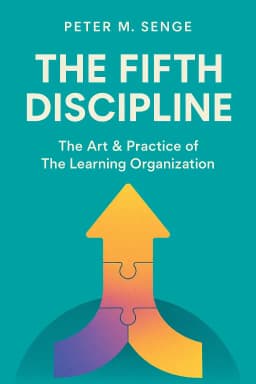
Nova: That insight into changing the fundamental equation is precisely what Peter Senge builds upon in "The Fifth Discipline." He emphasizes that true learning organizations master systems thinking to avoid repeating past mistakes. They don't just react to the traffic; they design a better city.
Atlas: Okay, so if I'm trying to innovate, if I'm a strategist or a problem-solver, this means I need to stop just looking at my product or my immediate team, and start looking at the around it? How does this translate into practical steps for designing robust outcomes?
Nova: It means fostering a culture where people question assumptions and map interdependencies. Senge talks about "personal mastery" – individuals constantly clarifying their own vision and seeing reality objectively – and "shared vision" – aligning the entire organization around a common goal. When everyone understands the system, they can proactively design for future challenges instead of constantly reacting to crises.
Atlas: Can you give an example? Because it sounds like a big conceptual leap from mapping flows to actually designing an organization that doesn't make the same mistakes.
Nova: Certainly. Think about a tech company that uses systems thinking to anticipate shifts in user behavior. Instead of rigidly sticking to a five-year product roadmap, they model how changes in privacy regulations, social media trends, or even global events could influence their users' needs and their platform's usage. They design for flexibility and adaptability, building modular systems that can pivot quickly, rather than being caught off guard. They see how a change in one part of the user experience might ripple through the entire customer journey, and they design to accommodate that. It's about seeing the interdependencies – how say, a new privacy feature might impact user engagement, or how a competitor's move might create a bottleneck in their own user acquisition.
Atlas: That’s a perfect example. It's about seeing the entire web, not just the spider. And it's how you move from being a firefighter to being an architect.
Synthesis & Takeaways
SECTION
Nova: Exactly. Our journey today has been about recognizing the limits of our intuition in complex systems, embracing the power of systems thinking to shift from events to patterns, and finally, moving towards proactive system design. This approach truly enables more robust and predictable outcomes, allowing innovators to build intelligent systems and power the future, just as our listeners are driven to do.
Atlas: Honestly, that’s actually really inspiring. It's a profound shift in perspective, from seeing isolated problems to understanding the entire dynamic. It's about connecting the dots, seeing the 'how' and the 'why,' and then using that knowledge to make a tangible difference. So, what's one tiny step someone can take to start applying this today?
Nova: The book gives us a brilliant "Tiny Step." Identify a recurring problem in your work, something that keeps coming back no matter what you do. Then, sketch its system diagram. Just a simple drawing, showing the stocks, the flows, and the feedback loops. It’s a simple act of mapping, but it can reveal leverage points you never saw before.
Atlas: That’s actionable. It’s not about grand sweeping changes immediately, but about fundamentally changing how you the problem. It's about building with others, understanding the entire system, and really making a difference.
Nova: It’s about becoming a builder of a more predictable, more resilient future.
Atlas: Absolutely. This is Aibrary. Congratulations on your growth!