Stop Chasing Metrics, Start Shaping Systems: The Guide to Scalable Impact.
Golden Hook & Introduction
SECTION
Nova: What if I told you that the very thing making you a brilliant engineer – your ability to optimize individual components – might also be your biggest blind spot when it comes to creating truly scalable, impactful Agent systems?
Atlas: Whoa, Nova, that's a bold claim right out of the gate! I mean, as engineers, we're hardwired to break things down and make each piece sing. Are you telling me that's actually holding us back? That sounds almost counterintuitive.
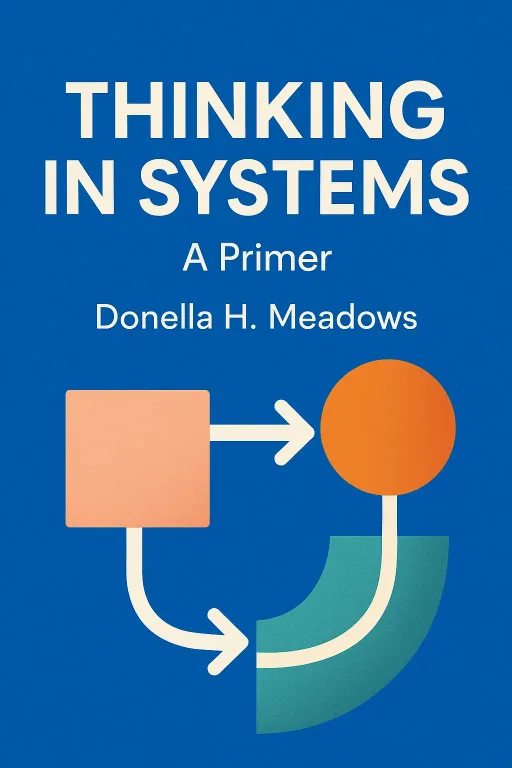
Nova: It absolutely is, Atlas, and that's precisely the blind spot we're shining a light on today. We're diving into a concept that fundamentally shifts our focus from isolated actions to understanding the intricate dance of interconnectedness. And it's a concept that's been profoundly shaped by two absolute titans: Donella H. Meadows, with her groundbreaking work "Thinking in Systems," and Peter Senge, who gave us "The Fifth Discipline." Meadows, an environmental scientist and systems analyst, brought a clarity to complex ecological and societal systems that transcended academic silos, influencing everyone from policy makers to economists. And Senge, building on that, took those systemic insights and applied them directly to organizations, popularizing the idea of a 'learning organization' and showing how collective intelligence can drive true innovation. Their work isn't just theory; it's a blueprint for understanding the world, and especially relevant for anyone building complex Agent architectures today.
Atlas: That's fascinating. So, we're talking about moving beyond just optimizing a single algorithm, or a specific data pipeline, and looking at the whole picture. I can definitely see how that's a challenge for us practitioners who often have tight deadlines and very specific deliverables.
Nova: Exactly. Because real value creation, especially in Agent engineering, comes from understanding and influencing the entire system, not just its parts.
Deep Dive into Core Topic 1 (Meadows): Understanding System Structures & Leverage Points
SECTION
Nova: So, let's start with Donella Meadows. Her central premise is that complex problems, the ones that seem to defy all our best efforts, often arise from the of the system itself, not from individual failures. Think of a traffic jam, Atlas. We often blame the "bad drivers" or "that one bottleneck." But Meadows would say, look deeper. It's the feedback loops between driver behavior, road capacity, and traffic light timings that create the persistent pattern.
Atlas: That makes sense. We try to optimize the individual car, right? Make it faster, more efficient. But the system still chokes. So, in an Agent system, what's a "stock" or a "flow" when we're talking about code and data? I'm picturing a database as a stock, maybe, and API calls as flows?
Nova: You're absolutely on the right track! A stock is anything that accumulates or depletes – like the number of active Agents, the amount of data processed, or even the collective knowledge base of your Agent system. Flows are the rates of change to those stocks – how quickly new Agents are deployed, how fast data streams in, or how rapidly the knowledge base is updated. And the magic happens in the. A reinforcing loop, for instance, is where more Agents lead to more data, which leads to better models, which then encourages the deployment of even more Agents. Sounds great, right?
Atlas: Yeah, that sounds like growth! But I'm guessing there's a flip side?
Nova: There always is. That reinforcing loop, left unchecked, can lead to exponential growth that eventually hits a limit – maybe your infrastructure can't keep up, or data quality degrades. Then you have a balancing loop kicking in, trying to bring the system back to some equilibrium. Meadows teaches us how to identify these loops, and crucially, how to find "leverage points" within them. These are places in a system where a small shift can create a large change in the behavior of the entire system.
Atlas: Okay, so this is where it gets really interesting for an Agent architect. Instead of just trying to make my individual Agent's decision-making algorithm 2% faster – which feels like optimizing a single car in that traffic jam – I should be looking at the feedback loop between the Agent's performance, how users interact with it, and the quality of the data it's consuming.
Nova: Precisely! Imagine you have an Agent designed to recommend products. You could spend endless hours tweaking its recommendation algorithm. But what if the real leverage point isn't the algorithm itself, but the where user engagement data is collected and fed back into the training model? A small improvement in how that feedback is captured and contextualized could lead to a far more significant, systemic improvement in recommendation quality and user satisfaction than any individual algorithm tweak. You're influencing the entire learning process of the system, not just a static component.
Atlas: That's a great way to put it. So, you're saying instead of just trying to make my Agent smarter on its own, I should look at how it and within its broader environment, and how that environment then shapes its future performance. It's a much bigger picture.
Deep Dive into Core Topic 2 (Senge): The Learning Organization & Agent Architecture
SECTION
Nova: And that naturally leads us to the second key idea we need to talk about, which often acts as a powerful complement to Meadows's structural insights: Peter Senge's concept of the "learning organization." Once we understand the system's structure, the next logical step, as Senge brilliantly laid out, is to understand how that system and. For Senge, true innovation in any complex system – be it a company or an Agent architecture – comes from collective learning and systemic thinking.
Atlas: Learning organization sounds a bit like corporate jargon, Nova. How does this translate to the nitty-gritty of an Agent's decision logic or its ability to adapt in real-time? Are we talking about a self-improving Agent, or something else entirely? Because for an architect, the rubber meets the road when we talk about actual code and deployment.
Nova: That's a fair challenge, Atlas. It's not just about an Agent being "self-improving" in isolation. Senge's "Fifth Discipline" – systemic thinking – is the cornerstone. It's about designing Agent systems, and crucially, the teams building them, to be continuously adaptive and self-correcting. Think of an Agent system not as a static piece of software, but as a living entity within an ecosystem. A learning Agent architecture isn't just one that processes information; it's one that learns from its interactions with users, with other Agents, and with the dynamic external environment. And then, it critically, not just its parameters.
Atlas: So, for an architect trying to achieve 'high-performance Agent system design and optimization,' this means building in transparent mechanisms for continuous feedback and adaptation, not just shipping a static product. Like, how does this Agent's decision in a real-world scenario impact user behavior, and how does information then inform the next iteration of the Agent's design?
Nova: Exactly! It's about designing for continuous evolution. Imagine an Agent-powered customer service system. A static design might just process queries. A learning system, influenced by Senge, would not only answer questions but also identify patterns in unresolved issues, flag emerging customer pain points, and even suggest modifications to its own knowledge base or interaction flows. The system itself becomes a feedback loop for its own improvement, fostering what Senge would call "generative learning." It's about creating a living, breathing architecture that can adapt to unforeseen challenges and opportunities.
Atlas: That's actually really inspiring. It means our job as architects isn't just about constructing efficient machines, but designing intelligent ecosystems that can evolve beyond our initial scope. It's about building resilience and future-proofing into the very fabric of our Agent systems.
Synthesis & Takeaways
SECTION
Nova: Absolutely, Atlas. Both Meadows and Senge fundamentally shift our focus. They show us that the true power, the scalable impact, isn't found in endlessly optimizing individual components, but in understanding and influencing the dynamic, interconnected whole. It's about seeing the forest, the trees, and the intricate root systems that connect them all.
Atlas: This all brings us back to a really profound question, Nova – one that I think every engineer and architect listening needs to ask themselves: What is one feedback loop in your current Agent system that, if understood better, could unlock significant improvements?
Nova: That's the million-dollar question, isn't it? It's about taking a moment, stepping back from the code, and mapping out those invisible connections. Where does the output of one Agent become the input for another? How does user behavior reshape your data? What seemingly small interaction, if tweaked, could ripple through your entire system and create a breakthrough? The leverage is often in those hidden places.
Atlas: Yeah, it’s not always the most obvious part that holds the most power. Sometimes it's that tiny, overlooked connection that makes all the difference. Understanding those loops, that's where the real architectural artistry comes in.
Nova: It truly is. It's about moving from being a component optimizer to a master system shaper.
Atlas: Fantastic insights today, Nova. I'm definitely going to be looking at my Agent projects with a fresh, more systemic lens.
Nova: And that's exactly what we hope for our listeners. Thanks for tuning in, everyone.
Atlas: This is Aibrary. Congratulations on your growth!