Stop Building Alone, Start Building Systems: The Guide to Scalable Impact.
Golden Hook & Introduction
SECTION
Nova: What if I told you that the harder you try to fix a problem, the worse it sometimes gets? That our best intentions, our most dedicated efforts, can inadvertently create the very issues we’re fighting against?
Atlas: Oh, I know that feeling. It’s like trying to untangle a knot and somehow making it tighter, right? That sounds rough, but also… deeply relatable.
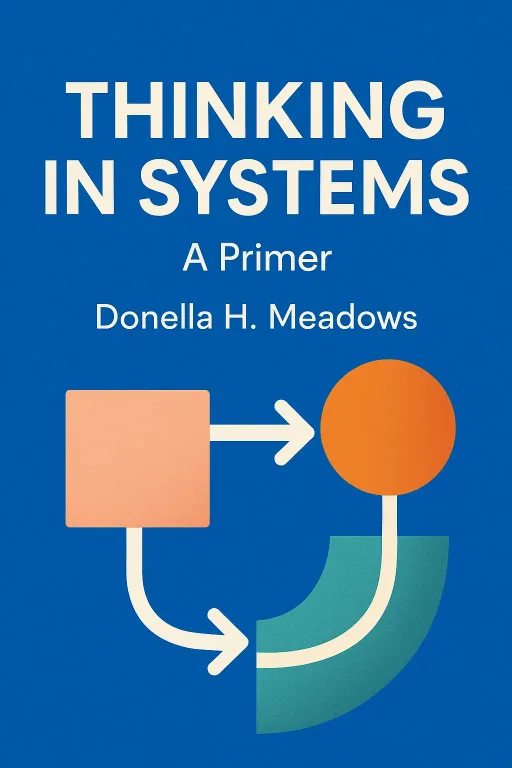
Nova: Absolutely. Today, we're diving into the profound wisdom found in the world of systems thinking, particularly through the lens of two seminal works: Donella H. Meadows' "Thinking in Systems" and Peter M. Senge's "The Fifth Discipline." Meadows' work, in particular, is often considered foundational text for understanding how everything is connected, a book that has shaped countless approaches to environmental policy, organizational change, and even personal development, long after her passing.
Atlas: Wow. So it’s not just some academic theory, but something that actually has real-world teeth, as you said. It sounds like it’s about seeing beyond the immediate, which is often so hard to do.
Nova: Exactly. And that naturally leads us into our first core idea: unveiling the hidden architecture that governs our world, and how understanding it can lead to truly lasting change.
Unveiling the Hidden Architecture: Understanding Systems for Lasting Change
SECTION
Nova: Many of us, when faced with a problem, tend to focus on the most obvious, isolated symptom. We see traffic, we build more roads. We see a lack of housing, we build more units. But systems thinking, as Meadows so brilliantly lays out, teaches us that this often misses the underlying dynamics.
Atlas: Right, like trying to treat a persistent cough without realizing it's a symptom of something much deeper, a lung infection, or even just allergies. We’re so focused on the cough, we miss the cause.
Nova: Precisely. Let's imagine a bustling city, let's call it Veridia. The city council is desperate to reduce traffic congestion. Their solution? Build a massive new highway, expanding capacity significantly. On the surface, this feels like a logical, direct fix, right? More roads, more space, less traffic.
Atlas: That makes sense. That’s what most people would intuitively think. I mean, we’ve all been stuck in traffic, wishing for another lane to magically appear.
Nova: For a short period, it works. Traffic eases, commuters cheer. But then, something subtle starts to happen. With the new, faster highway, more people decide to drive instead of taking public transport or carpooling. Businesses start to spread out, relying on easy highway access. Developers build new suburbs further away, because the commute is now "manageable."
Atlas: Oh, I see where this is going. So the very solution they put in place starts to encourage more of the behavior it was meant to solve?
Nova: Exactly! It's a classic example of a "reinforcing feedback loop." The new highway, intended to solve congestion, actually more demand for driving, which eventually brings congestion right back, often worse than before. The system adapts to the "fix," rendering it ineffective. Meadows would call this "compensating feedback," where an intervention causes a systemic response that counteracts the desired effect.
Atlas: That’s fascinating, and a bit terrifying. So, the "leverage point" wouldn't have been to build more roads? What would it have been?
Nova: A leverage point, in systems thinking, isn't always the most obvious or intuitive place to intervene. It's a point in the system where a small shift can produce large changes in the whole. In our city of Veridia, a true leverage point might have been to heavily invest in robust, efficient public transportation, or to create walkable, bikeable communities, or even to incentivize remote work. These interventions would shift the for driving, rather than just expanding the supply of roads, thereby changing the underlying dynamics of the system.
Atlas: So basically you’re saying, instead of treating the symptom—the traffic jam—they should have looked at what was causing the demand for individual car use in the first place? That’s a fundamentally different way to approach problem-solving. It’s like, for everyone trying to make a real difference, you have to ask, "Am I just patching a leak, or am I turning off the tap?"
Nova: Precisely. And that shift in perspective from patching leaks to turning off taps is what truly unlocks scalable impact. And once you begin to see these hidden architectures, the next step is cultivating the collective intelligence to navigate them.
The Living System: Cultivating Collective Intelligence and Adaptive Growth
SECTION
Nova: This brings us beautifully to Peter Senge’s "The Fifth Discipline," which views organizations not as static machines, but as living systems. If Meadows teaches us to see the system, Senge teaches us collectively. He emphasizes that for true continuous improvement and scalable impact, teams and organizations need to master several disciplines, like personal mastery, shared vision, and team learning.
Atlas: That sounds great on paper, Nova, but how does a team actually "team learning" without just having more meetings that go nowhere? I imagine a lot of our listeners, the "Practical Architects" among them, are thinking, "Okay, but how do I actually this?"
Nova: That’s a perfect question, Atlas. Let’s take a non-profit organization dedicated to combating food waste, for instance. Initially, they might have different departments working in silos: one team collects surplus food, another distributes it, a third works on public education. Each team is doing good work, but their efforts aren't always synchronized. They're building alone.
Atlas: Yeah, I can definitely relate. It’s like everyone’s rowing, but not necessarily in the same direction, or even in the same boat sometimes.
Nova: Exactly. A "living system" approach would shift this. Instead of just individual wins, they start cultivating a "shared vision"—everyone truly understands and commits to the overarching goal of zero food waste, not just their individual task. More importantly, they engage in "team learning." This means regular, open discussions where they collectively analyze why certain food goes to waste, what barriers exist in distribution, and what unexpected challenges arise. They map out their "mental models"—the often-unspoken assumptions they hold about how the system works.
Atlas: So, it’s about actually talking about the failures, and the assumptions, in a way that’s constructive, not just pointing fingers? Can you give an example of how that might look?
Nova: Absolutely. Imagine a team meeting where instead of just reporting numbers, they bring a specific, complex problem to the table—say, why a certain type of produce is consistently spoiling before it reaches recipients. Instead of one person presenting a solution, the team collectively maps out the entire journey of that produce, from farm to plate. They identify all the touchpoints, the potential delays, the temperature fluctuations. They uncover hidden assumptions, like "farmers always sort perfectly," or "recipients always pick up on time."
Atlas: That makes me wonder, how would that be different from a typical brainstorming session?
Nova: The key difference is the deep dive into things are happening, and challenging those mental models. It's not just generating ideas; it's about developing a shared understanding of the problem's root causes and the system's dynamics. They might discover a tiny change at the farm level, like improved packaging, has a huge ripple effect on spoilage, distribution efficiency, and educational messaging. This collective understanding allows them to identify those leverage points together, and adapt their strategy dynamically, just like a living organism responding to its environment.
Atlas: So, for our "Curious Explorers" who love to dive deep, this isn't just about individual deep dives anymore. It's about combining those insights into a collective, evolving intelligence. It’s like a hive mind, but a really healthy, productive one.
Synthesis & Takeaways
SECTION
Nova: Precisely. Ultimately, both Meadows and Senge are guiding us to a fundamental truth: if you want to make a truly scalable and sustainable impact, you have to stop building alone and start building systems. It's not about rigid structures, but about understanding dynamics, feedback, and the incredible power of collective intelligence.
Atlas: That’s such a hopeful way to look at it. It takes the pressure off the individual hero and puts it onto the collective, but in a way that feels empowering. The "Tiny Step" from the book content really resonates here: "Map out a current project and identify its key components, showing how they influence one another." How is that simple act actually a powerful leverage point, Nova?
Nova: Because that act of mapping forces you to do exactly what these books advocate. You stop seeing isolated tasks and start seeing connections, identifying the loops, and challenging your own assumptions about how things work. That's the very first step toward finding those leverage points and, crucially, building a shared understanding with others about how to intervene effectively. It’s the genesis of both systems thinking and collective intelligence.
Atlas: I totally know that feeling. It's so easy to get caught in the weeds of individual tasks. But stepping back, seeing those connections… it’s like suddenly seeing the entire blueprint of a building, not just the brick you're laying. That’s truly transformative for anyone driven by making a difference.
Nova: Indeed. So, what systems are you building within, and how might a deeper understanding of their hidden architectures and living dynamics transform your approach?
Nova: This is Aibrary. Congratulations on your growth!