Scaling Beyond Limits: The Systems Thinking Advantage
Golden Hook & Introduction
SECTION
Nova: Atlas, if I told you that the biggest problem most scaling businesses face isn't competition, or market shifts, or even a lack of talent, but something entirely invisible to most leaders, what would your first thought be?
Atlas: Huh. Invisible. My first thought is probably that it sounds like a riddle wrapped in an enigma, which usually means it's either incredibly simple or mind-bendingly complex. And knowing us, it's probably the latter. What kind of invisible force are we talking about here? Ghostly executives? Supply chain goblins?
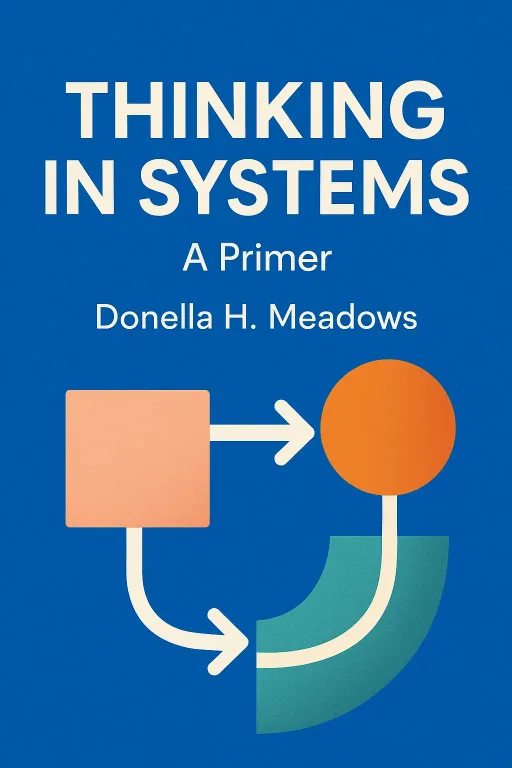
Nova: Even more insidious, I'd say. We're talking about the unseen systemic flaws that quietly sabotage growth, turning every step forward into two steps sideways. And it’s this precise challenge that two seminal works, Donella H. Meadows’ "Thinking in Systems" and Peter Senge’s "The Fifth Discipline," help us to not just see, but to actually master.
Atlas: "Thinking in Systems" by Donella H. Meadows. That book, I remember reading, was almost like a philosophical treatise on how the world works, not just business. And Senge's "The Fifth Discipline" built on that, right? I recall it being a cornerstone of organizational learning for decades. Many consider it essential reading for anyone serious about building an enduring company.
Nova: Exactly. Meadows, a brilliant environmental scientist and system analyst, essentially laid the groundwork for understanding how everything from ecological systems to economic markets operate. Her work, though academic, profoundly shifts how you view problems. And Senge, a senior lecturer at MIT, translated much of that into the organizational context, making it digestible for business leaders.
Atlas: So this isn’t just some trendy management fad. We’re talking about foundational principles here, from some seriously heavy hitters. I'm already intrigued by this idea of "unseen systemic flaws." It sounds like something that could plague anyone trying to build something significant, especially those aiming for exponential growth.
Unseen Systemic Flaws: The Wall to Scaling
SECTION
Nova: It absolutely does. Think about it this way: you’re building a magnificent skyscraper. You’ve got the best architects, the strongest steel, the most skilled construction workers. But if the very earth beneath your foundation has a hidden fault line, that skyscraper, no matter how impressive, is eventually going to hit a wall, or worse, crumble.
Atlas: That’s a powerful analogy. I imagine a lot of our listeners, the scaling architects and legacy builders, have felt that invisible tremor. They're pushing hard, innovating, but the growth feels… sticky. Like they’re constantly patching leaks instead of building a watertight ship.
Nova: Precisely. The cold fact, as our source material puts it, is that scaling a business often hits a wall not because of a lack of effort, but because of these unseen systemic flaws. You're building, and sometimes the foundations aren't as robust as they need to be to support exponential growth.
Atlas: So, what does a "systemic flaw" actually look like in a business context? Can you give an example? Because for someone focused on quarterly targets, it’s easy to just see a dip in sales or a talent drain as isolated problems.
Nova: Absolutely. Take a common scenario: a rapidly growing tech startup. They're hiring fast, products are flying off the shelves. But soon, customer support wait times skyrocket. The immediate fix? Hire more customer support reps. But the problem persists, maybe even worsens.
Atlas: Oh, I've seen that movie before. It's like pouring water into a leaky bucket, just faster.
Nova: Exactly. A systems thinker would ask: why are wait times increasing in the first place? They might discover a complex feedback loop. The sales team, incentivized solely by new customer acquisition, is selling a product that's still buggy or has unclear features. This leads to more support tickets. The support team gets overwhelmed, leading to longer wait times, which then frustrates customers, leading to complex tickets as they get angrier. Meanwhile, product development is under pressure to release new features, not fix existing ones, because that's incentive.
Atlas: Wow. So the 'flaw' isn't just the understaffed support team, it's the entire interconnected web of incentives, communication breakdowns, and product issues that are all feeding into each other. It’s like a corporate hydra, cut off one head and two more grow.
Nova: Exactly. Meadows would call these "feedback loops." They can be reinforcing, making problems worse, or balancing, trying to stabilize the system. The issue is, most leaders are only seeing the output of the loop—the long wait times—and not the loop itself. They’re fixing symptoms, not the underlying structure.
Atlas: That's why the "Tiny Step" recommendation from our source is so brilliant: "Identify one recurring problem in your business. Diagram its causes and effects to uncover the underlying system structure, not just the visible symptoms." It forces you to draw the connections.
The Power of Systems Thinking: From Symptoms to Solutions
SECTION
Nova: And that naturally leads us to the second key idea, which is the actual power of systems thinking itself. "Thinking in Systems" by Donella Meadows fundamentally shifts how you approach growth, moving from fixing symptoms to designing resilient, self-optimizing systems.
Atlas: That sounds like a superpower, honestly. Moving beyond firefighting. Because many leaders, especially in high-growth environments, feel like all they do is put out fires. They're so busy responding to crises, they never get to build.
Nova: Peter Senge, in "The Fifth Discipline," takes this further by emphasizing that organizations are living systems. He argues that learning to see the 'whole' rather than just the parts allows for more effective intervention and fostering a true learning organization. He’s talking about understanding the 'leverage points' within these systems.
Atlas: Leverage points. What does that mean in practice? Is it like finding that one small change that has a massive ripple effect throughout the entire system?
Nova: Precisely. Imagine a seesaw. You can push hard on one end and exert a lot of effort to lift the other, or you can find the fulcrum—the leverage point—and with minimal effort, achieve a much greater effect. In a system, a leverage point is a place where a small shift can lead to large changes in the overall system behavior.
Atlas: So, going back to our customer support example, hiring more reps is just pushing harder on one end. What would a leverage point be there?
Nova: A systems thinker might identify a leverage point in the product development process. Perhaps by investing in a more robust quality assurance team, or by implementing clearer feature documentation launch, they could drastically reduce the number of support tickets generated in the first place. Or even better, by changing the incentive structure for sales to reward customer retention and satisfaction, not just acquisition.
Atlas: That’s fascinating. It’s about understanding the interconnectedness, not just the individual components. It speaks directly to the user profile of the "AI Alchemist" or "Legacy Builder" – someone who sees patterns and aims for significant, enduring growth. They’re not just looking for a quick fix; they want to build something that lasts.
Nova: Exactly. Senge's work highlights that these learning organizations, these "living systems," continuously adapt and evolve because they understand these feedback loops and leverage points. They are always learning, always self-optimizing. It’s a profound shift from a mechanistic view of business to an organic one.
Atlas: So it’s not just about solving problems, it’s about designing systems that prevent problems, or at least learn from them rapidly. It’s about building resilience inherently into the structure. That's a mind-shift from reactive to proactive, from isolated fixes to integrated design.
Synthesis & Takeaways
SECTION
Nova: And that's the profound insight these books offer. They equip you with a lens to see past the noise, past the symptoms, and into the very DNA of your organization. It’s about recognizing that every part influences every other part, and true mastery comes from understanding those interactions.
Atlas: What really strikes me is that this isn't just about business efficiency. It's about a deeper understanding of how the world works, and how we can influence it more effectively. For anyone driven by impact, for anyone who wants to build something truly enduring, this is essential. It moves you from a tactical mindset to a strategic one, from observer to architect.
Nova: It truly does. It's about embracing complexity, rather than being overwhelmed by it. And the tiny step of diagramming one recurring problem's causes and effects – that's where it all begins. That first diagram can be the first step to seeing the invisible and ultimately, scaling beyond limits.
Atlas: I imagine a lot of our listeners are already thinking about that one problem in their business, or even their life, that just keeps coming back. This gives them a powerful new way to approach it. A way that promises not just a temporary fix, but a fundamental shift.
Nova: It’s not just a fix; it’s an evolution. And it’s a journey worth taking.
Atlas: Absolutely. This is Aibrary. Congratulations on your growth!