The Trust Equation: Building Cohesion and Psychological Safety
Golden Hook & Introduction
SECTION
Nova: Most people think of trust as a warm, fuzzy feeling. Something nice to have, maybe a bonus. But what if I told you that a lack of trust is literally costing organizations millions, slowing down every project, and stifling innovation? It's not just a feeling; it's a cold, hard economic equation.
Atlas: Whoa, that's a bold claim, Nova. Costing millions? I can definitely see how a lack of trust could gum up the works, create friction in a team, or make communication difficult. But to put a dollar figure on it, or to say it's an economic imperative? That feels… aggressive. How does something as abstract as trust get quantified that way?
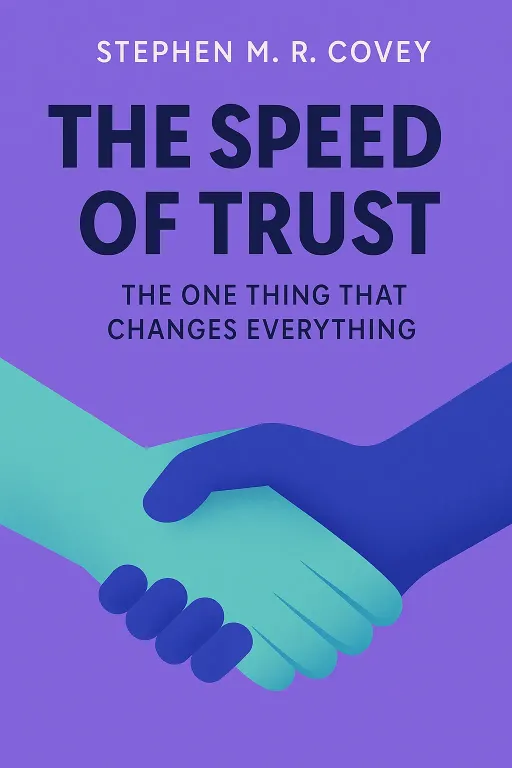
Nova: It’s aggressive because it’s true, Atlas. And our exploration today dives into exactly that, thanks to two groundbreaking thinkers. First, we'll unpack "The Speed of Trust" by Stephen M. R. Covey. Now, Covey isn't just another business guru; he's the son of Stephen Covey, the legendary author of "The 7 Habits of Highly Effective People." Stephen M. R. built on his father's legacy by zeroing in on trust not as a moral virtue alone, but as a measurable, actionable leadership competency that directly impacts the bottom line. He really bridges that gap between ethical leadership and tangible business results.
Atlas: So, he’s taking something that feels inherently human and making it analytical. I'm intrigued.
Nova: Exactly. And then we’ll layer that with the insights from Amy Edmondson’s "Teaming: How Organizations Learn, Innovate, and Compete in the Knowledge Economy." Edmondson, a Harvard Business School professor, made this incredible, counterintuitive discovery. Her pioneering research on psychological safety actually started because she noticed that the most successful hospital teams reported errors, not fewer.
Atlas: That's fascinating. So, the teams that seemed to be messing up more were actually the good ones? My initial thought as a strategist would be to minimize errors, not encourage reporting them. That’s definitely a head-scratcher.
Nova: It is! And that led her to uncover the profound truth that these teams weren't making more mistakes; they were simply more willing to admit them because they had a culture where people felt safe to speak up. It’s a game-changer. Both Covey and Edmondson pull back the curtain on how building trust, whether through character and competence or through psychological safety, fundamentally unlocks a team's potential.
Trust as an Economic Imperative
SECTION
Nova: So let's start with Covey and this idea of trust as an economic imperative. He argues that trust isn't a soft skill; it's the single most critical leadership competency. And here's the crucial part: it’s quantifiable. He talks about the "trust tax" and the "trust dividend."
Atlas: The "trust tax" and "trust dividend"—I like that framing. It makes it sound less like a philosophical concept and more like something you'd see on a balance sheet. But how does this tax or dividend manifest in day-to-day operations? For someone trying to align a strategic team, how does "character" or "competence" actually impact their quarterly reports?
Nova: Great question. Let's imagine two scenarios. In the first, you have a team launching a new product. There's low trust between the marketing department and the engineering team. Engineering thinks marketing constantly overpromises; marketing thinks engineering always under-delivers.
Atlas: Oh, I've seen that movie before. The finger-pointing starts before the project even kicks off.
Nova: Precisely. So, every decision is second-guessed, every email is scrutinized for hidden agendas. They spend hours in meetings clarifying, documenting, and re-documenting because no one implicitly trusts the other's word or ability. The project gets delayed, resources are wasted on redundant checks, and missed deadlines incur real financial penalties. That, Atlas, is the "trust tax." It slows everything down and drives up costs.
Atlas: I see. So, the friction isn't just emotional; it’s operational. It translates directly into wasted time and resources. For someone focused on strategic communication, that's a nightmare. You can communicate all you want, but if the underlying trust isn't there, every message is met with suspicion.
Nova: Exactly. Now, flip that. Imagine a high-trust environment. Marketing knows engineering is competent and has their back, engineering trusts marketing to accurately represent their capabilities. When a problem arises, they jump straight to solving it, not assigning blame. They share information freely, anticipate needs, and move with incredible speed. Decisions are made faster, fewer reworks are needed, and innovation flourishes because people aren't afraid to share half-baked ideas. That's the "trust dividend"—it accelerates everything and lowers costs.
Atlas: That's a perfect example. It's like having a high-speed internet connection versus dial-up for your business operations. The character part, though—Covey emphasizes integrity and intent. How do leaders actively build that within a team, especially one that might be inherently skeptical or has a history of broken trust?
Nova: That's where Covey's framework really shines. It's about consistent behavior. Integrity is about doing what you say you'll do, being honest. Intent is about genuinely caring about others' success, not just your own. A leader builds character by demonstrating transparency, by being vulnerable, and by genuinely listening to concerns, even when it’s difficult. It’s about showing up consistently as someone who is reliable and has good intentions.
Atlas: So, it's not just about a one-off speech; it's a sustained effort. It’s about walking the talk, day in and day out, to prove you’re not just saying the words but living them. That makes perfect sense for someone looking to lead effectively and connect with their team.
Psychological Safety for Innovation
SECTION
Nova: And speaking of leading effectively and connecting with teams, that naturally leads us to the second crucial layer of this trust equation, one that Amy Edmondson unearthed through some truly fascinating research: psychological safety. It’s the bedrock of innovation and learning in any organization.
Atlas: Psychological safety is a term I hear a lot, but I think many people still struggle to define it beyond "being nice." You mentioned Edmondson's work with hospitals—that's a high-stakes environment where mistakes can be catastrophic. How did she connect error reporting to psychological safety?
Nova: She found that in the best hospital units, nurses and doctors weren't making fewer mistakes; they were reporting of them. This wasn't because they were careless, but because they felt safe enough to admit errors, learn from them, and prevent future ones. Psychological safety, as she defines it, is the shared belief held by members of a team that the team is safe for interpersonal risk-taking.
Atlas: So you're telling me that a team that is actually? That seems incredibly counterintuitive for a strategist focused on efficiency and minimizing risk. How do you create that environment without just encouraging sloppiness or a lack of accountability?
Nova: That's the key distinction, Atlas. Psychological safety is not about lowering performance standards or ignoring accountability. It’s about creating an environment where people feel comfortable being vulnerable, asking questions, challenging the status quo, and admitting mistakes without fear of punishment or humiliation. Consider a product development team. In a low-psychological-safety environment, a junior engineer might notice a critical flaw in a new design but stay silent, fearing ridicule from a senior colleague or a negative impact on their performance review.
Atlas: Oh, I've definitely seen that dynamic. The "shoot the messenger" mentality. It stifles innovation because people self-censor. They become less engaged, less creative, and ultimately, the organization suffers from a lack of diverse perspectives.
Nova: Exactly. That small, unvoiced concern could lead to a massive recall later, costing the company millions. Now, in a high-psychological-safety environment, that same junior engineer feels empowered to raise the concern. The team discusses it openly, finds a solution, and the product launches successfully. That's innovation born from safety, not despite it. Edmondson explains that leaders can actively cultivate this. It starts with framing the work as a learning problem, not just an execution problem. Leaders need to acknowledge their own fallibility – saying things like, "I might miss something here, so I need your input."
Atlas: That's powerful. Admitting you don't have all the answers. It reminds me of the idea of "influential storytelling" – if a leader can tell a story about a mistake they made and how they learned from it, it creates a space for others to do the same. It’s about vulnerability as a strength.
Nova: Absolutely. And it's also about modeling curiosity, asking questions, and actively soliciting diverse viewpoints. It ties back to conflict resolution, too. When there's psychological safety, disagreements become productive debates aimed at finding the best solution, rather than personal attacks or suppressed resentments. People can navigate difficult conversations with grace because they trust that everyone is operating with good intent and aiming for shared success.
Atlas: It sounds like both Covey and Edmondson are ultimately saying that trust, in its various forms, creates the conditions for peak performance. Whether it's the economic benefits of fast, high-trust execution or the innovative leaps that come from psychologically safe teams, it all circles back to people feeling safe and respected enough to bring their full selves to the work.
Synthesis & Takeaways
SECTION
Nova: Precisely, Atlas. Covey gives us the framework for building trust through character and competence, which fuels efficiency and speed. Edmondson shows us how psychological safety unleashes learning and innovation, transforming potential into progress. Together, they paint a complete picture of why trust is the bedrock of effective communication, team performance, and ultimately, sustained success.
Atlas: So, for our listeners who are navigating complex team dynamics or trying to foster better collaboration, this isn't just theoretical. It's about tangible actions. And I keep coming back to that deep question from our material: "Consider a recent team interaction where trust could have been higher. What specific action, based on character or competence, could you have taken to build it?"
Nova: That's such a critical question, and it brings it all home. When you reflect on that interaction, ask yourself: Was it a character issue? Did I clearly communicate my intent, or did I perhaps not follow through on a commitment, even a small one? Or was it a competence issue? Did I not demonstrate the capability needed, or did I fail to communicate my skills effectively? Pinpointing that specific action, whether it's being more transparent, admitting a mistake, or simply delivering on a promise, is where the real growth happens.
Atlas: It makes me think that strategic communication isn't just about what you say, but how you live your values and demonstrate your abilities. And influential storytelling becomes the way you share those experiences, both successes and failures, to build that collective trust and safety.
Nova: Exactly. Because when trust is high, everything moves faster, everything costs less, and innovation isn't just possible—it's inevitable. It's the ultimate accelerator.
Atlas: That's a powerful thought to leave our listeners with. Thank you, Nova, for shedding such insightful light on these crucial concepts.
Nova: My pleasure, Atlas. Always a great conversation.
Atlas: This is Aibrary. Congratulations on your growth!