The Architecture of Meaning
Golden Hook & Introduction
SECTION
Nova: Peak performance isn't just about grinding harder. It's about finding a hidden connection. And here's the kicker: it's probably right under your nose, waiting to be discovered.
Atlas: Oh, I love that. A hidden connection? My ears are definitely perked for this. Because honestly, Nova, sometimes "grinding harder" feels like the option, especially when you're trying to make a real impact.
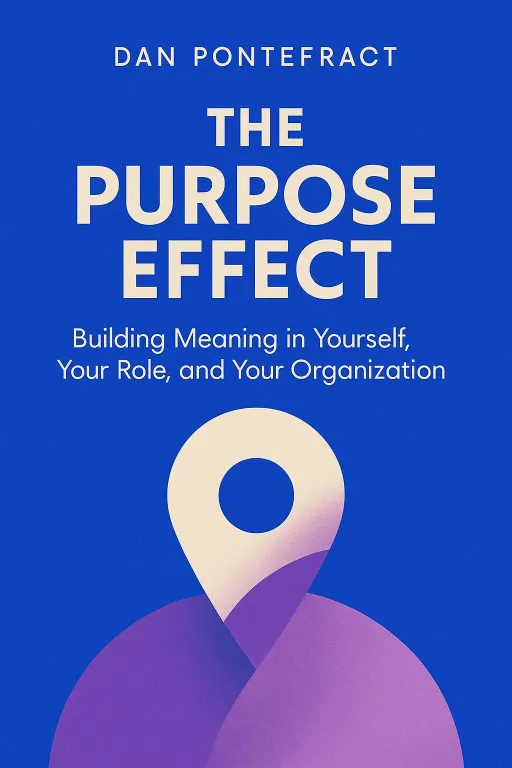
Nova: It's a feeling many share, Atlas. And today, we're diving into "The Architecture of Meaning," exploring two brilliant minds who unpack this very idea: Dan Pontefract with "The Purpose Effect" and Nikos Mourkogiannis with his impactful work, "Purpose." Pontefract, known for his transformative work in organizational leadership and culture, gives us a practical framework. Mourkogiannis, a strategic thinker focused on ethics and enduring success, reveals how historical giants were built on more than just profit.
Atlas: That's a fascinating pairing. One sounds like the 'how-to' for individuals, and the other, the 'why' for entire enterprises. But how do these two ideas, this individual 'purpose effect' and a grand 'moral purpose,' actually connect? Is it just two sides of the same coin, or something deeper?
Nova: It's definitely deeper, and they absolutely inform each other. They connect at the very heart of what drives us, both personally and professionally. And Dan Pontefract gives us a fantastic starting point with what he calls the 'Sweet Spot' of productivity.
The Sweet Spot of Individual Purpose
SECTION
Nova: Imagine a Venn diagram, Atlas, with three overlapping circles. The first circle is your —what genuinely motivates you, your deepest values, what you believe in. The second is your —how your specific job contributes to the organization's goals. And the third is the —the company's overarching mission, its reason for existence beyond just making money.
Atlas: That makes sense. So, the 'Sweet Spot' is where all three of those align? Where your personal drive, your daily tasks, and the company's mission are all pulling in the same direction?
Nova: Exactly! When those three circles intersect, that's Pontefract's Sweet Spot. It’s where you experience peak engagement, fulfillment, and, yes, productivity. It’s not about working longer hours; it’s about working with profound meaning. Think about it: when you deeply believe in what you're doing, and you see how your specific actions contribute to a larger, meaningful goal, your motivation shifts from external rewards to internal drive.
Atlas: Okay, but how often does that happen? For listeners in high-stakes environments, like healthcare, this might sound like a utopian dream. You're often just trying to keep your head above water, dealing with immediate crises. Finding your 'personal purpose' while managing a critical patient case can feel like a luxury.
Nova: That's a powerful and completely valid point, Atlas. It's rarely easy. But the power lies in those intersections, even small ones. Consider a seasoned nurse, let's call her Elena. Her personal purpose might be to alleviate suffering and bring comfort. Her role purpose is to administer medication, monitor vitals, and communicate with families. The organizational purpose of her hospital is to provide compassionate, cutting-edge care.
Atlas: So, Elena might feel overwhelmed by the daily grind – the paperwork, the long shifts. But if she connects giving a comforting word to a scared patient to her personal value of alleviating suffering, and sees how that contributes to the hospital's mission of compassionate care... that's the sweet spot?
Nova: Precisely. It’s not about grand, sweeping gestures every day. It's about recognizing how those seemingly small, routine tasks are imbued with meaning when connected to your deeper values and the organization's mission. Elena isn't just administering medication; she's part of a healing process, upholding dignity, and contributing to the well-being of her community. That connection transforms the work itself.
Atlas: I see. It’s less about waiting for purpose to strike you like lightning and more about actively seeking out and strengthening those connections. That gives me a lot to think about. For our listeners who are managing high-pressure teams, or feeling a bit disconnected themselves, what's one concrete step they can take to start finding that intersection, especially when their daily tasks feel like a grind?
Nova: A great starting point is what I call the "Why Five." Take five minutes today, not next week, but today, to identify one way of your daily tasks, no matter how small, contributes to a larger societal improvement you genuinely believe in. Just one. For Elena, it might be, "My charting today ensures continuity of care, which supports patient safety, a societal good I deeply value." It's about consciously drawing that line.
Atlas: That's a powerful challenge. It turns the abstract into something tangible. It’s about shifting perspective, really. Not just what you do, but it matters, and how that aligns with who you are and what the organization stands for. That makes perfect sense.
The Moral Compass of Corporate Success
SECTION
Nova: And that naturally leads us to a broader, perhaps even more profound, aspect of purpose that Nikos Mourkogiannis explores in his book, "Purpose." While Pontefract focuses on the individual's sweet spot, Mourkogiannis argues that the most successful, enduring companies are driven by what he calls a 'moral purpose' rather than just chasing financial targets.
Atlas: Hold on. In a world obsessed with quarterly earnings, aren't we just talking about good PR? Can a 'moral purpose' truly drive financial success in the long run, or is it just a nice-to-have when times are good? That sounds a bit out there for some of our more hard-nosed strategists listening.
Nova: That's the conventional wisdom, isn't it? That business is purely about profit. But Mourkogiannis challenges that by looking at historical cases. He contends that companies with a clear, deeply embedded moral purpose—a sense of what they stand for, beyond what they sell—outperform in the long run. It's not about being 'nice'; it's about having a fundamental guiding principle that informs every decision, especially during a crisis.
Atlas: Can you give an example? Because it's hard to imagine a multinational corporation genuinely putting 'moral purpose' ahead of the bottom line when push comes to shove.
Nova: Absolutely. The classic case Mourkogiannis, and many others, point to is Johnson & Johnson during the Tylenol crisis in 1982. Seven people died after consuming Tylenol capsules laced with cyanide. The natural, profit-driven response might have been to recall only the affected batches, or to issue cautious statements while lawyers got involved. But J&J had a deeply ingrained Credo, written decades earlier, that explicitly stated their first responsibility was to the doctors, nurses, patients, mothers, and fathers who use their products.
Atlas: So, what did they do?
Nova: They immediately initiated a nationwide recall of 31 million bottles of Tylenol, a decision that cost them over $100 million at the time, which was a staggering amount. They also worked with law enforcement, implemented tamper-resistant packaging, and pioneered new safety standards for the entire industry. It was an unprecedented move, driven by that core moral purpose of protecting their consumers, even at immense short-term financial cost.
Atlas: Wow. That's incredible. Most companies would have folded under that kind of pressure, or at least tried to minimize the damage quietly. So, the moral purpose wasn't just a slogan; it was a non-negotiable operating principle. And what was the outcome? Did it pay off?
Nova: It absolutely did. The financial analysts at the time predicted the end of Tylenol. Yet, within a year, J&J had not only recovered but regained its market share. Why? Because consumers saw their unwavering commitment to safety. That moral purpose built an unshakeable foundation of trust that far outweighed the immediate financial hit. It became a benchmark for crisis management and ethical leadership.
Atlas: That's a powerful story. It makes me wonder, for a company today, how do you even that core moral purpose? Is it something you discover, or something you consciously create and then embed into the culture? Especially for leaders trying to elevate their professional impact and foster team cohesion.
Nova: Mourkogiannis would argue it's a bit of both, but primarily it's about the inherent good your organization brings to the world, and then to that as your primary driver. It’s about asking: "What problem do we uniquely solve that genuinely improves lives or society?" and "What values are non-negotiable for us, even if they cost us short-term profits?" Leadership plays a critical role in articulating and championing this purpose, making it the company's moral compass. It's not just about what you produce; it's the positive impact you're striving for.
Synthesis & Takeaways
SECTION
Nova: So, whether we're talking about Elena finding her 'Sweet Spot' in healthcare or Johnson & Johnson navigating a crisis with a moral compass, the thread connecting them is purpose. It’s the ultimate connective tissue, giving meaning to individual effort and strategic direction to entire enterprises.
Atlas: It truly is. It's almost like the individual sweet spot is how we personally plug into that larger moral grid. If a company has a strong moral purpose, it makes it easier for individuals within that company to find their own sweet spot. And conversely, if individuals are pursuing their personal purpose, they'll naturally gravitate towards organizations that align with those deeper values.
Nova: Exactly! It creates a virtuous cycle. And this brings us back to our challenge for our listeners, especially those in healthcare, who are driven by impact and progress. Our takeaway today, inspired by both Pontefract and Mourkogiannis, is to take five minutes today to identify one way your daily tasks in healthcare contribute to a larger societal improvement you believe in.
Atlas: That's a powerful challenge. It’s not just about what you, but you do it, and how that ripples outwards to create real, tangible progress. It's about making those conscious connections. That's a step towards not just feeling more fulfilled, but truly elevating your impact.
Nova: It is. Recognizing that connection can be incredibly motivating and clarifying. It reminds us that even in the most demanding roles, our work can be imbued with profound meaning.
Atlas: This has been incredibly insightful, Nova. It's a reminder that purpose isn't just a buzzword; it's the fundamental architecture of a meaningful life and a successful organization.
Nova: Couldn't agree more, Atlas. And for everyone listening, thank you for joining us on this exploration of meaning. We hope this sparks some deep reflection for you.
Atlas: We'd love to hear how you identify your own sweet spot or the moral purpose you see in your work. Share your insights with us!
Nova: This is Aibrary. Congratulations on your growth!