The 'DevOps' Trap is a Myth: Why You Need a Culture of Continuous Flow.
Golden Hook & Introduction
SECTION
Nova: Atlas, quick question for you. When I say "DevOps trap," what's the first image that pops into your head?
Atlas: Oh, the DevOps trap? That's easy. It's the moment you realize you've spent six months implementing a shiny new CI/CD pipeline, only for the ops team to still be manually deploying everything on a Friday afternoon, praying to the server gods. It’s the digital equivalent of buying a Formula 1 car and then driving it exclusively in rush hour traffic.
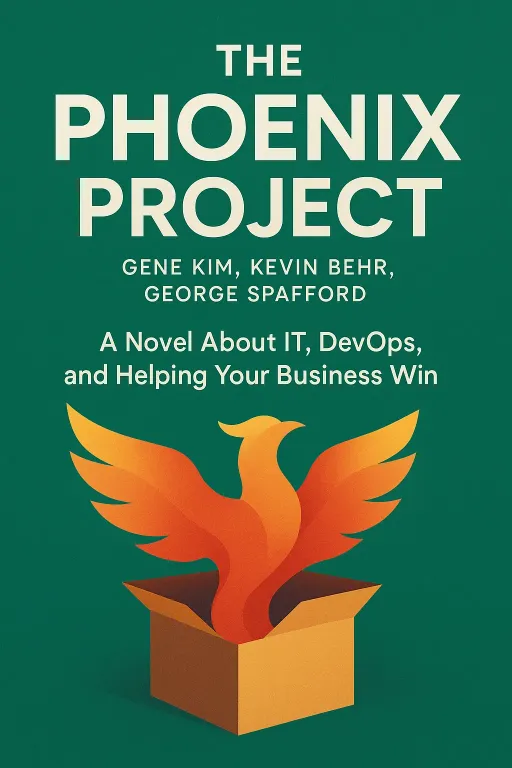
Nova: Exactly! It's that feeling of pushing a rope up a hill, where all your efforts for efficient delivery somehow get swallowed by an invisible force. And that invisible force is what we're dissecting today, through the lens of two foundational books: "The Phoenix Project: A Novel About IT, DevOps, and Helping Your Business Win" by Gene Kim, Kevin Behr, and George Spafford, and "Accelerate: The Science of Lean Software and DevOps" by Nicole Forsgren, Jez Humble, and, again, Gene Kim.
Atlas: Gene Kim, that name rings a bell. What’s his deal?
Nova: Well, Gene Kim isn't just an author; he’s a former CTO and security researcher. His background is deeply rooted in information security and technology operations. He’s lived in the trenches of IT, which gives his work a rare blend of technical depth and practical, real-world experience. He's not just theorizing; he's been there, done that, and seen the chaos firsthand. It’s why his books resonate so strongly with anyone who’s ever faced the daily grind of IT.
Atlas: That makes sense. It’s one thing to talk about theoretical improvements, quite another to have actually navigated the minefield of legacy systems and siloed teams. So, he’s seen the trap up close.
The 'DevOps' Trap: Tools vs. Culture
SECTION
Nova: He has, and that leads us directly into our first core idea: the 'DevOps' trap itself. Many organizations, despite their best intentions, fall into this blind spot. They see DevOps as a shopping list of tools—automated testing, continuous integration, infrastructure as code—or a set of practices to implement.
Atlas: Oh, I imagine a lot of our listeners can relate to that. The pressure to "do DevOps" often translates into management asking, "Have we bought the right tools yet?" rather than, "Are we actually working together better?"
Nova: Precisely. It’s like believing that simply owning a guitar makes you a rock star. The tools are essential, but they're just instruments. Without understanding the underlying principles, the culture of collaboration, and the shared responsibility, those tools become shelfware. You end up with highly sophisticated, often expensive, solutions that don’t actually solve the core problem of inefficient delivery.
Atlas: Wait, are you saying that all the investment in these tools is essentially wasted if the culture isn't there? That sounds a bit harsh, but I can see how it happens. As someone driven by tangible impact, I always want to see the new thing built, the new system deployed. But if the human element is missing, I can see how that effort gets undermined.
Nova: It’s not wasted, but its potential is severely limited. Think of Bill, the protagonist in "The Phoenix Project." He gets promoted to VP of IT Operations, inheriting a nightmare project called "Phoenix." The company's future hinges on it, but everything is constantly breaking, deadlines are missed, and the development and operations teams are perpetually at war.
Atlas: Oh man, I know that feeling. The blame game, the finger-pointing. It’s a classic scenario for anyone who’s been in a high-stakes tech environment.
Nova: Exactly. The book vividly illustrates how operational silos and miscommunication sabotage efficiency, not just the technical debt. Developers are throwing code over the wall to operations, ops is constantly dealing with fires, and neither truly understands the other's world. There’s no shared context, no empathy. The tools they have, like change management systems, become bottlenecks rather than enablers because the culture around them is broken.
Atlas: So basically you’re saying the 'DevOps trap' is believing that technology alone can fix people problems. And the cost of that is not just missed deadlines, but a complete breakdown of trust and productivity. It's like trying to build a beautiful building, but the architects and the construction crew aren't speaking the same language.
The Three Ways of DevOps: Flow, Feedback, and Continuous Learning
SECTION
Nova: That's a perfect analogy. And "The Phoenix Project" doesn't just show the problem; it illuminates the path out, which is where the "Three Ways" of DevOps come in. The first is
Atlas: Flow. That sounds nice and zen, but what does it actually mean for someone trying to build robust, scalable solutions?
Nova: It means optimizing the entire value stream, from the moment an idea is conceived to when it's delivered to the customer. It's about speeding up the work, making it visible, and eliminating bottlenecks. Imagine a highly efficient manufacturing line versus a chaotic workshop where parts are constantly getting lost or waiting for manual approval. The goal is to move work quickly and smoothly from left to right, minimizing handoffs and delays.
Atlas: So for a developer, it's about not having their code sit in a queue for days waiting for a review or deployment? It’s about getting that feedback loop tightened up.
Nova: Exactly. And that leads us to This is about creating rapid, amplified feedback loops throughout the system. "Accelerate"—which provides data-driven evidence for these principles—shows that high-performing teams prioritize quick detection and learning from issues.
Atlas: How does that actually work in practice? I imagine a lot of our listeners, especially those building new things, are worried about making mistakes. How do you encourage feedback when mistakes are often punished?
Nova: It's a cultural shift away from blame. Instead of a catastrophic failure taking down the entire system, you want to design for small, contained failures that provide immediate, actionable feedback. Think of it like a scientist running experiments. You don't try to get it perfect the first time; you iterate, learn, and adjust. "Accelerate" proves that teams with fast feedback loops have higher deployment frequency, lower lead times for changes, and crucially, lower change failure rates. They're actually stable and reliable because they learn faster.
Atlas: That’s fascinating. So it's not about avoiding failure, but about making failure small, visible, and a learning opportunity. That’s a fundamentally different mindset for a lot of organizations. And the third way?
Nova: This is where the culture truly shines. It’s about creating a culture of psychological safety, where everyone can constantly learn, experiment, and share knowledge without fear. It’s about treating every incident as a learning opportunity, not a chance to find a scapegoat.
Atlas: Okay, so you're saying slower to start, faster to finish, and more stable? That sounds too good to be true for someone just trying to get things done, someone who just wants to build robust, scalable solutions and see them in the wild.
Nova: It sounds counter-intuitive, doesn't it? But "Accelerate" provides the hard data. Teams that embrace these three ways—Flow, Feedback, and Continuous Learning—don't just deliver faster; they deliver higher quality, more stable products, and their employees are more engaged. It’s about building a learning organization that naturally leads to efficient, continuous delivery, rather than forcing it through tools alone.
Synthesis & Takeaways
SECTION
Nova: So, what we've really been talking about today is that the 'DevOps trap' is a myth if you understand that DevOps is fundamentally about culture. It's about those 'Three Ways' – Flow, Feedback, and Continuous Learning – that transform how teams work and interact. It’s about seeing the system, not just the individual parts.
Atlas: It’s clear that without addressing the communication breakdowns and the cultural silos, all the fancy tools in the world won’t save you. For anyone out there who's a builder, an innovator, or a pragmatist, this really emphasizes that the human element is the ultimate architecture.
Nova: Absolutely. And that brings us to our deep question today: Where in your current workflow is communication breaking down between development and operations, and what's one small step you could take to bridge that gap?
Atlas: One small step. I like that. It feels less overwhelming than "overhaul our entire organizational culture." So, what's a tangible first step our listeners can take to start cultivating this culture of continuous flow?
Nova: It’s incredibly simple, yet profoundly effective: identify just one specific communication breakdown you’ve witnessed between development and operations this week. Then, instead of just complaining about it, schedule a 15-minute, informal cross-functional coffee chat—virtual or in-person—with someone from the other side. Just to discuss that one specific issue, no blame, just understanding.
Atlas: A 15-minute coffee chat. That’s brilliantly pragmatic. It’s about building a bridge, one conversation at a time. It’s about making those connections that ultimately lead to better flow and better feedback.
Nova: Exactly. Because continuous flow begins with continuous conversation.
Atlas: That’s a powerful thought to leave our listeners with.
Nova: This is Aibrary. Congratulations on your growth!