The Strategic Playbook: Gaining an Unfair Advantage in AI.
Golden Hook & Introduction
SECTION
Nova: What if I told you that most companies chasing AI aren't actually building a strategy, but simply collecting expensive digital toys? And that the real 'unfair advantage' comes from doing less, but doing it with ruthless clarity?
Atlas: Oh, I like that. "Expensive digital toys." That’s going to resonate with anyone who’s watched their budget disappear into a sea of AI pilot projects that… just kind of float there. For leaders trying to drive competitive advantage, that clarity sounds like a lifeline.
Nova: Absolutely, Atlas. It's easy to mistake activity for strategy, especially in a field as buzzy as AI. Today, we’re cracking open 'The Strategic Playbook: Gaining an Unfair Advantage in AI', a guide that dares us to look beyond the hype and truly understand what it takes to win in this new era.
Atlas: Winning, Nova, that's what every leader is after. Especially when the stakes feel as high as they do with AI. I’m curious, what's the biggest pitfall you see companies falling into when they they're doing AI strategy? Is it just throwing money at the problem?
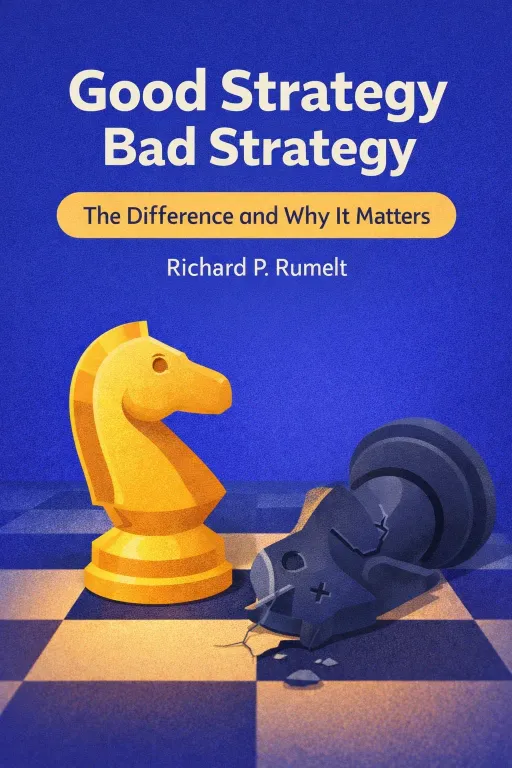
Nova: It often starts that way, doesn't it? But the deeper issue, and what this playbook makes crystal clear, is a lack of what Richard Rumelt calls 'good strategy.' He argues that a truly good strategy isn't just about setting ambitious goals. It's about overcoming specific, identified obstacles with focused, coherent action.
The Essence of Good AI Strategy: Beyond Buzzwords and Towards Coherent Action
SECTION
Atlas: Okay, so a good strategy isn't just a wish list. That makes sense. But how does that apply specifically to AI? Because it feels like every week there’s a new AI tool or framework. How do you even begin to focus?
Nova: Exactly! That deluge of tools is precisely where many go wrong. They see AI as a collection of solutions looking for a problem, instead of the other way around. Rumelt’s framework helps us cut through that noise. It has three parts: first, a diagnosis of the challenge; second, a guiding policy to address it; and third, a set of coherent actions.
Atlas: So basically you’re saying you can’t just say, "We need more AI!" You have to start with the actual pain point. Can you give an example of how this plays out in the AI world?
Nova: Absolutely. Let's imagine a mid-sized retail company, let's call them "TrendSetters," struggling with customer churn. Their online reviews are full of complaints about slow, inconsistent customer support. They're losing loyal customers to competitors who offer faster, more personalized service.
Atlas: Oh, I know that feeling. Nothing’s worse than waiting 20 minutes on hold for a simple question.
Nova: Precisely. So, for TrendSetters, the isn't just "we need AI." It's: "Our current customer support system is a bottleneck causing significant customer frustration and a 15% annual churn rate, especially for common inquiries that could be automated." They’ve identified the specific problem and quantified its impact.
Atlas: That’s a powerful start. It’s about moving beyond vague issues to a precise understanding. What comes next in Rumelt's framework?
Nova: Next is the. This isn't just a goal like "reduce churn." It's a high-level approach to overcome the diagnosed challenge. For TrendSetters, it might be: "Reduce customer churn by 20% within 18 months by providing empathetic, efficient AI-powered support, specifically focusing on instantly resolving common queries, escalating complex issues seamlessly to human agents, and proactively identifying customer sentiment for personalized outreach." Notice how it’s specific, directional, and sets constraints.
Atlas: That’s a great way to put it. It’s not just they want to achieve, but they intend to get there, with AI as a specific lever. But then, the rubber meets the road, right? The actual doing.
Nova: Exactly! That leads us to the. This is where the strategy translates into concrete steps. For TrendSetters, this would involve: investing in a state-of-the-art Natural Language Processing model tailored for retail customer service; meticulously training that model with their specific product data and customer interaction history; seamlessly integrating it with their existing CRM system; upskilling their human agents to handle only the most complex, nuanced customer cases; establishing crystal-clear escalation protocols between the AI and human teams; and, crucially, implementing continuous feedback loops to constantly improve the AI's performance.
Atlas: That’s a perfect example. It’s a whole ecosystem, not just one piece of software. It makes me wonder, how often do companies just skip straight to those "coherent actions" without a clear diagnosis or guiding policy?
Nova: All the time, Atlas. That’s the "bad strategy" Rumelt warns against. It’s mistaking activity—like "we're implementing a new chatbot!"—for actual strategic progress. Without that foundational diagnosis and guiding policy, those actions are scattered, resources drain, and true competitive advantage remains elusive. It’s about making tough choices and committing to a focused approach that leverages your distinct strengths.
Navigating AI Disruption: The Innovator's Dilemma for the Modern Enterprise
SECTION
Atlas: That makes so much sense. It’s about intentionality. And sometimes, Nova, the toughest choices aren't just about to implement strategy, but strategy to pursue when a new wave of tech threatens to upend everything.
Nova: You've hit on a crucial point that brings us to our second big idea, one that Clayton Christensen explored brilliantly in "The Innovator's Dilemma." It’s about how even the most successful, well-run companies can fail by not embracing disruptive technologies early enough. For AI, this is a massive challenge.
Atlas: Oh, I’ve heard about that. Isn’t it about how big companies often miss the next big thing because they’re too good at what they already do?
Nova: Precisely. Christensen’s work shows how companies can become victims of their own success. They listen to their best customers, invest in improving their existing profitable products, and optimize their processes. But then, a "disruptive" technology emerges – often simpler, cheaper, and initially less profitable, appealing to a different, underserved market.
Atlas: So, are you saying success can actually blind you? For leaders trying to drive competitive advantage, how do you even identify these 'disruptive' AI models when they look so unpolished at first? Because if it’s not immediately profitable, it’s a hard sell to the board.
Nova: That's the dilemma! Let's take a hypothetical traditional software company, "LegacySoft," that makes highly customized, on-premise enterprise software. They have a loyal, high-paying client base, and their product is incredibly robust. Now, imagine a new startup, "AI-First," emerges with a cloud-native, open-source AI platform that does 70% of what LegacySoft’s product does, but for a fraction of the cost and with much faster deployment.
Atlas: That sounds rough. LegacySoft’s existing customers probably aren’t clamoring for a cheaper, less powerful version. Why would they cannibalize their own market?
Nova: Exactly! The dilemma for LegacySoft is whether to protect their lucrative existing business, which their current customers love and demand incremental improvements for, or to invest heavily in this initially less profitable, unpolished, AI-driven model that could eventually eat their lunch. The AI-First platform might lack features but it’s fundamentally more scalable, adaptable, and innovative long-term. LegacySoft’s existing business model and customer demands naturally push them away from investing in AI-First.
Atlas: That gives me chills. So, for a company that’s a steward of an established, successful business, how do you make that uncomfortable bet? How do you pivot when everything tells you to keep doing what made you successful?
Nova: It requires immense foresight and courage. It means recognizing that the metrics of success for a disruptive technology are different. It’s knowing when to protect your existing business, yes, but also knowing when to pivot to new, AI-driven models, even if they seem less profitable initially. It's about setting up separate entities, or entirely new strategic units, to nurture these disruptive AI innovations, shielding them from the gravitational pull of the core business. You have to be willing to make those tough choices.
Synthesis & Takeaways
SECTION
Atlas: Wow, those two ideas together paint such a clear picture. On one hand, you need ruthless clarity in your AI strategy, and on the other, you need the courage to embrace disruption, even if it feels counterintuitive. It’s a powerful combination for anyone aiming for meaningful transformation.
Nova: It truly is. The real unfair advantage in AI isn't about adopting every new tool or chasing every trend. It's about combining that Rumeltian strategic discipline—diagnosing, guiding, acting coherently—with Christensen’s insight into disruption. It's about making tough choices, committing to a focused approach that leverages your distinct strengths, and having the courage to pivot when AI-driven disruption calls for it, even if it means cannibalizing your own success. It’s about being intentional, not just active.
Atlas: So, for our listeners, the strategists and innovators out there, what's a 'tiny step' they can take to start building this unfair advantage? To really trust their vision and lead their teams through this?
Nova: Here’s your tiny step, right from the playbook itself: Identify one specific AI challenge your company faces, then map out a simple 'diagnosis, guiding policy, coherent actions' plan for it. Don't try to solve everything at once. Pick one area, apply this framework, and dedicate specific time each week to exploring that new AI application or educating yourself on its potential. That focused, intentional approach is where the real advantage begins.
Atlas: That’s a fantastic, actionable takeaway. It’s about starting small but thinking big and strategically. Thank you, Nova, for shedding such illuminating light on this.
Nova: My pleasure, Atlas. Always a privilege to explore these ideas with you.
Nova: This is Aibrary. Congratulations on your growth!