Stop Chasing Trends, Start Shaping Futures: The Guide to Enduring Impact.
Golden Hook & Introduction
SECTION
Nova: What if everything you've been taught about what makes a company successful is actually a recipe for its eventual downfall?
Atlas: Hold on, Nova, that sounds almost heretical. We're constantly striving for success, building, innovating, but you're telling me that very drive can be a trap? How does that even work?
Nova: It’s the ultimate paradox, Atlas. We’re talking about the cold, hard fact that disruptive change is often completely invisible until it’s too late. Your current offerings, your current success, can become irrelevant if you ignore these subtle shifts. This isn't about chasing trends; it's about shaping futures.
Atlas: Wow. So, if success can be a blindfold, where does this phenomenon actually come from? What's the root cause of this strategic myopia for even the most brilliant minds out there?
The Invisible Tsunami & The Innovator's Dilemma
SECTION
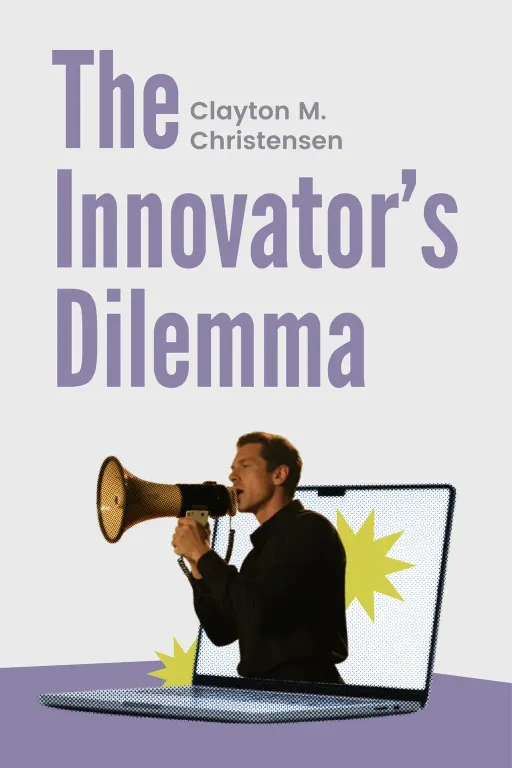
Nova: That's precisely where Clayton M. Christensen comes in, with his groundbreaking work, "The Innovator's Dilemma." Christensen, a truly influential Harvard Business School professor, observed something fascinating: successful companies, often the market leaders, consistently failed when confronted with disruptive innovations.
Atlas: Right, like how does a leader suddenly become an underdog? That seems counterintuitive to everything we understand about market dynamics and strategic planning.
Nova: Exactly! The dilemma is this: these companies failed not because they were poorly managed, but often because they were. They listened too closely to their existing, most profitable customers. These customers demanded better versions of existing products, incremental improvements.
Atlas: So, they were just doing what good businesses do: serving their customers well. What's the problem there?
Nova: The problem is that disruptive innovations usually start in niche, often low-margin markets. Think about the hard disk drive industry in its early days. Major players focused on high-performance, high-margin drives for mainframe computers.
Atlas: Okay, that makes sense. That’s where the money was.
Nova: But then, smaller, nimbler companies started developing much smaller, less powerful, and cheaper drives. Initially, these couldn't compete for the mainframe market. They were "inferior" by the metrics of the established players. But they found a home in nascent markets: desktop PCs, then laptops.
Atlas: I see. So, the big players ignored them because their existing customers didn't want them, and the margins were too low.
Nova: Precisely. They poured resources into improving their high-end products, while the disruptive technology matured in these overlooked niches. By the time the smaller drives were powerful enough to threaten the mainframe market, it was too late. The established giants were too entrenched, too slow, and their entire cost structure was built around the old paradigm. The emotional stakes for those incumbents were huge, watching their dominance erode.
Atlas: But wait, isn't 'listen to your customer' business gospel? Are you saying we should actively ignore our best clients? That sounds like a fast track to bankruptcy for anyone trying to build something impactful, especially if you're trying to shape the future of a field like education.
Nova: It's more nuanced. It’s about understanding customers to listen to and to prioritize. The insights from Christensen tell us that true strategic foresight requires looking beyond the immediate demands of your current customer base and identifying those subtle shifts that are redefining markets at their fringes. It's about spotting the unseen tsunami before it hits.
Atlas: So, for those of us trying to build something meaningful, how do we spot these 'subtle shifts' before they become an existential threat? And once we spot them, how do we actually capitalize on them?
Bridging the Chasm & From Niche to Mainstream
SECTION
Nova: That's exactly where our next insight comes in. Because even when you spot that disruptive shift, the journey from a niche idea to mainstream impact is fraught with peril. This is where Geoffrey A. Moore's "Crossing the Chasm" becomes absolutely indispensable. Moore, with his deep ties to Silicon Valley's tech booms, brilliantly articulated why so many promising innovations fail to gain widespread adoption.
Atlas: I've heard the term "crossing the chasm" before, but what does that really mean in practice? Is it just about marketing?
Nova: It’s far more than just marketing; it's a deep understanding of customer psychology. Moore identifies a massive gap, a "chasm," between early adopters and the early majority. Early adopters are visionaries; they're eager for new technology, willing to tolerate glitches, and driven by the sheer novelty and potential.
Atlas: Right, the enthusiasts who pre-order everything and love being first.
Nova: Exactly. But the early majority? They are pragmatists. They want proven solutions, references, and a complete product. They don't buy into vision; they buy into practical benefits and reliability. Think about the early days of personal computers or even electric vehicles. There were the early enthusiasts, but then there was this huge hurdle to convince the average family or business owner.
Atlas: So, you can have a brilliant, disruptive idea, capture that early adopter market, and still fall into a "valley of death" if you can't convince the pragmatists?
Nova: Precisely. The strategies that work for early adopters actively alienate the early majority. To cross the chasm, you can't just scale up what you were doing. You have to focus intensely on a specific niche within the early majority, create a "whole product" solution for them – meaning not just the core technology, but all the complementary services and support – and then use that beachhead to expand.
Atlas: That makes me wonder: if I'm looking at an emerging AI application, like that tiny step you mentioned earlier, how do I actually this chasm? What's the practical strategy to move from serving a few enthusiasts to genuinely shaping the future for a broader audience, especially in a field like education where impact is everything?
Nova: The key is to pick your battles. Identify specific, underserved customer segment within that early majority that has a compelling reason to adopt your AI solution, even if it's still a bit rough around the edges. Then, you obsess over making that solution perfect for, creating a complete ecosystem around it. It’s about building trust and demonstrating undeniable value to the pragmatists.
Atlas: It sounds like "The Innovator's Dilemma" tells us for the future, and "Crossing the Chasm" tells us with what we find. Is that the 'strategic foresight' Nova's Take was hinting at in the main content?
Synthesis & Takeaways
SECTION
Nova: Absolutely, Atlas. Together, these insights fundamentally solve the problem of strategic foresight. They give us the frameworks to anticipate and act on disruptive forces before they become existential threats. It’s about seeing the future not as an inevitable tide, but as something we can actively sculpt.
Atlas: So, the real impact comes from having the vision to see the invisible shifts, and then the strategy to actually build the bridge to a new future. It’s about proactively building, not just reacting to what’s already happening. For someone driven by impact, particularly in shaping the future of education, this is incredibly powerful.
Nova: Exactly. That's why our tiny step for today is so crucial: identify one niche market where an emerging AI application could serve an overlooked customer need that your current offerings do not address. Dedicate time each week to explore that emerging AI application and map its potential impact. That's how you move from chasing trends to shaping futures.
Atlas: And for those of us driven by impact, especially in fields like education, that foresight, that ability to build responsibly, is absolutely critical for elevating our enterprise influence and truly leading, not just responding.
Nova: This is Aibrary. Congratulations on your growth!