The Infinite Game: Sustaining Vision and Adaptability
Golden Hook & Introduction
SECTION
Nova: What if everything you've been taught about winning is actually setting you up to lose in the long run?
Atlas: Whoa, that’s a bold statement right out of the gate. I mean, isn't winning the whole point? The finish line, the trophy, the market dominance? That’s what we’re told to aim for.
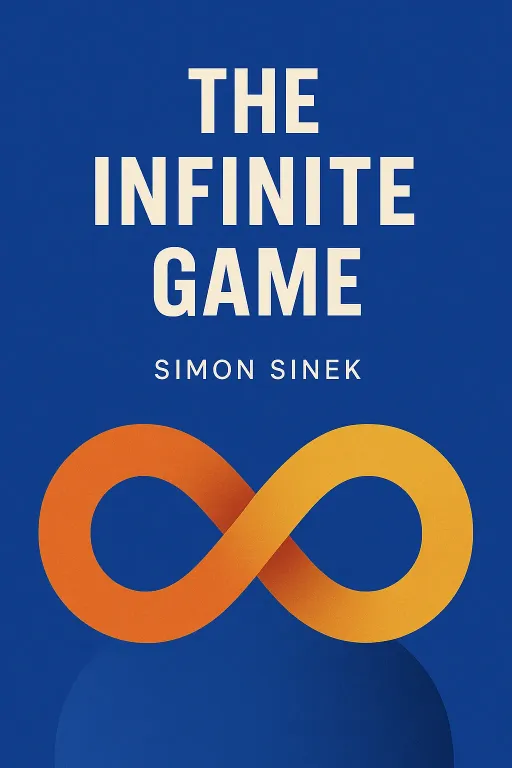
Nova: Exactly! And that conventional wisdom, Atlas, is precisely what Simon Sinek challenges in his profound work, "The Infinite Game." Sinek, a renowned leadership expert and motivational speaker, really built on his wildly popular TED Talks and previous bestsellers to make us question the very nature of our pursuits. He pushes us to look beyond those short-term victories and think about sustained vision.
Atlas: Oh, I like that. Sustained vision. And speaking of challenging conventional wisdom, that perfectly sets the stage for another mind-bending concept we're diving into today: Nassim Nicholas Taleb's "Antifragile: Things That Gain from Disorder." Taleb, a former options trader turned philosopher, is known for his incisive critiques of our understanding of risk, famously introducing the 'Black Swan' idea. And in 'Antifragile,' he takes it a step further, exploring how some systems don't just withstand chaos, they actually become stronger because of it.
Nova: Absolutely. These two books, when brought together, offer such a powerful one-two punch for anyone navigating a world that feels increasingly unpredictable. They fundamentally shift our perspective on what it means to succeed, not just for a moment, but for the long haul.
The Infinite Game: Playing to Stay in the Game
SECTION
Nova: So, let's unpack Sinek's "Infinite Game." We're conditioned to think about almost everything in terms of finite games, right? Clear rules, known players, a definite beginning, an end, and a winner. Think football, or a quarterly sales target.
Atlas: Right, like, if I'm playing chess, there's a winner, a loser, and the game ends. Pretty straightforward.
Nova: Exactly. But Sinek argues that life, business, and even politics, are actually infinite games. The players come and go, the rules are mutable, there’s no true finish line, and the goal isn't to the game, it's to.
Atlas: Hold on, so if there's no winning, how do you even keep score? How do you motivate people without that ultimate victory to strive for? That sounds… a bit Zen, but also a bit un-American for a lot of corporations.
Nova: That’s the core tension, isn't it? Sinek says when you apply a finite mindset to an infinite game, you run into serious problems. Think about the Cold War. If the US had approached it as a finite game, trying to 'defeat' the Soviet Union outright in a single, decisive blow, it likely would have ended in disaster. Instead, they played an infinite game – outlasting, adapting, maintaining their values, and continuously innovating, eventually leading to the collapse of the Soviet system.
Atlas: That’s a great example. They weren't trying to 'win' a specific battle, but to persist and endure.
Nova: Now contrast that with the Vietnam War. The US went in with a finite mindset, trying to 'win' against an enemy playing an infinite game for their homeland. The finite mindset led to strategic errors, a lack of adaptability, and ultimately, a loss of purpose and morale. It wasn't about winning territory, but about outlasting the opponent.
Atlas: So you’re saying that when you're caught in an infinite game, focusing on short-term wins can actually blind you to the larger objective of just… continuing?
Nova: Precisely. And this applies to business too. Think about companies that obsess over quarterly earnings or crushing competitors. They might achieve finite 'wins,' but often at the cost of innovation, employee morale, or long-term customer relationships. Apple, under Steve Jobs, for all its intensity, often played an infinite game. They focused on purpose, on making beautiful, intuitive products, on continuously adapting and redefining categories, rather than just beating Microsoft quarter by quarter.
Atlas: That makes me wonder, for our listeners who are trying to lead teams or build something lasting, how do they actually adopt this infinite mindset? It sounds like it requires a fundamental shift in how you define success.
Nova: It absolutely does. It comes down to having a Just Cause – a vision for the future that is bigger than any single product or profit margin, something so compelling that people are willing to make sacrifices to advance it. And then, it’s about courageous leadership, which means making decisions that serve that Just Cause, even if it means sacrificing short-term metrics. It's about being willing to innovate, to learn from mistakes, and to continuously adapt.
Antifragility: Thriving on Disorder
SECTION
Nova: Speaking of continuous adaptation, that infinite mindset almost lays the groundwork for a concept that takes resilience even further: Taleb's antifragility.
Atlas: Ah, Antifragile. This is where things get really interesting, because it’s not just about bouncing back, right? It's about getting stronger.
Nova: Exactly. Most people understand fragility – something that breaks under stress, like a delicate vase. And we understand robustness – something that can withstand stress without breaking, like a rock. But Taleb introduces antifragility as something that from disorder, from shocks, from volatility. It thrives on chaos.
Atlas: That’s a bit out there. I mean, who disorder? I imagine a lot of our listeners are trying desperately to chaos in their lives and businesses. How do you invite chaos without just, well, breaking?
Nova: That’s the paradox! It’s not about actively seeking out destructive chaos, but about understanding that certain types of systems, when exposed to stressors, actually improve. Think about the mythical Hydra. When you cut off one of its heads, two more grow back. It gains from being attacked.
Atlas: So it’s like... a system that learns and evolves from being challenged. Give me a real-world example, because my brain is still struggling with the 'gains from disorder' part.
Nova: A perfect example is the internet itself. It was designed to be decentralized precisely so it wouldn't have a single point of failure. When one node goes down, information finds another path. It’s constantly under attack from viruses and hackers, but those attacks often lead to stronger security protocols, more resilient networks, and innovative solutions. The internet, as a system, becomes more robust and capable because of the constant disorder it faces. It’s antifragile.
Atlas: Oh, I see! So it's not about being immune to problems, but having a structure that actually leverages those problems for improvement. Like how our immune system works – exposure to pathogens makes it stronger.
Nova: Precisely! Or physically, think about bodybuilding. You intentionally create micro-tears in your muscle fibers through strenuous exercise. These are small stressors, small 'disorders.' Your body then repairs those tears, not just back to their original state, but stronger than before. That’s antifragility in action.
Atlas: That’s a great way to put it. So, how do we actually this into our lives or our work? It sounds fantastic in theory, but how do we consciously become antifragile without just inviting disaster?
Nova: Taleb suggests several pathways. One is to have optionality – many small bets, many small experiments, rather than one huge, fragile plan. If one fails, you learn from it and move on; if one succeeds, you scale it. Another is to remove what is fragile first, before trying to build something antifragile. Simplify, reduce dependencies, and get rid of things that are highly susceptible to breakdown. And crucially, it's about exposing ourselves to small, controlled doses of stress or uncertainty, allowing us to learn and adapt without catastrophic failure. It's about creating systems that have more to gain from upside volatility than to lose from downside volatility.
Synthesis & Takeaways
SECTION
Nova: Bringing these two powerful ideas together – Sinek's "Infinite Game" and Taleb's "Antifragile" – we see a profound synergy. An infinite mindset gives us the long-term vision, the Just Cause to keep playing, while antifragility provides the means to adapt, grow, and even gain strength from the inevitable challenges and disorders that an infinite game will throw our way.
Atlas: So it's about having a purpose that transcends any single setback, and then building a system that actually benefits from those setbacks. It's not just about enduring, but evolving.
Nova: Absolutely. Both books challenge that innate human desire for certainty and control. They urge us to embrace uncertainty, not as a threat to be avoided, but as a fertile ground for sustained purpose and profound strength. True resilience, true strength, comes not from avoiding the storm, but from learning how to sail better, and even gain speed, from its winds.
Atlas: Wow, that’s actually really inspiring. For anyone listening right now, what’s one thing they could do today to start cultivating these mindsets?
Nova: I'd say, ask yourself: In what area of my life or work am I playing a finite game when I should be playing an infinite one? And then, where can I intentionally introduce small, manageable doses of 'disorder' or experimentation to learn and grow, rather than trying to perfectly control every outcome?
Atlas: That’s a fantastic reflective question. Our listeners are going to have a lot to chew on after this.
Nova: Indeed. What if the path to lasting success and fulfillment isn't about winning, but about learning to play better and stronger, indefinitely?
Atlas: That’s the kind of question that stays with you.
Nova: This is Aibrary. Congratulations on your growth!