

Strategy is Storytelling: How to Lead by Crafting a Compelling Narrative.
Golden Hook & Introduction
SECTION
Nova: What if the very thing you've been told makes an engineer great – pure technical brilliance – is actually the important ingredient for true leadership and impact?
Atlas: Whoa, Nova. That's a bold claim, especially to a crowd of engineers who live and breathe technical specs. Are you saying my meticulously crafted algorithms are… secondary?
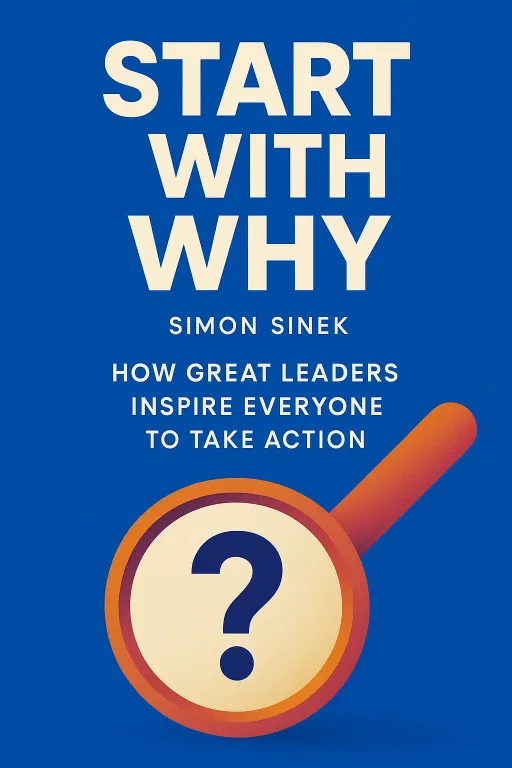
Nova: Not secondary, Atlas, but perhaps not the for inspiring action. Today, we're cracking open a foundational idea from leadership guru Simon Sinek, best known for his revolutionary concept of "Start with Why."
Atlas: Ah, Sinek! His TED Talk is legendary. But I'm always curious, what's his background? How did he stumble onto this 'why' phenomenon?
Nova: What's fascinating is Sinek wasn't always a business thinker; he actually started his career as an anthropologist. That gives his insights this really unique human-centric lens on why some leaders inspire and others don't. He's looking at deep human behavior, not just market trends or balance sheets, to understand what truly drives loyalty and innovation.
Atlas: That's an interesting twist. So he's looking at human behavior, not just balance sheets, to understand leadership? That makes sense. It’s not just about the code, but the people who use it, and the people who build it, right?
Nova: Exactly! And that perspective fundamentally shifts how we think about strategy, even for something as technical and cutting-edge as Agent engineering. It moves us from simply building solutions to articulating the profound impact our work creates.
The 'Why' of Agent Engineering: Beyond Features to Purpose
SECTION
Nova: Many of us, especially in engineering, are wired to focus on the 'what' and the 'how.' We build incredible Agent systems – the 'what.' We use the latest frameworks and design complex architectures – the 'how.' But Sinek argues that truly inspiring leaders and organizations start with the 'why.'
Atlas: Okay, but as an engineer, I'm measured on deliverables, on the 'what.' My boss wants to know the Agent’s latency, its accuracy, its memory footprint. How does 'why' help me build a more stable, scalable Agent system? Isn't this a bit… soft for a tech architect?
Nova: That's a completely valid question, Atlas, and it's a common skepticism. But the 'why' isn't soft; it's the bedrock. Consider the Golden Circle: 'What' you do, 'How' you do it, and at the very center, 'Why' you do it. Most companies communicate from the outside-in: 'Here's what we make, here's how we make it.' But inspiring leaders, like Apple, communicate from the inside-out.
Atlas: So, instead of saying, 'We make great computers,' it's more like, 'We challenge the status quo, and we happen to make great computers'?
Nova: Precisely. People don't buy you do; they buy you do it. They connect with your purpose, your belief. For Agent engineering, imagine two teams. Team A says, "We're building a predictive AI for power distribution." The 'what' is clear. Team B says, "We are building a sustainable future by preventing blackouts, reducing waste, and empowering communities with reliable energy through intelligent agents."
Atlas: Wow, that's a powerful reframing. Team B's 'why' immediately gives their work a much deeper meaning. It's not just about the technology, but the impact.
Nova: Exactly! That 'why' isn't just marketing; it's the north star for the entire development process. It guides design decisions for resilience, efficiency, and ethical considerations. When that Agent system faces a complex technical challenge, the team driven by the 'why' will find innovative solutions because they're connected to a greater purpose. It attracts top talent, fosters innovation, and ensures the system is built with a deeper sense of mission, leading to better long-term outcomes and actual value creation.
Atlas: So, the 'why' becomes the blueprint for the very stability and scalability we as architects are constantly striving for. It’s not just about the lines of code, but the behind every line. It's about designing for a future, not just a feature.
Playing the Infinite Game: Sustained Value and the 'Just Cause' in Agent Systems
SECTION
Nova: Once you've found your 'why,' Sinek argues you're not playing a finite game, but an infinite one. This is where his concept of "The Infinite Game" comes in, and it's absolutely crucial for sustained success in Agent engineering.
Atlas: An infinite game? That sounds a bit daunting for someone trying to ship a product by next quarter. How does this apply to an Agent system's roadmap, especially when we're always chasing the next feature or benchmark, or dealing with the latest model update?
Nova: That's the core tension, isn't it? Sinek defines finite games as having known players, fixed rules, and a clear end—like a football match. Infinite games, however, have known and unknown players, changeable rules, and no real end. Business, and especially the rapidly evolving field of Agent engineering, is fundamentally an infinite game. An infinite mindset is about having a 'just cause' – a vision so compelling you'd be willing to sacrifice for it.
Atlas: A 'just cause'... that sounds like a big ask when you're debugging a tricky Agent interaction flow at 2 AM.
Nova: It is a big ask, but it's what differentiates sustained success from fleeting wins. For Agent engineering, this means not optimizing for quarterly metrics or the immediate release cycle, but for the long-term impact, the ethical evolution, and the continuous improvement of the system itself. Think of two Agent engineering teams again. One is focused on hitting short-term performance metrics – a finite game. They might rush code, accumulate technical debt, and optimize for benchmarks that don't truly serve the user.
Atlas: And that leads to brittle systems, constant refactoring, and ultimately, a lack of trust from users. I've seen that play out.
Nova: Exactly. Now, consider a second team driven by a 'just cause,' perhaps "democratizing access to complex information through intelligent agents" or "building truly human-centric AI that augments, not replaces." This team, operating with an infinite mindset, might prioritize robust architecture, invest in ethical AI frameworks, contribute to open-source, and focus on long-term user value, even if it means slightly slower initial releases.
Atlas: So, it's about building a legacy rather than just a product cycle. That's a mind shift! For architects, that means designing for adaptability, for unknown future challenges, and for continuous learning. It's like building a city that can grow and change over centuries, not just a temporary structure.
Nova: That’s a perfect analogy, Atlas. It's about designing Agent systems that can evolve, adapt, and remain relevant for decades, not just years. It's understanding that the game never truly ends, so your strategy must be about perpetual improvement and upholding that 'just cause.' It's how you ensure stability and scalability, not just for the next sprint, but for the next generation of users and technologies.
Synthesis & Takeaways
SECTION
Nova: So, bringing these powerful ideas together, combining the clarity of your 'why' with the endurance of an 'infinite mindset' transforms Agent engineering from a purely technical task into a mission-driven endeavor. It leads to more resilient, scalable, and profoundly impactful Agent systems.
Atlas: This really ties into our listener's desire for 'high-performance Agent system design' and 'Agent decision logic with human intelligence.' It's not just about the code; it's about the purpose behind the code, and how that purpose drives the very architecture and long-term vision.
Nova: Absolutely. It’s about building intelligent systems that truly serve a greater purpose, not just fulfilling a technical requirement. For our engineers and architects out there, the tiny step from Sinek's work is clear: articulate the 'why' behind your current Agent engineering project in a single, clear sentence. How does it serve a greater purpose?
Atlas: That's a powerful challenge. It forces you to look beyond the immediate technical problem and connect to the bigger picture. It's a 'mindset shift' that can lead to 'breaking boundaries' in how we approach Agent tech. So, what's your 'why' for your Agent project?
Nova: Exactly! And we'd love to hear it. Share your 'why' with us and the Aibrary community. Let's start a conversation about purpose-driven Agent engineering.
Atlas: That’s a fantastic call to action, Nova. It’s all about putting these ideas into practice.
Nova: This is Aibrary. Congratulations on your growth!









