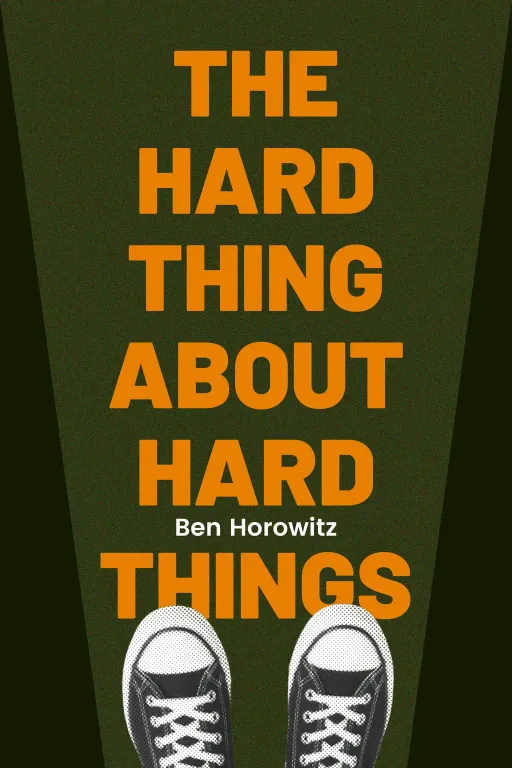
Beyond the Hype: Building an AI-Driven Startup Through 'The Hard Thing About Hard Things'
Golden Hook & Introduction
SECTION
Nova: We've all seen the highlight reels, right? The grand vision, the successful launch, the rapid growth. But what about the late-night doubts, the gut-wrenching decisions, the sheer, unrelenting loneliness of leadership? Forget the fairy tales. Today, we're plunging headfirst into 'the struggle' – the unvarnished truth of building a business when there are no easy answers. This isn't just about survival; it's about finding greatness in the fire. And joining me today to dissect this reality, turning complex content into personal, actionable insights, is Frank Wu, cofounder of Aibrary, and a Harvard Master in Public Policy graduate. Frank, thank you for joining us.
Frank Wu: Nova, it's great to be here. And the way you put it, 'the struggle,' really resonates. Ben Horowitz's book is such a breath of fresh air because it acknowledges that romanticized view of entrepreneurship is often just that – a romance. The reality, as we experience at Aibrary building an Agentic AI for Personal Growth, is far more complex, intense, and, well,.
Nova: Absolutely. And that's exactly why we wanted to dive into 'The Hard Thing About Hard Things' with you today, Frank. Because if anyone understands transforming the 'hard' into 'growth,' it’s you. Today we'll dive deep into this from three perspectives. First, we'll explore the raw, unvarnished reality of 'the struggle' itself and why it's indispensable. Then, we'll discuss the counter-intuitive power of radical transparency as a CEO. And finally, we'll focus on how to master the inherently human elements of leadership, from navigating difficult decisions to building a world-class team, especially when you're pioneering something as innovative as Agentic AI.
Deep Dive into Core Topic 1: Embracing 'The Struggle' as a Catalyst for Growth
SECTION
Nova: So, let's just jump right into that first point, 'The Struggle.' Horowitz doesn't sugarcoat it. He defines 'the struggle' as that period where you want the pain to stop—a profound sense of self-doubt, unhappiness, and feeling completely overwhelmed. It's not just a bad day; it's an existential crisis that often feels distinctly lonely. And he argues that it's from this struggle that greatness actually comes. There’s a fantastic example from his time at Opsware, where the company was just money and losing competitive deals left and right.
Frank Wu: Hmm. I can only imagine that feeling. In the AI space, the pace of innovation alone can feel like a constant struggle, right? Always pushing, always adapting.
Nova: Precisely. Horowitz recounts that Opsware was being 'killed, killed, killed out there.' They were losing too many deals, and the company’s very survival was at stake. Instead of hiding the grim reality, he called an all-hands meeting. To paraphrase, he openly admitted to the entire company that they were 'getting their asses kicked' and that their survival depended on every single person rallying to build a winning product. He wasn’t projecting false optimism; he was exposing their vulnerability and challenging them to respond.
Frank Wu: That's incredibly brave, and frankly, counter-intuitive to how many leaders are taught to present themselves. As a co-founder, balancing that relentless optimism needed to motivate your team and attract investors, with the stark realism required for truly effective problem-solving, is a daily tightrope walk. You have to believe in the vision unequivocally, but you also have to be brutally honest about where you're currently falling short.
Nova: Exactly! And the outcome for Opsware? The team rally. They focused on building a superior product, and the company not only turned around but was eventually sold to Hewlett-Packard for $1.6 billion. It showed that sharing the burden, even the terrifying truth of 'the struggle,' can galvanize a team unlike anything else.
Frank Wu: That makes so much sense. For an AI company like Aibrary, where we're betting on truly advanced technology for personal growth, the struggle can come from so many angles: the tech itself, market adoption, even just the philosophical implications of 'Agentic AI.' It's not just business metrics, it's also a moral and intellectual struggle. Making it communal rather than individual... that's where the resilience truly builds, doesn't it? As leaders, we often feel we have to carry it all, but Horowitz suggests sharing the weight makes it lighter, and stronger.
Nova: It really does. It reframes the struggle from a personal failing to a collective challenge. And that leads us beautifully into our second core idea Frank, because that kind of shared struggle demands a foundation of absolute truth.
Deep Dive into Core Topic 2: The Uncomfortable Truth: Why Radical Transparency Builds Trust and Drives Innovation
SECTION
Nova: So, Frank, Horowitz pulls no punches on this one. He states unequivocally that CEOs should "tell it like it is," even when 'it' is incredibly painful news. He vividly describes how his single biggest personal improvement as CEO came the day he stopped being 'too positive.' He learned that employees aren't fooled by superficial optimism. In fact, they often find it insulting.
Frank Wu: That's a great point. You know, from a marketing perspective, there's always pressure to craft a positive narrative. But if that narrative diverges too much from reality, you lose all credibility. And I imagine that's even truer internally.
Nova: It is. He recounts a brilliant, humbling anecdote: early in his career, before he fully grasped this, he tried to project an image of unwavering confidence. He met a senior AT&T executive, 'Fred,' and later asked his brother-in-law, Cartheu, a long-time AT&T lineman, if he knew Fred. Cartheu's blunt response was, "Yeah, I know Fred. He comes by about once a quarter to blow a little sunshine up my ass."
Frank Wu: ** Oh, wow. That hits hard. The 'sunshine up my ass' analogy really lays bare the employee's perception of insincere leadership. It's a vivid reminder that people are smart, they see through the façade, and they resent being patronized.
Nova: Exactly. Horowitz realized his employees probably felt the same way. This revelation was a turning point for him. He understood that obscuring problems actually prevents the best people from contributing solutions. When problems are hidden, only a few people at the top actually worry about them, while the very people who could them are left in the dark. He argues that trust in any human interaction is inversely proportional to the amount of communication required. High trust means less need for incessant explanations.
Frank Wu: That's powerful. At Aibrary, where we're building cutting-edge AI for personal growth, user trust is paramount, but so is internal team trust. This transparency principle isn't just about avoiding 'sunshine up the ass,' it’s about activating the collective intelligence of your entire company. If we're not transparent about a technical challenge or a market shift, we're essentially handicapping our best minds. And for something as ethically sensitive as AI, transparency in our processes and challenges isn't just good management; it's a foundational ethical stance. We want our users to trust the 'agentic' aspect of our AI, and that starts with us being honest about our journey and our struggles internally. It fosters a culture of authenticity, which I think is essential in the 'personal growth' space.
Nova: You've nailed it, Frank. It’s about more than just feel-good culture; it’s a strategic imperative. And speaking of culture and teams, that naturally brings us to our third core topic—the intensely human, often gut-wrenching, decisions a leader faces when managing talent.
Deep Dive into Core Topic 3: Mastering the Human Equation: Navigating Difficult People Decisions with Principle
SECTION
Nova: So, Frank, transitioning from transparency, let’s talk about the hardest 'hard things': managing people. Horowitz tackles layoffs head-on, urging leaders to handle them with honesty, respect, and speed. He offers a compelling example from Opsware’s multiple layoff rounds when they were bleeding cash. They'd laid off 400 employees in three separate rounds. Despite immense negative press, the company eventually recovered and was sold for $1.6 billion. One of his board members, a seasoned venture capitalist, admitted he’d never seen a company recover from back-to-back layoffs like that.
Frank Wu: Nova, those are the types of decisions that keep founders awake at night. Layoffs aren't just numbers on a spreadsheet; they're lives and families. At Aibrary, we're building a team around this deeply human mission, and the idea of that kind of decision…it’s heavy. Horowitz's emphasis on respect and transparency there sounds like it's vital for the moral fabric, not just the remaining team's morale, but for your own as a leader.
Nova: Absolutely. He insists that the CEO must be visible and present, communicating not just the 'what' but the 'why,' acknowledging the company's failures, not the laid-off employees'. And it’s not just layoffs. He delves into 'Demoting a Loyal Friend,' where he advises prioritizing the 'good of the whole'—the company's needs—even over personal loyalty, but always with maximum empathy and alternative roles if possible. Then there’s the challenge of 'When Smart People Are Bad Employees.' He categorizes them into archetypes like 'the Heretic'—brilliant but destructive in their criticism, 'the Flake'—genius but unreliable, or 'the Jerk'—talented but toxic.
Frank Wu: I've seen shades of those archetypes, even in smaller teams. It’s a tension between IQ and EQ, really. For Aibrary, building an AI that helps with personal growth, we need incredibly smart people solving complex problems. But if a 'Heretic' undermines team cohesion, or a 'Flake' introduces unreliability, that directly impacts our ability to deliver on our promise. How do you, as a founder, navigate that? The book highlights the Confucian principle for demoting a friend, putting the collective good first. But for the 'smart but bad,' is it about remediation, or swift, decisive action?
Nova: Horowitz suggests it's a delicate balance. Sometimes you 'hold the bus' for truly exceptional talent, like a Terrell Owens figure in sports, but you make that an explicit exception to prevent wider anarchy. Otherwise, your loyalty must be to the of your employees—the ones doing the hard work—who deserve a world-class management team. He argues this is why an HR team should function as 'Management Quality Assurance,' constantly evaluating and improving the effectiveness of leadership, rather than being purely administrative.
Frank Wu: That 'Management Quality Assurance' idea is compelling. Coming from a public policy background, I appreciate structured evaluation and accountability. Applying that lens to management effectiveness, especially in a startup, feels proactive. It reminds me that scaling a company isn't just about scaling technology or users, but scaling leadership. And that means being disciplined about these 'human equations,' even when they are emotionally taxing.
Synthesis & Takeaways
SECTION
Nova: Frank, this has been such an illuminating conversation, truly showing how 'The Hard Thing About Hard Things' translates directly to the modern, innovative startup world. We've journeyed from embracing 'the struggle' as a crucible for greatness, to harnessing radical transparency as a force for trust and collective problem-solving, and finally, to mastering the profoundly human challenges of team leadership with both principle and pragmatism.
Frank Wu: It's been a powerful reminder that while technology evolves at lightning speed, the fundamental challenges of leadership and human dynamics remain constant. For us at Aibrary, these aren't just management theories. They're essential blueprints for how we build our company, our culture, and ultimately, our Agentic AI for Personal Growth. The candor in Horowitz's book, especially around 'the struggle,' normalizes the inherent difficulty and enables a deeper, more intentional approach to growth, both for the company and for us as leaders.
Nova: Precisely. And so, for all of our listeners, especially those of you building something new, working against the odds, or simply looking to grow through challenge, here's a final thought inspired by our conversation today: How can you, in your own journey, not just endure 'the struggle,' but actively embrace it as the most potent catalyst for your own personal and professional growth? Frank, thank you so much for sharing your insights. This has been truly invaluable.
Frank Wu: My pleasure, Nova. Thank you for having me.
Nova: What a conversation, folks! If you loved this deep dive and Frank’s incredible insights, make sure to check out Aibrary, where you can turn complex content into personalized, podcast-style learning, making growth seamless in your everyday life. Until next time, keep embracing the hard things, because that’s where the real victories are forged.