Leading Through Turbulence: Building an Antifragile Mindset
Golden Hook & Introduction
SECTION
Nova: What if everything you thought about resilience was, well, not quite enough? We often talk about "bouncing back" from adversity, dusting ourselves off, getting back on our feet. But what if the goal isn't just recovery, but something far more potent?
Atlas: Oh, I like that. "Not quite enough." Because let's be honest, getting back to "normal" after a major hit sometimes feels like a Pyrrhic victory. You're back, but you're also often depleted, scarred, and maybe even a little more fragile.
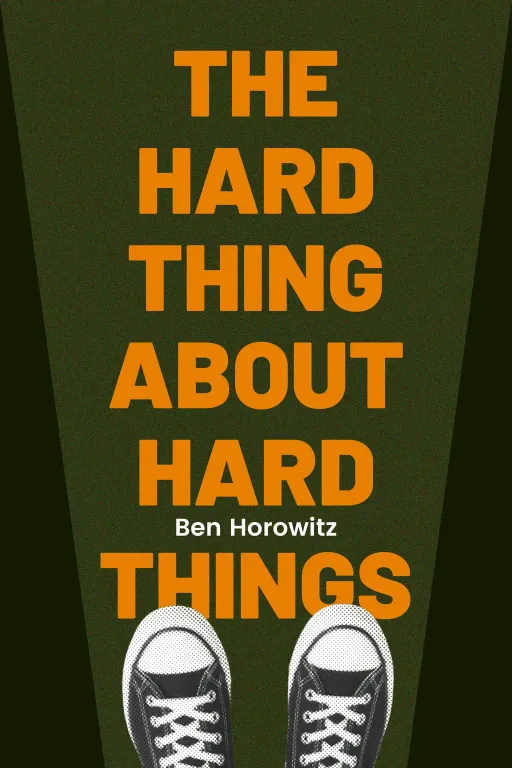
Nova: Exactly. It’s like a rubber band that snaps back into shape, but eventually, it loses its elasticity. Today, we’re challenging that very idea, drawing from two titans of modern thought. We’re diving into Ben Horowitz's unflinching look at leadership in crisis in “The Hard Thing About Hard Things,” and then we’re going to shatter some paradigms with Nassim Nicholas Taleb’s groundbreaking work, “Antifragile: Things That Gain from Disorder.”
Atlas: Horowitz, the Silicon Valley CEO, known for his raw, unfiltered accounts of what it takes to run a company, especially when everything's going sideways. His book is practically a survival guide from the trenches, praised for its brutal honesty. And then Taleb, the former derivatives trader turned philosopher of randomness, whose ideas have sparked both fierce debate and widespread intellectual reverence. His work, building on concepts from his earlier book, "The Black Swan," doesn't just offer a different perspective; it offers a whole new operating system for living.
Nova: It’s a powerful pairing. Horowitz gives us the stark reality of the battlefield, the mental toughness required for sheer survival. Taleb then swoops in and says, "Hold my beer. What if we could actually to get stronger from the battle?"
Atlas: So you're saying it's not just about enduring the hard things, but actually leveraging them? That’s going to resonate with anyone trying to refine their workflow or maximize their impact, because unexpected challenges are a constant.
Navigating the Hard Things: The Reality of Turbulence
SECTION
Nova: Precisely. Let's start with Horowitz, because he doesn't pull any punches. His book is a collection of deeply personal, often agonizing, accounts of his time as a CEO. He talks about the "struggle"—that period when you're questioning everything, when panic sets in, when you feel utterly alone. He doesn’t offer platitudes; he offers strategies for navigating the mud.
Atlas: That sounds rough, but real. I mean, for our listeners in high-stakes environments, whether they're leading a team or trying to launch a new initiative, that feeling of isolation and overwhelming pressure is universal. What’s one of the most striking "hard things" he describes?
Nova: One of the most vivid and emotionally taxing scenarios he details is the necessity of employee layoffs. This isn't just a business decision; it’s a deeply human one. Horowitz talks about the immense burden of having to deliver that news, the impact on the individuals, and the ripple effect on the remaining team's morale and trust. He emphasizes that there's no "good" way to do it, only less bad ways, and the importance of being incredibly direct, honest, and compassionate, even when it’s excruciating.
Atlas: Oh, I know that feeling. It’s the kind of decision that keeps you up at night, because you’re not just impacting a spreadsheet; you’re impacting lives. But wait, how do you maintain a company's culture and vision when you're making decisions that inherently feel destructive, like cutting staff or navigating competitive betrayals? It seems like those actions would erode trust and morale.
Nova: That’s the core tension Horowitz addresses. He argues that mental toughness isn't about being emotionless, but about processing those emotions, making the hard choices anyway, and then owning them completely. He talks about the loneliness of leadership, where you often can't share your deepest fears or uncertainties with your team. The hard choice isn't just to do, but to do it in a way that minimizes collateral damage and, crucially, preserves the long-term integrity and vision of the organization. He's big on leading through storytelling, even in crisis, to remind people of the 'why'.
Atlas: So it’s about having the grit to face the brutal facts, make the tough call, and then stand by it, all while trying to keep the ship pointed in the right direction. It’s about robustness—withstanding the stress.
Nova: Exactly. Horowitz teaches us how to be robust. How to absorb the shocks, endure the blows, and keep fighting. He’s the ultimate guide for survival in the entrepreneurial jungle. He doesn't sugarcoat the experience, which is why his book is so highly regarded among founders and leaders who appreciate that raw, unfiltered perspective. It’s a testament to the fact that even the most celebrated companies have faced existential threats.
Beyond Robustness: Embracing Antifragility
SECTION
Nova: Now, if Horowitz teaches us how to survive the hard things, Taleb offers a radical path to from them. He introduces a concept that goes beyond mere robustness. It’s called antifragility.
Atlas: Antifragility. That sounds like something out of a superhero comic. What exactly do you mean by beyond robustness? Because honestly, just being robust sounds pretty good when things are falling apart.
Nova: It does, right? But Taleb argues that robustness is simply the ability to shocks without breaking. Think of a very strong oak tree. It can withstand a mighty storm, but it doesn't get stronger of the storm. Antifragility, however, is a property of systems that don't just resist shocks, but actually from them. They gain from disorder, volatility, uncertainty, and randomness.
Atlas: Wait, so you're saying I should chaos? That sounds incredibly counterintuitive for someone trying to refine workflows and maximize impact. My entire goal is to uncertainty, not invite it in for tea!
Nova: That’s the magic and the challenge of Taleb’s idea! He’s not advocating for reckless chaos, but for designing systems—personal, professional, societal—that are structured to benefit from stress. Think of the human body: a fragile system breaks under stress, a robust system tolerates it, but an antifragile system, like our muscles or immune system, actually gets stronger from stressors. A workout makes your muscles grow; exposure to pathogens strengthens your immunity.
Atlas: That’s a great analogy. So, it's not about being reckless, but about engineered exposure to beneficial stressors. But how does this apply to, say, a business or a career? Horowitz talks about layoffs as a brutal necessity. How could that ever be antifragile?
Nova: That's where the nuance comes in. Taleb, with his background as a statistician and derivatives trader, saw firsthand how complex financial systems were designed to be brittle, collapsing under rare, high-impact events – what he called "Black Swans." He argues that many modern systems are designed for efficiency, which often means removing redundancy and optionality, making them incredibly fragile to unexpected events. An antifragile system, conversely, has built-in redundancy, small-scale failures, and optionality, allowing it to learn and adapt.
Atlas: So, it’s about creating systems that have built-in "shock absorbers" that don't just absorb the shock, but convert its energy into growth. It’s a really challenging concept for many, and I know his work can be polarizing. Some find it empowering, others find it too abstract or even controversial in its critiques of modern institutions.
Nova: Absolutely. And that’s part of its power. Taleb doesn't shy away from challenging conventional wisdom. He argues that many things we consider "efficient" or "stable" are actually incredibly fragile, because they haven't been exposed to stressors. Conversely, things that appear messy or decentralized might actually be antifragile. He encourages us to think about how we can build optionality into our lives, to have choices and alternatives that allow us to benefit when things don't go as planned. It’s about having more upside than downside.
Designing for Growth: Practical Antifragile Strategies
SECTION
Nova: So, bringing these two ideas together: if Horowitz shows us the hard choices needed to survive the storm, Taleb shows us how to harness the storm's energy to become a stronger, more adaptable vessel. The deep question becomes: How can you proactively design your professional and personal systems to not only withstand setbacks but to actually grow stronger and more adaptable from them?
Atlas: Okay, this is where the rubber meets the road for our focused achievers and resilient explorers. How do you actually "gain" from a setback in, say, a project failure or a career pivot? It's one thing to say it, another to live it.
Nova: It begins with a shift in mindset, away from simply avoiding failure, towards understanding its informational value. Horowitz teaches us to face the failure squarely. Taleb then prompts us to ask: how can this failure actually make us smarter? For example, in a project failure, instead of just recovering, an antifragile approach might involve analyzing the failure for hidden vulnerabilities in your process, then restructuring that process to intentionally include small, controlled experiments or feedback loops that expose weaknesses early, before they become catastrophic.
Atlas: So it's about building in what you might call "beneficial stressors" or "learning loops." Like how a startup might intentionally launch a minimum viable product to get early feedback, knowing it will be imperfect, but that imperfection will lead to a stronger final product.
Nova: Exactly! That’s a perfect example. Or consider career growth. Instead of always seeking the safest, most predictable path, an antifragile mindset might encourage taking on projects with higher uncertainty, or even deliberately exploring new fields where you're a novice. The initial discomfort and "failure" to immediately master it becomes the stressor that forces new learning, new connections, and ultimately, greater adaptability and growth.
Atlas: That’s powerful. It’s about building systems that don't just tolerate stress, but actually use it as fuel. So for our listeners, what’s a tiny, actionable step they can take to start building this antifragile muscle?
Nova: The tiny step is this: identify one area in your current career or personal growth where you've recently faced an unexpected challenge. Instead of just recovering, brainstorm three ways you could reframe or restructure that area to gain from similar future disruptions. It could be a new skill you had to learn on the fly, a team dynamic that broke down, or even a personal goal that hit a snag.
Atlas: So it's about looking at that challenge not as a problem to be fixed, but as a data point, an input that can make your system smarter and more robust, but ultimately, antifragile. It's about asking, 'how can this challenge make me stronger?' rather than 'how do I just get through this?'
Synthesis & Takeaways
SECTION
Nova: What we’ve learned today from Horowitz and Taleb is that leadership, and indeed life itself, is less about avoiding turbulence and more about mastering the art of navigation, and even leveraging it. Horowitz provides the gritty, honest blueprint for surviving the storm, emphasizing mental toughness and hard choices.
Atlas: And Taleb swoops in, challenging us to go further, to evolve beyond mere survival. He pushes us to consider how we can actually design our lives and our professional systems so that disorder, volatility, and uncertainty don't just happen us, but actually make us better, stronger, and more capable. It’s a profound shift from defense to offense.
Nova: It’s a journey from simply enduring to actively evolving. The core insight is that you have the power to transform adversity into an engine for growth. It requires courage, the kind Horowitz talks about, and intellectual curiosity, the kind Taleb ignites.
Atlas: So the next time an unexpected challenge lands in your lap, pause. Don't just react. Ask yourself, "How can I not just recover from this, but actually gain from it? What optionality can I build in? What lessons can I extract to make myself, or my system, antifragile?" That’s the real work.
Nova: That's the path to building a truly robust inner compass.
Atlas: This is Aibrary. Congratulations on your growth!