The Invisible Architect: Building Systems That Scale Beyond Code.
Golden Hook & Introduction
SECTION
Nova: You know, Atlas, I was reading this fascinating article recently about how some of the most successful companies aren't just selling products, they're selling the of problems. They've mastered the art of making the complex feel invisible.
Atlas: Oh, I love that! Like a perfectly designed piece of software you don’t even notice because it just. Or a bridge so well-engineered, you cross it without a second thought, completely oblivious to the thousands of calculations that went into making it safe.
Nova: Exactly! And it makes me think about the hidden architectures that govern so much of our modern world. The intricate systems that, when they hum along, we take for granted, but when they falter, everything grinds to a halt.
Atlas: That’s going to resonate with anyone who’s ever had their internet go down or their favorite app crash right before a deadline. It’s like, who the invisible architect behind all this, and why can’t they just make it all perfect?
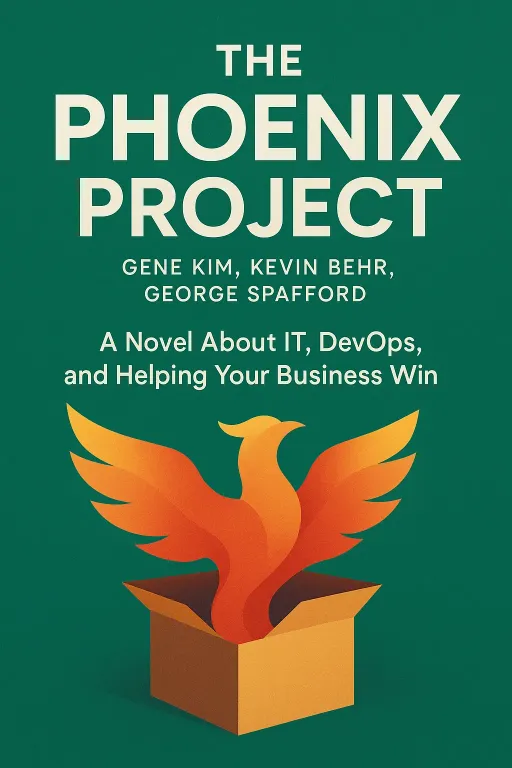
Nova: Well, that's precisely what we're diving into today. We’re exploring how to build systems that scale beyond just lines of code, systems that are resilient, efficient, and almost magically effective. We're looking at two foundational texts that really illuminate this: by Gene Kim, Kevin Behr, and George Spafford, and by Eliyahu M. Goldratt.
Atlas: Ah,. I know that one has become almost a legend in the tech world. It’s not just a dry textbook, is it? It’s a novel, a story.
Nova: That's right. What's fascinating about is that it’s structured as a business novel. Gene Kim, one of the authors, actually started his career in security and then became deeply involved in the DevOps movement. He, along with Kevin Behr and George Spafford, wrote it to make the often-abstract principles of DevOps incredibly relatable. It became a runaway success, widely acclaimed for its ability to convey complex ideas through a compelling narrative, almost like a modern-day parable for IT professionals. It really helps you see the human side of system failures and successes.
Atlas: So it’s like a Trojan horse for system thinking, sneaking in profound insights wrapped in a story. I can definitely see the appeal. It makes you wonder how many other critical business concepts could be taught through a compelling narrative.
The Hidden Leverage: Optimizing Flow, Feedback, and Continuous Learning
SECTION
Nova: Absolutely. And that leads us to our first core idea: the hidden leverage of optimizing flow, feedback, and continuous learning, particularly in IT operations. tells the story of Parts Unlimited, a fictional manufacturing company, and its IT manager, Bill Palmer. Bill is thrown into the deep end when his company’s crucial IT project, codenamed ‘Phoenix,’ is massively over budget, behind schedule, and threatening to sink the entire company.
Atlas: Oh, I’ve been there. Not literally with a company-sinking project, but that feeling of being handed a burning platform and told to put out the fire, blindfolded. What does Bill do?
Nova: Well, he’s initially overwhelmed, just trying to keep his head above water, dealing with one crisis after another. But then he meets a mysterious board member, Eric, who guides him using principles inspired by manufacturing and lean methodologies. Eric helps Bill see that IT isn’t just a cost center or a support function; it’s a complex value stream, much like a factory production line.
Atlas: So, it’s about treating code deployment and system maintenance like building cars, essentially? That sounds… counterintuitive to some IT folks, who often see themselves as artists or pure problem-solvers.
Nova: It’s a powerful reframing. The book introduces three core ways of working: The First Way is about optimizing. Think of it as the speed and smoothness with which work moves from development to operations to the customer. Bill realizes that his team is constantly interrupted, juggling too many tasks, and has huge queues of unfinished work. This creates chaos and delays. They start to streamline processes, reduce work-in-progress, and make sure that every piece of work adds value.
Atlas: That makes me wonder how many of our listeners, especially those managing complex projects in places like AT&T, are facing similar issues. It’s like everyone’s busy, but nothing seems to be actually forward.
Nova: Precisely. The Second Way is about amplifying. This means getting information back quickly, whether it’s from testing, monitoring, or customer feedback. In Bill’s world, problems would often only be discovered late in the game, leading to costly fixes and huge outages. By creating faster, more direct feedback, they can catch issues early, learn from them, and prevent them from recurring.
Atlas: So, it's not just about fixing the bug, but understanding the bug happened and putting systems in place so it doesn’t happen again. That’s a fundamentally different approach than just patching things up.
Nova: Absolutely. And that leads to The Third Way: continuous learning and experimentation. This is about fostering a culture where teams are constantly learning, sharing knowledge, and improving. It’s about creating psychological safety so people can experiment, fail fast, and innovate without fear. It’s how Parts Unlimited transforms its IT department from a bottleneck into a strategic enabler, capable of rapid innovation and reliable service delivery.
Atlas: That’s actually really inspiring. It sounds like isn't just about IT; it's about transforming organizational culture through a systems-thinking lens. It’s about building trust and creating an environment where everyone feels empowered to contribute to the overall flow, not just their individual tasks.
The Theory of Constraints: Identifying and Managing Bottlenecks for Systemic Improvement
SECTION
Nova: It truly is. And that naturally leads us to our second key idea, which underpins much of what teaches: Eliyahu M. Goldratt’s Theory of Constraints, famously illustrated in his book,.
Atlas: ! Now that’s a classic. I’ve heard it mentioned in so many business contexts, not just manufacturing.
Nova: It’s a masterpiece. Goldratt, who was a physicist before he became a management guru, fundamentally changed how people thought about business operations. was published in 1984 and became an instant sensation, selling millions of copies and being translated into dozens of languages. It’s widely regarded as one of the most influential business books ever written, praised for its innovative narrative style that makes complex operational science accessible through a compelling story. Like, it’s a novel, following plant manager Alex Rogo as he tries to save his failing factory.
Atlas: So, another business novel. Is this a secret weapon for explaining complex ideas?
Nova: It seems to be! Goldratt’s central premise is beautifully simple: every complex system, and a factory or an IT department is a complex system, has at least one that limits its overall output. He calls this the Theory of Constraints. He argues that focusing improvement efforts anywhere on the constraint is largely wasted effort.
Atlas: Hold on. So, if I have a hundred problems in my system, I shouldn’t try to fix all of them? I should find the one thing that's slowing everything down and just focus on that? That sounds a bit out there.
Nova: It is counterintuitive, isn't it? But think of a chain. If you want to make the chain stronger, you don’t strengthen every link a little bit. You find the weakest link and reinforce that one. Goldratt outlines five focusing steps: First, the constraint. Second, the constraint—make sure it’s never idle, that it’s always working on the most important thing. Third, everything else to the constraint. This means all other parts of the system should work to support the constraint, even if it means they appear to be idle sometimes.
Atlas: So, if the constraint is a specific machine, or even a specific person, everyone else should be ensuring that machine or person has everything they need and isn't being held up by anything. Even if they themselves have to slow down.
Nova: Exactly. The fourth step is to the constraint—if exploiting and subordinating aren't enough, you invest in improving the constraint directly, perhaps buying a faster machine or hiring more people for that critical role. And finally, step five: if the constraint moves, go back to step one and don't let set in. Always be looking for the new constraint.
Atlas: That’s a powerful framework. I can see how that applies not just to manufacturing but to any project, any team, even personal productivity. It shifts your focus from being busy everywhere to being strategic where it matters most. It's about finding the lever that moves the whole system.
Nova: It really is. And the deep question for our listeners, especially those like our listener transitioning to a Lead System Engineer role at AT&T, is: where in your current system do you suspect a bottleneck or constraint is slowing down progress? It's not always obvious, and often it’s something you’ve just learned to live with. But identifying it can be the first step towards truly transformative change.
Synthesis & Takeaways
SECTION
Nova: So, whether we’re talking about Bill Palmer struggling with the Phoenix project’s IT disasters or Alex Rogo fighting to save his factory, the core message from both and is profound: systems thinking is the ultimate hidden leverage. It’s about moving beyond individual tasks to orchestrate complex systems for maximum impact and efficiency.
Atlas: It’s not just about working harder, it’s about working smarter by understanding the underlying mechanics of how things flow, where they get stuck, and how everything is connected. It’s about seeing the invisible architecture.
Nova: And it makes you realize that the most impactful changes often aren't about adding more resources or pushing people harder. They're about identifying that one critical point, that one bottleneck, that one broken feedback loop, and strategically intervening there. The ripple effect can be astonishing, turning chaos into clarity.
Atlas: Wow, that’s actually really inspiring. It gives you a sense of agency, doesn't it? Instead of feeling overwhelmed by a million problems, you’re empowered to find the one that matters most. It’s about becoming the architect, not just a bricklayer.
Nova: Precisely. It’s about understanding that the systems we build, whether they are technological, organizational, or even personal, are dynamic. They require continuous observation, adaptation, and an unwavering commitment to improvement. It’s a continuous journey, not a destination.
Atlas: That’s such a hopeful way to look at it. It transforms the daunting task of systemic overhaul into a focused, achievable process. For anyone feeling bogged down by complexity, these books offer not just tools, but a whole new way of seeing the world.
Nova: Agreed. And for anyone looking to make a significant impact in their role, especially in a large organization, understanding these principles is absolutely essential. It’s the difference between merely managing and truly leading.
Atlas: Absolutely. That’s a powerful thought to leave our listeners with.
Nova: This is Aibrary. Congratulations on your growth!