

The Hidden Cost of 'Good Enough': Why Your Processes Need a Radical Rethink.
Golden Hook & Introduction
SECTION
Nova: What if I told you that trying to make everything in your business faster, smoother, and more efficient is actually the single best way to slow it down?
Atlas: Whoa, hold on. That sounds like corporate heresy, Nova. Every strategic playbook I’ve ever read screams "efficiency everywhere!" Are you telling me we’ve been optimizing ourselves into a standstill?
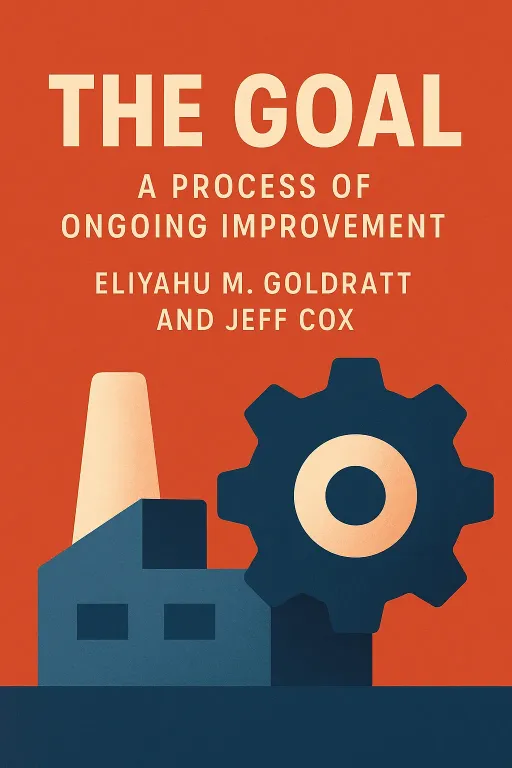
Nova: Precisely, Atlas. And it’s a concept brilliantly unraveled in a couple of landmark books we're diving into today. First, there’s "The Goal" by Eliyahu M. Goldratt, a fascinating read because Goldratt, a physicist by training, chose to present his revolutionary business theory as a novel, making it incredibly accessible and impactful. Then we have "Lean Thinking" by James P. Womack and Daniel T. Jones, which distills the principles born from the legendary Toyota Production System.
Atlas: A physicist writing a business novel? That's definitely an unexpected approach. But it sounds like both books are pointing us towards a significant blind spot in how we typically approach improvement.
Nova: Absolutely. They challenge that ingrained belief that more efficiency, everywhere, automatically translates to better overall performance.
The Blind Spot of 'Efficiency Everywhere'
SECTION
Atlas: Okay, so let’s unpack that. Because for our listeners who are strategists and optimizers, the idea of making everything faster feels almost counterproductive. Why would striving for universal efficiency be a trap?
Nova: It's because we often fall into the trap of what Goldratt calls 'local optima.' We optimize individual departments or steps in a process, making them super-efficient in isolation. But without understanding the entire system, all that local efficiency can just create a pile-up somewhere else, or even worse, generate waste that slows everything down.
Atlas: Right, like making your assembly line workers incredibly fast, but then the painting booth can’t keep up, and you just have a mountain of unpainted parts.
Nova: Exactly! Imagine a multi-lane highway. You spend millions adding more lanes, making each lane incredibly efficient. But then all those lanes converge into a single-lane bridge. No matter how fast those highway lanes are, the traffic is still limited by that bridge. All your optimization efforts on the highway lanes were largely wasted. Goldratt's story in "The Goal" is all about Alex Rogo, a plant manager whose factory is drowning despite everyone working frantically. He’s got machines running at top speed, people pushing hard, but orders are late, and the company is losing money. He’s optimizing locally, but the system is failing globally.
Atlas: So the frustration isn't just about things being slow; it’s about the wasted effort and resources that go into optimizing the wrong things. For anyone trying to streamline a complex production process, that translates directly into lost time, budget overruns, and missed opportunities.
Nova: It’s a huge hidden cost. Think about a software development team. The coding team might be incredibly fast, churning out features like crazy. But if the testing team is a small bottleneck, or the deployment process is cumbersome, all those quickly-coded features just sit in a queue. The overall project delivery slows down, even though one part of the process is "efficient." It’s incredibly frustrating for everyone involved.
Atlas: I can imagine. It’s like everyone’s on a treadmill, running hard, but the finish line isn't moving any closer. So, if making everything faster isn't the solution, what is?
Strategic Optimization: Identifying and Eliminating the True Bottleneck
SECTION
Nova: That’s where Goldratt's Theory of Constraints comes in, and it's truly a radical rethink. He argues that every system, no matter how complex, has one single constraint – one weakest link – that limits its overall output. True optimization means finding that one constraint and focusing your improvement efforts there.
Atlas: How do you even begin to find that "magical" bottleneck? It can’t be as simple as just looking for the slowest part, right? Because sometimes the slowest part is slow it’s being starved by something earlier in the process.
Nova: That's a brilliant point, Atlas. It's not always obvious. Goldratt outlines five focusing steps: First, the constraint. This requires careful analysis of the entire system. Second, the constraint – make sure it’s never idle, that it’s always working on the most important tasks. Third, everything else to the constraint – meaning, every other part of the system should operate at the pace of the bottleneck, not faster.
Atlas: Subordinate everything else... so you're saying if the painting booth is the bottleneck, the assembly line should actually so it doesn't overwhelm the painting booth? That feels incredibly counterintuitive to an optimizer!
Nova: It does, doesn't it? But if you don't, you just build up massive work-in-progress inventory before the bottleneck, which is waste. The fourth step is to the constraint – invest in improving its capacity. Only once you’ve done all that, if the constraint shifts, you go back to step one. It’s a continuous improvement cycle.
Atlas: For our listeners who are leading teams and processes, what's a practical, actionable way to start identifying their core constraint? Because it sounds like this requires a shift in perspective.
Nova: It absolutely does. And this is where "Lean Thinking" by Womack and Jones offers a powerful complementary approach. Lean focuses on identifying and eliminating "waste," or "muda" in Japanese. Waste is anything that doesn't add value for the customer. Often, waste accumulates around bottlenecks, or it's generated by trying to "optimize" non-bottleneck steps, creating overproduction or unnecessary motion. So, a great starting point is to map out your process from end-to-end and look for where things pile up, where there's waiting, or where efforts produce no real value.
Atlas: So it's not just about speed, but about value creation and removing anything that doesn't directly contribute to that, especially around that critical constraint. That's a much more holistic view of efficiency.
Nova: Precisely. Think of a busy hospital emergency room. If the bottleneck is often the single MRI machine or the availability of a specific specialist, simply making the triage nurses work faster won't improve patient flow. In fact, it might just create a longer queue for the MRI or the specialist, leading to more patient frustration. But if you focus on maximizing the MRI's uptime, scheduling it optimally, and ensuring the specialist's time is used only for critical cases, the entire patient journey improves dramatically. That’s strategic optimization, and it's how you unlock collective power for your team.
Atlas: That's a powerful distinction. It’s about building better systems by focusing laser-like on the one thing that truly matters, rather than chasing marginal gains everywhere else. That's a strategic insight that can really shape the future of a company.
Synthesis & Takeaways
SECTION
Nova: So, what we've really explored today is that true optimization isn't about making every single part of a process faster, but about identifying and strategically managing the critical constraint. It's about working smarter, not just harder, and understanding that a system's overall performance is limited by its weakest link.
Atlas: And that brings us back to Goldratt’s profound question, and the deep question posed in our content today: "Where is the single biggest bottleneck in your current production process that, if improved, would impact the entire system?" Answering that isn't just about finding a problem; it's about unlocking massive, systemic growth.
Nova: It requires a radical rethink, a strategic outlook, and the willingness to challenge conventional wisdom. It’s about embracing the journey of leadership by truly seeing where your influence can have the most impact.
Atlas: It’s a call to action for every strategist and optimizer out there to look beyond surface-level efficiencies and truly understand the pulse of their operations.
Nova: This is Aibrary. Congratulations on your growth!









