Stop Guessing, Start Optimizing: The Guide to Flawless Route Planning.
Golden Hook & Introduction
SECTION
Nova: We've all been told to "work smarter, not harder." It’s practically a mantra in every industry. But Atlas, what if working smarter, especially when it comes to your most strategic plans, actually means doing… less?
Atlas: Less? That sounds almost heretical, Nova. My initial thought is, how can doing less ever lead to more efficiency, especially when we're constantly pushing for greater output and faster delivery? For anyone trying to navigate complex operations, it almost feels like a trick question.
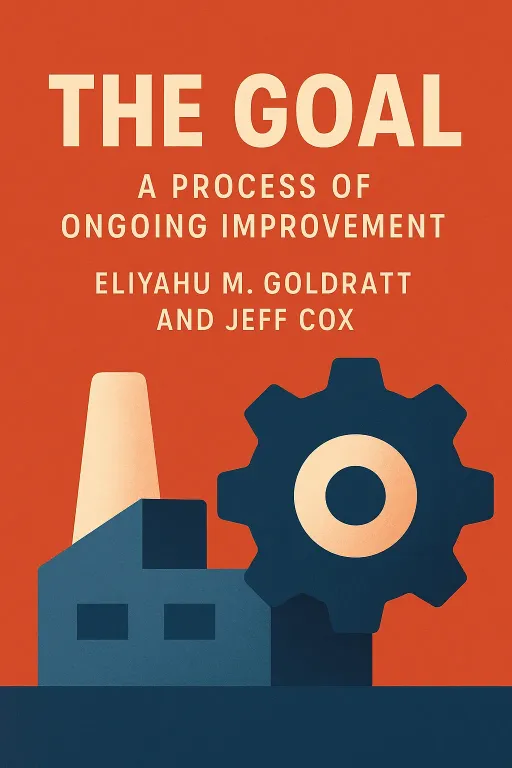
Nova: Well, it’s not a trick, but it is deeply counter-intuitive, and it's the core idea behind today's deep dive into how to truly "Stop Guessing, Start Optimizing." We're talking about transforming operations by identifying and breaking constraints that silently hinder your progress. And to get there, we're drawing heavily from two foundational texts. The first is Eliyahu M. Goldratt's groundbreaking book, "The Goal."
Atlas: Ah, "The Goal"! I remember hearing about that one. Isn't it famous for being a business book disguised as a novel? That's quite a unique approach for explaining complex management theory.
Nova: Absolutely! Goldratt, with his background as a physicist, chose to present the Theory of Constraints through a compelling story about a struggling factory manager. It was revolutionary, making abstract ideas incredibly accessible and relatable, and it’s had a massive impact far beyond manufacturing, becoming a cornerstone for operational efficiency across countless industries. But Goldratt's work often gets paired with another powerful school of thought.
Atlas: Right, because once you’ve identified the constraint, you still need to make everything else flow smoothly, don't you? That’s where I imagine "Lean Thinking" comes in. We’re talking about James P. Womack and Daniel T. Jones, correct?
Nova: Precisely. Their work, stemming from their research into the Toyota Production System, which they detailed in "The Machine That Changed the World," truly formalized the principles of Lean. It's been lauded globally for its focus on continuous improvement and waste elimination, though it certainly comes with its own set of implementation challenges in different organizational cultures. Together, these two philosophies offer a powerful one-two punch for anyone looking to optimize their processes.
Deep Dive into The Theory of Constraints: Finding Your Bottleneck
SECTION
Nova: So, let's start with Goldratt's "The Goal" and the Theory of Constraints. The core idea is deceptively simple: every system, no matter how complex, has at least one bottleneck, one single limiting factor that dictates the overall output of the entire system. And here's the crucial part: focusing improvement efforts on this constraint will lead to the most significant gains in throughput, inventory, and operating expense.
Atlas: But how do you that one bottleneck in a complex routing process? It feels like everything is a bottleneck sometimes! For anyone trying to analyze complex situations, it can feel like a hydra, you chop off one head and two more appear. Isn't it incredibly tempting to try and fix everything at once, especially when you have a strategic mind that sees all the potential improvements?
Nova: It absolutely is tempting, and that's precisely where Goldratt's insight is so powerful. He uses a fantastic analogy, the "Boy Scout Hike." Imagine a group of Boy Scouts on a hike. Some are fast, some are slow. If you want the to get to the campsite faster, what do you do? Do you tell the fast hikers to run even faster?
Atlas: No, that wouldn't make the group faster, just stretch it out. The fast ones would just get further ahead and then have to wait around.
Nova: Exactly! The speed of the entire group is determined by the slowest hiker. They are the bottleneck. To speed up the group, you need to focus on that slowest hiker. Maybe you give them a lighter pack, or help them over difficult terrain. Once they're no longer the slowest, then the next slowest hiker becomes the new bottleneck.
Atlas: So, when we translate that to route planning, we're not talking about optimizing every single truck's speed or individual driver's efficiency. We're looking for that one point in the where things consistently pile up or slow down. Is it the loading dock? Is it the dispatch system? Or maybe the route optimization software itself?
Nova: Precisely. Goldratt outlines five focusing steps of TOC. First, identify the constraint. Second, exploit it – meaning, make the absolute most of whatever capacity that constraint have. Third, subordinate everything else to the constraint – make sure all other parts of the system are working to support the constraint, not overproducing or idling. Fourth, elevate the constraint – if needed, invest to increase its capacity. And fifth, if the constraint shifts, go back to step one. It's a continuous cycle.
Atlas: Okay, so are you saying that improving a non-bottleneck is actually a waste of resources? That feels counter-intuitive to the idea of continuous improvement everywhere.
Nova: It can be. If you make a non-bottleneck faster, it just means it will produce more output that then piles up in front of the bottleneck, creating more inventory, more waiting, and no increase in overall system throughput. It's like having a super-fast highway that feeds into a single-lane bridge. Making the highway faster doesn't get cars across the bridge any quicker. The breakthrough moment comes when you realize the system's performance is limited by its weakest link, and that's where your strategic focus belongs.
Deep Dive into Lean Thinking: Eliminating Waste and Streamlining Flow
SECTION
Nova: Once we've managed that bottleneck, once we've exploited it, elevated it if necessary, and subordinated everything else to it, what's next? That's where Lean Thinking comes in, sweeping away the inefficiencies that might still exist even in an optimized system.
Atlas: So, Theory of Constraints helps us find the biggest rock in the road, and Lean helps us smooth out the asphalt for the rest of the journey? For practical achievers looking for actionable steps, this seems like the perfect complement.
Nova: That’s a fantastic analogy, Atlas. Lean, heavily influenced by the Toyota Production System, focuses on identifying and systematically eliminating "Muda," or waste. This isn't just about cutting costs; it's about removing anything that doesn't add value from the customer's perspective. Think about the eight common types of waste: overproduction, waiting, unnecessary transport, over-processing, excess inventory, unnecessary motion, defects, and underutilized talent.
Atlas: Wow, that’s a comprehensive list. I can instantly see how many of those apply to route planning. Give me an example of how eliminating waste, beyond just the bottleneck, can streamline a delivery operation.
Nova: Certainly. Let's say a delivery company has already optimized its loading dock. Trucks are loaded efficiently. But then, routes are still being planned manually each day, leading to unnecessary detours. Drivers are spending excessive time filling out multiple paper forms at each stop. Or perhaps, they're carrying extra inventory "just in case," adding weight and fuel costs.
Atlas: And these aren't necessarily bottleneck issues, but they're definitely inefficiencies. So Lean isn't just about speed, it's about making the smoother and safer, right? Less chaos means fewer errors, fewer accidents, a better experience for the driver and the customer?
Nova: Absolutely. By systematically identifying and eliminating these wastes, you create a smoother, more predictable flow. For instance, implementing digital forms reduces over-processing, which not only saves time but also reduces errors and improves data accuracy. Optimizing route sequences with software minimizes transport waste and fuel consumption. Reducing unnecessary motion in the warehouse makes the entire operation safer and faster. It’s about ensuring every step adds value, and if it doesn't, you question why it's there.
Atlas: I can see how that would appeal to anyone who cares about efficiency and safety. It's about creating a system where mistakes are less likely, and every movement is purposeful. So, if I'm looking at my routing process, what's the tiny step I can take to start applying these principles?
Nova: The tiny step, as suggested by "Stop Guessing, Start Optimizing," is profoundly simple but incredibly powerful: map out your current routing process. Draw it out, literally. And then, identify the single biggest bottleneck that slows down your operations. Just one. Don't try to solve everything at once. Focus your lens.
Synthesis & Takeaways
SECTION
Nova: The true power, Atlas, comes from combining Goldratt's laser focus on the bottleneck with Lean's relentless pursuit of waste elimination. It's not one or the other; it's a synergistic approach that truly transforms operations.
Atlas: That makes perfect sense. For strategic navigators and practical achievers, it’s about having a clear strategy to first identify the most critical point of leverage, and then systematically refine everything else. So, if you had to give our listeners one single, most important takeaway from "Stop Guessing, Start Optimizing" about this synergy, what would it be?
Nova: It's about shifting from local optimization to systemic flow. Stop trying to make every single part of your system 100% efficient in isolation, because that often creates chaos and doesn't improve the whole. Instead, work smarter by first finding that one thing truly holding you back, then relentlessly smoothing out everything else around it. It’s a profound shift that unlocks dormant potential, ensuring every strategic plan you have gets a flawlessly executed operational runway. It means less stress, fewer delays, and ultimately, greater impact and efficiency for everyone involved.
Atlas: That’s a powerful insight. It’s about being strategic in your optimization, not just busy. So the tiny step we discussed earlier, mapping your process and finding that single biggest bottleneck, is truly the starting gun for this entire journey. This kind of focus, for those driven by impact, can be transformative.
Nova: Absolutely. It’s a journey of continuous improvement, but it starts with that first, critical step. And that’s a journey worth taking.
Atlas: Couldn't agree more.
Nova: This is Aibrary. Congratulations on your growth!