Stop Chasing Efficiency, Start Designing Flow: The Guide to Sustainable Innovation.
Golden Hook & Introduction
SECTION
Nova: Atlas, I was today years old when I realized that trying to be 'green' can actually make things worse if you're not looking at the whole picture.
Atlas: Wait, worse? How can trying to be green be... bad? That sounds like a cruel twist of fate for anyone dedicated to sustainability.
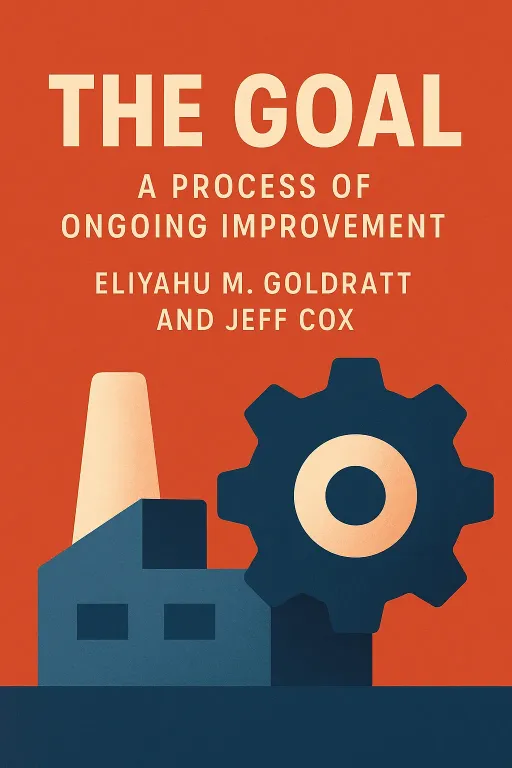
Nova: It’s all about where you focus your energy. We're talking about the core ideas behind "Stop Chasing Efficiency, Start Designing Flow: The Guide to Sustainable Innovation." It's a powerful synthesis of ideas, especially drawing on the foundational works of management guru Eliyahu M. Goldratt, whose radical ideas in his seminal book, 'The Goal,' completely reshaped manufacturing and now offer a blueprint for truly sustainable design.
Atlas: For our listeners who are visionaries in sustainable chemistry, or strategic leaders driving impact, this probably sounds counterintuitive. We’re often told to optimize, optimize, optimize every single step.
Nova: Exactly. And that's where the cold fact hits us: many well-intentioned green efforts miss the bigger picture entirely. They focus on local efficiencies, on isolated improvements, and often inadvertently create new problems or miss systemic opportunities.
The Blind Spot of Local Efficiency
SECTION
Nova: Think about it like this: imagine a factory, right? They want to reduce their environmental footprint. So, they focus intensely on one step, say, reducing water usage in a specific washing process. They succeed! They pat themselves on the back.
Atlas: Sounds like a win. What's the catch?
Nova: The catch is, because they reduced the water in that one step, the chemicals became more concentrated. Now, the step in the process requires more energy for heating to dissolve those concentrated chemicals, or it generates a more potent, harder-to-treat waste product down the line. The local 'win' created a systemic 'loss.'
Atlas: So, you're saying a good intention, a focused effort to do good, can actually have a ripple effect that cancels out the good, or even makes things worse overall? That feels like a brutal truth for anyone trying to make a real impact.
Nova: Precisely. It's like optimizing one single lane on a superhighway without ever considering the entire traffic network. You might manage to speed up that one lane, but if it just bottlenecks further down the road, you haven't solved anything. You've just shifted the problem. In green innovation, this means sustainability isn't truly built-in; it's bolted on, and often quite poorly, leading to these unintended consequences.
Atlas: When you say 'bolted on,' what does that look like in practice for, say, a sustainable innovator trying to implement a new process, or a leader strategizing for green solutions?
Nova: It often looks like a company switching to a 'greener' raw material, which sounds great on paper. But if that material is sourced from halfway across the world with massive shipping emissions, or it requires entirely new, energy-intensive machinery to process, or it creates a different, equally difficult waste stream... the 'green' benefit is severely diluted. The focus was on the material itself, not the material.
Atlas: It makes sense. Our listeners are driven by meaningful contribution, by a desire for ethical industry, and that kind of partial solution must be incredibly frustrating. It’s like running really fast in the wrong direction.
Nova: Exactly. It's the difference between trying to put out small fires versus understanding what's causing the entire forest to burn. We need to zoom out.
Designing for Systemic Flow: The Goldratt and Lean Principles
SECTION
Nova: And that frustration, that feeling of hitting a wall with partial solutions, is exactly what leads us to the solution. And it comes from an unexpected place: the world of manufacturing, specifically Eliyahu M. Goldratt's revolutionary book, 'The Goal,' and 'Lean Thinking' by James P. Womack and Daniel T. Jones.
Atlas: Goldratt? Lean Thinking? Those sound like buzzwords from a business school textbook, or maybe for optimizing car production. How do they apply to something as complex and vital as green chemistry and sustainable innovation?
Nova: Goldratt’s genius, which he presented through a captivating novel, was realizing that every system—from a factory to a complex chemical process, even an ecosystem—has a single biggest bottleneck. He called it the 'constraint.' His Theory of Constraints shows that if you want to improve the system's overall output, you must identify and manage. Remove it, and you unlock the entire system's flow.
Atlas: So, it's counterintuitive because our instinct is to optimize and try to improve every little cog. But he showed that local optimizations, if not at the bottleneck, are often wasted effort or even detrimental?
Nova: Absolutely. He proved that if you make a non-bottleneck process more 'efficient,' it often just creates inventory buildup before the real bottleneck, adding cost and waste, and not actually helping the overall system's throughput. For green innovation, this means if your biggest environmental impact comes from, say, a specific energy-intensive drying stage, optimizing the precursor synthesis might feel good, but it won't move the needle on your overall footprint.
Atlas: So, if I'm a sustainable innovator trying to make a green chemical process, how do I find my 'bottleneck' in terms of environmental impact? Is it always obvious?
Nova: Not always obvious, but Goldratt provides the tools. For example, imagine a chemical plant trying to reduce solvent use. They might discover that the biggest 'bottleneck' for environmental impact isn't the amount of solvent used in reaction A, but the for solvent B, which then contaminates a much larger waste stream. Fixing single point has a disproportionately massive impact on the entire system's environmental footprint, far beyond tweaking individual reactions.
Atlas: That's a powerful revelation. And how does 'Lean Thinking' fit into this flow design, once you've identified and addressed the constraint?
Nova: Lean Thinking, pioneered by Womack and Jones through their extensive study of Toyota, is all about identifying and systematically eliminating waste to create continuous value flow. In green chemistry, that means relentlessly reducing resource use, energy consumption, and environmental impact. It complements Goldratt perfectly: once you've removed the biggest constraint, Lean helps you smooth out all the other inefficiencies, making the entire 'river' flow smoothly and cleanly.
Atlas: So, instead of just making a 'less bad' product or process, we're designing solutions that are inherently more efficient, inherently less wasteful, and therefore more impactful and sustainable, from start to finish. That's a huge shift in mindset from just "being green" to "designing green."
Nova: Exactly. It's about designing flow – thinking of the entire process as a river. You don't just clean one section; you ensure the entire river flows cleanly and efficiently, minimizing pollution and maximizing resource utilization at every bend and turn. It’s about building sustainability in, not bolting it on.
Synthesis & Takeaways
SECTION
Nova: The core insight here is that true green innovation isn't about incremental tweaks or isolated improvements. It's about a systemic reimagining. It's about stepping back, seeing the whole river of your process, understanding its dynamics, identifying its choke points, and then designing an elegant, efficient flow that minimizes environmental impact by design.
Atlas: For our listeners who embrace the complexity of systems, who see challenges as opportunities for innovation, and who seek out interdisciplinary projects, this is a powerful framework. It's about shifting from just 'doing good' to 'doing good effectively and systemically,' aligning their passion for sustainable chemistry with practical, impactful application.
Nova: Yes, and the tiny step, the immediate action you can take, is deceptively simple but incredibly powerful: Map out your current process. Identify one major bottleneck – that one point where things slow down, build up, or create disproportionate waste. Then ask, 'How does addressing impact the entire system's environmental footprint?' You might be genuinely surprised at what you find.
Atlas: That's a fantastic challenge. It really makes you think about how many 'green' solutions might just be moving the problem around, or creating new ones. What's one bottleneck in your own life or work you can identify today, that if you addressed it, would create a cascade of positive flow?
Nova: Indeed. It's a powerful way to start designing for flow, not just chasing efficiency. This is Aibrary. Congratulations on your growth!