Stop Talking Past Each Other, Start Building Shared Understanding: The Guide to Aligned Teams.
Golden Hook & Introduction
SECTION
Nova: I was today years old when I realized that the biggest threat to my groundbreaking Agent project wasn't a coding bug, or even a tight deadline, but a silence. That awkward, unspoken assumption that quietly kills innovation and derails brilliant technical ideas.
Atlas: Oh man, that hits home! You know, as architects and engineers, we’re wired for logic, for code, for tangible solutions. But that unspoken stuff? It’s like a silent compiler error that doesn’t show up until deployment, and by then, it’s a full-blown crisis. How does that silence manifest in high-performance teams, Nova?
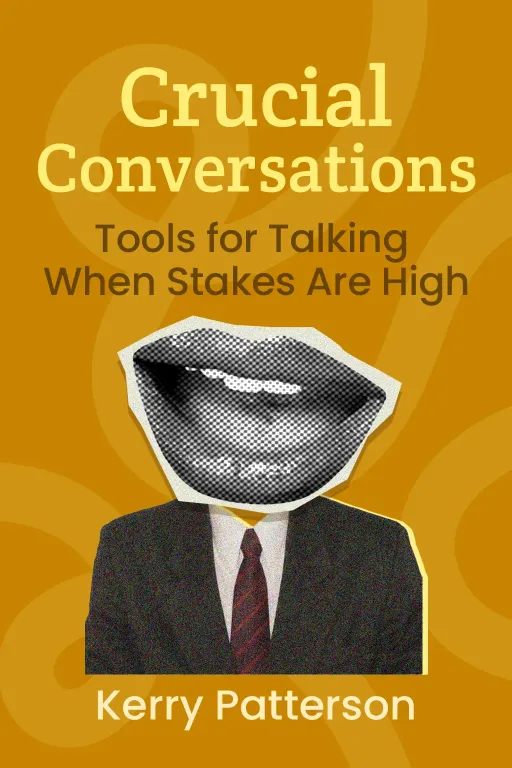
Nova: Exactly! It’s the meeting where everyone nods, but no one actually agrees. It's the project update where critical issues are sugarcoated. It’s those moments where we talk each other instead of each other. And that's why today, we're diving into two absolute game-changers for anyone building high-stakes Agent systems: "Crucial Conversations" by Kerry Patterson, Joseph Grenny, Ron McMillan, and Al Switzler, and "The Five Dysfunctions of a Team" by Patrick Lencioni.
Atlas: Crucial Conversations? That sounds… intense. How does a book focused on interpersonal dialogue apply to the nitty-gritty of Agent engineering, where it’s all about algorithms and distributed systems?
Nova: Well, "Crucial Conversations" isn't just theory; it's the result of two decades of research. Its four authors observed over 10,000 hours of real-life conversations to understand what makes some discussions productive and others disastrous. They distilled that into a practical, actionable framework. And for us, it's about realizing that the most brilliant technical ideas can wither if the people behind them can't communicate effectively.
Atlas: Okay, you've piqued my interest. So, let’s talk about those high-stakes discussions.
Mastering High-Stakes Dialogue
SECTION
Nova: The core idea of "Crucial Conversations" is that certain conversations are "crucial" because they involve high stakes, differing opinions, and strong emotions. Think about it: debating a critical architectural decision for an Agent system under a tight deadline, where one team member believes Solution A is scalable, and another is convinced Solution B offers better stability.
Atlas: I know that feeling! It’s not just about the technical merits anymore; it quickly becomes personal. You're trying to integrate new Agent tech, and suddenly, you're navigating a minefield of egos and assumptions. How does an engineer, often focused on objective data, suddenly become a master communicator in that scenario? Give me a concrete principle.
Nova: Absolutely. The first principle they introduce is "Start with Heart." It means before you even open your mouth, you need to get clear on what you want. Not just what you want to win, but what you want for yourself, for the other person, and for the relationship.
Atlas: So basically you’re saying, step back from the immediate urge to prove your point, and instead think about the bigger picture? If I'm arguing for Solution A, I need to ask myself: Do I want to "win" this argument, or do I want the best, most stable Agent system for the team and the project?
Nova: Exactly! If your goal is truly a stable, scalable Agent system, and a good working relationship, then your approach to the conversation changes entirely. You're less likely to attack, and more likely to inquire. And that leads us to another crucial tool: "Make it Safe."
Atlas: Make it safe? Like, emotionally safe? In a high-pressure tech environment where everyone's pushing boundaries, sometimes "safe" feels like it's compromising innovation.
Nova: That’s a great point, but it's not about avoiding challenge. It's about creating an environment where people feel secure enough to share their ideas, even if they're controversial. It means finding mutual purpose – reminding everyone, "Hey, we're all here to build the best Agent system possible, right?" – and mutual respect. When people feel respected and believe you share a common goal, they're far more likely to engage constructively.
Atlas: I can definitely relate to that. I’ve seen brilliant technical ideas get sidelined because someone felt attacked or unheard. It’s frustrating to watch potential value creation just evaporate because of interpersonal friction. So, these principles are less about being "nice" and more about engineering a productive dialogue.
Nova: Precisely. It’s about understanding the human operating system that underlies all your Agent systems.
Building Unbreakable Teams
SECTION
Nova: And that naturally leads us from individual crucial conversations to the broader landscape of team dynamics. Because even if you master those one-on-one dialogues, if the team foundation is shaky, it's still an uphill battle. That's where "The Five Dysfunctions of a Team" by Patrick Lencioni comes in.
Atlas: Ah, Lencioni. I’ve heard his name often in leadership circles. Isn't he known for simplifying complex business challenges?
Nova: He absolutely is. Lencioni, a best-selling author and speaker on business and team management, has a unique talent for simplifying complex organizational dynamics into compelling, narrative-driven insights. This book, often taught in MBA programs, uses a business fable to illustrate its points, making it incredibly accessible. He argues that there are five key dysfunctions that, if unaddressed, can cripple any team. And the first, the foundational one, is the "Absence of Trust."
Atlas: Absence of Trust? In a high-performance Agent team, isn't trust a given? We're all professionals, we're all on the same side.
Nova: That’s a common misconception. Lencioni isn't talking about predictive trust—like, "I trust you to do your job." He's talking about. It's the willingness of team members to be open with each other about their weaknesses, mistakes, fears, and even their challenges.
Atlas: Okay, so you’re saying it’s about admitting when you don't know something, or when you've screwed up a piece of Agent code?
Nova: Exactly. Imagine an Agent team where members are hesitant to admit they're struggling with a new framework, or that they made a mistake in a recent deployment. Those hidden problems fester, leading to duplicated effort, missed deadlines, and ultimately, a less robust system. Without that vulnerability, you can't build true trust. And if you don't have trust, you can't have the second dysfunction: "Fear of Conflict."
Atlas: Fear of conflict. Now that’s one I see all the time. In tech, "healthy debate" can often devolve into personal attacks, or worse, people just shut down to avoid confrontation. How do you embrace conflict without it becoming destructive?
Nova: That’s the magic. Lencioni clarifies that healthy conflict is about ideas, not people. A team that fears conflict often ends up with artificial harmony. They nod along, avoid challenging each other's ideas, and make suboptimal decisions because no one wants to rock the boat. Especially when designing critical Agent systems, where challenging assumptions and rigorously testing ideas is paramount for stability and scalability, avoiding conflict is catastrophic.
Atlas: That makes perfect sense. As an architect, my role isn’t just to design; it’s to foster an environment where the design emerges, and that often means challenging existing paradigms. If my team is afraid to push back or question a decision, we’re building on a weak foundation. So, if "Crucial Conversations" gives us the tools to navigate those difficult moments, then "The Five Dysfunctions" gives us the map of what to fix in the team structure.
Nova: Precisely. They're two sides of the same coin. Mastering crucial conversations provides the specific skills to address the dysfunctions, particularly fear of conflict, by making those difficult discussions productive and safe.
Synthesis & Takeaways
SECTION
Nova: So, what we're really talking about here is that human connection and communication aren't "soft skills" you just dabble in. They are foundational engineering principles for Agent project success.
Atlas: That’s actually really inspiring. For an architect, these aren't just about 'being nice' or 'getting along.' It's about designing resilient, high-performing human systems just like we design stable code. It’s about building a team that can iterate, adapt, and truly deliver value.
Nova: Absolutely. So, for our tiny step this week, Atlas and I challenge you: identify one upcoming team discussion in your Agent project that might be challenging. Then, plan how you will apply just one principle from "Crucial Conversations" – maybe "Start with Heart" or "Make it Safe" – to ensure a productive outcome.
Atlas: And remember, even a small, intentional shift in how you approach conflict, or how you foster vulnerability, can ripple through your team dynamics, akin to a well-placed architectural pattern improving an entire system. It’s about breaking the boundaries between technical and interpersonal skills.
Nova: Because ultimately, the most sophisticated Agent systems still rely on the clarity, the alignment, and the shared understanding of human intent.
Nova: This is Aibrary.
Atlas: Congratulations on your growth!