Stop Building Alone, Start Co-Creating: The Guide to Amplifying Your Vision.
Golden Hook & Introduction
SECTION
Nova: Atlas, if I were to ask you about the concept of "building alone," what's the first thing that springs to mind? Give me your five-word review.
Atlas: Oh man. Lone wolf, burnt out, lonely, slow, obsolete.
Nova: Obsolete! Wow. That's a strong word. But honestly, I think you've hit on something profoundly true. We're often sold this romanticized image of the lone genius, the visionary toiling away in isolation, only to emerge with a masterpiece that changes the world.
Atlas: Right? Like the hero in a movie montage, all dramatic lighting and soaring music. But in real life, that usually just leads to a lot of cold pizza and missed deadlines.
Nova: Exactly. And that's precisely what we're dissecting today with a powerful idea from a guide called "Stop Building Alone, Start Co-Creating: The Guide to Amplifying Your Vision." It's not just a book; it's a critical shift in mindset for anyone trying to build anything of significance in our increasingly complex and interconnected world. The premise is simple, yet revolutionary: your vision doesn't just survive; it when every single person on your team feels a deep sense of ownership and acts with a shared, unified purpose.
Atlas: I can definitely relate to that, especially for anyone trying to build a movement or launch a complex initiative. It sounds essential. But, you know, it’s one thing to say 'shared purpose,' it's another to actually make it happen when everyone has their own daily fires to put out. How do you even begin to knit that kind of united front together?
From Visionary to Vibrancy: Why Building Alone is a Blueprint for Failure
SECTION
Nova: That’s the million-dollar question, Atlas. And the book tackles it head-on by challenging the very structure many organizations default to. Think about it: traditional hierarchies are designed for predictable environments, for processes where information flows up, decisions flow down. But what happens when the environment is constantly shifting, when new challenges emerge daily?
Atlas: Then those top-down structures become bottlenecks. Decisions are too slow, information is siloed, and by the time you react, the landscape has changed again. It's like trying to navigate a white-water rapid in a battleship.
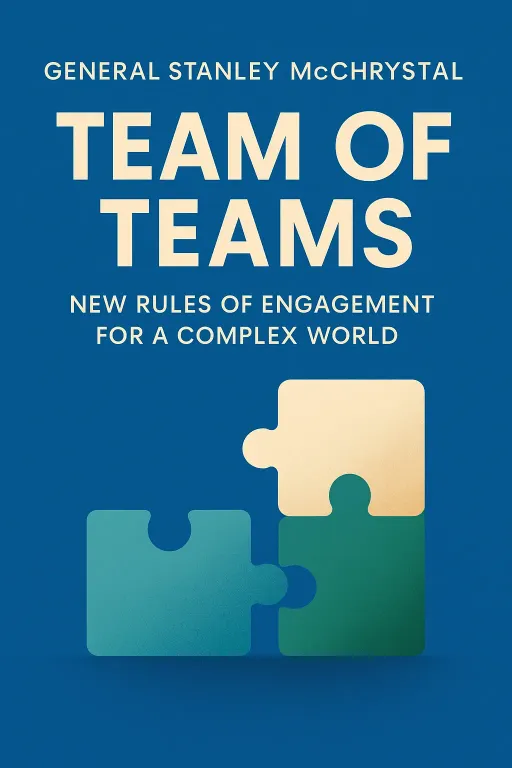
Nova: Exactly! And this is where the genius of comes into play, a concept deeply echoed in our guide today. McChrystal, a general who commanded special operations forces in Iraq, realized that his highly trained, but siloed, units were being outmaneuvered by a decentralized, agile enemy. He recognized that simply having talented individuals wasn't enough; they needed to operate as a single, interconnected organism.
Atlas: So he literally had a team of teams. What did that mean in practice?
Nova: It meant fostering what he called "shared consciousness" and "decentralized execution." Imagine a scenario: a critical intelligence report comes in about an imminent threat. In a traditional structure, that report goes up the chain, gets analyzed, decisions are made, and then commands are issued back down. By then, hours, even days, might have passed. The opportunity is lost.
Atlas: Yeah, I can see that. That's the battleship trying to turn.
Nova: But in a "Team of Teams" model, that intelligence is immediately shared across all relevant small units. They understand the broader strategic picture – the "why" – and because they're empowered, they can make decisions and act rapidly at their level, without waiting for top-down approval for every single step. They're all working from the same playbook, but adapting on the fly.
Atlas: That’s incredible. So, the cause of the traditional failure is slow information and centralized bottlenecks. The process of "Team of Teams" is rapid, widespread information sharing and localized decision-making. And the outcome is agility and effectiveness against a dynamic threat. But wait, how do you actually get those small units to have that "shared consciousness" without constantly checking in with everyone? For our listeners who are trying to lead strategic initiatives, this might feel like a massive undertaking, almost chaotic.
The Invisible Architecture: Trust, Transparency, and the True North of Alignment
SECTION
Nova: That's a brilliant question, Atlas, and it brings us to the absolutely critical invisible architecture that underpins any successful co-creation effort. You can decentralize decision-making all you want, but if your teams don't trust each other, if they don't truly understand each other's intentions, it falls apart. And this is where becomes incredibly illuminating, and it directly informs our guide's emphasis on deep trust and shared understanding.
Atlas: Oh, I know that feeling. I imagine a lot of our listeners have been on teams where something just felt off, where things moved slowly despite everyone being smart.
Nova: Exactly. Lencioni argues that trust is the absolute bedrock. Without it, you get a cascading series of dysfunctions. Think of a team trying to launch a new product. If there's no trust, people will be hesitant to engage in healthy conflict – they won't challenge ideas or voice concerns for fear of personal attack.
Atlas: So, they avoid conflict, just to keep the peace.
Nova: Which then leads to a lack of commitment. If people haven't openly debated an idea, they won't truly buy into the final decision. They'll nod in the meeting but then secretly drag their feet. And if there's no commitment, there's no accountability. Team members won't hold each other responsible for performance because they haven't truly committed to the plan in the first place.
Atlas: And then, ultimately, you get what? Inattention to results? People just focus on their own little tasks instead of the collective win?
Nova: Precisely. The outcome is not just poor results, but a fractured, disengaged team. Let me give you a quick example. I once saw a marketing team trying to launch a new campaign. The creative director had a bold idea, but the data analyst, who had some crucial reservations about the target audience, held back her concerns in meetings. She didn't trust that her feedback would be heard constructively.
Atlas: Oh, I've been there. So she just kept quiet?
Nova: She did. The campaign launched, missed its mark, and then the finger-pointing started. The data was there, the insight was there, but the to share that potentially uncomfortable truth wasn't. The team never truly committed to the strategy because it wasn't openly debated from a place of psychological safety.
Atlas: Wow, that's kind of heartbreaking. That gives me chills thinking about how much potential is lost there. So, Nova's Take in the guide emphasizes "deep trust and shared understanding across every part of your organization." How do you even begin to build that? It sounds so abstract.
Nova: It can feel abstract, but the guide offers a brilliant "Tiny Step" that really grounds it. It suggests scheduling a 15-minute 'no agenda' coffee chat with a team member you don't usually interact with, just to build connection.
Atlas: Hold on. A 15-minute coffee chat? That’s it? That sounds almost too simple to fix deep-seated trust issues.
Nova: It’s not about fixing everything in 15 minutes, Atlas. It's about initiating the human connection. It's about remembering that behind every job title is a person. Those small, consistent moments of genuine interaction, where you're not talking about tasks or projects, but just getting to know someone, are the building blocks of trust. They create the psychological safety needed for healthy conflict, real commitment, mutual accountability, and ultimately, collective results. It's the micro-action that chips away at the macro-problem.
Synthesis & Takeaways
SECTION
Nova: So, when you put McChrystal's "Team of Teams" and Lencioni's "Five Dysfunctions" together, what emerges is a powerful truth: amplifying your vision isn't about working harder alone. It's about intelligently structuring your collective effort and deeply investing in the human connections that allow that structure to flourish.
Atlas: That makes perfect sense. It's not just about having a great vision; it's about building the human ecosystem where that vision can actually take root and grow exponentially. It's about moving from that "lone wolf, obsolete" mentality to a truly vibrant, co-creative force.
Nova: Absolutely. So, for anyone listening who's a visionary, a strategist, an aligner – someone driven by impact and collective success – your one tiny step this week is to schedule that 15-minute 'no agenda' coffee chat. It might just be the most strategic decision you make for amplifying your vision.
Atlas: Because building deeper human connections isn't just a soft skill; it’s the hardest, most essential work of leadership. And it’s where true alignment begins.
Nova: This is Aibrary. Congratulations on your growth!