The 90-Day Code: A Project Manager's Playbook for Mastering New Roles
Golden Hook & Introduction
SECTION
Socrates: Ainebyoona, a study of over 1,300 senior HR leaders found that success or failure in the first few months is the single strongest predictor of overall success in a job. As a Project Manager in tech, you're constantly starting something new—a new project, a new team, a new stakeholder group. Those first 90 days are your window of opportunity, but also your moment of maximum vulnerability. The question is, are you leaving that critical period to chance?
AINEBYOONA ROBERT: That's a sobering thought. You put so much energy into getting the new role or project, you don't always think about having a strategy for the start itself. You just dive in.
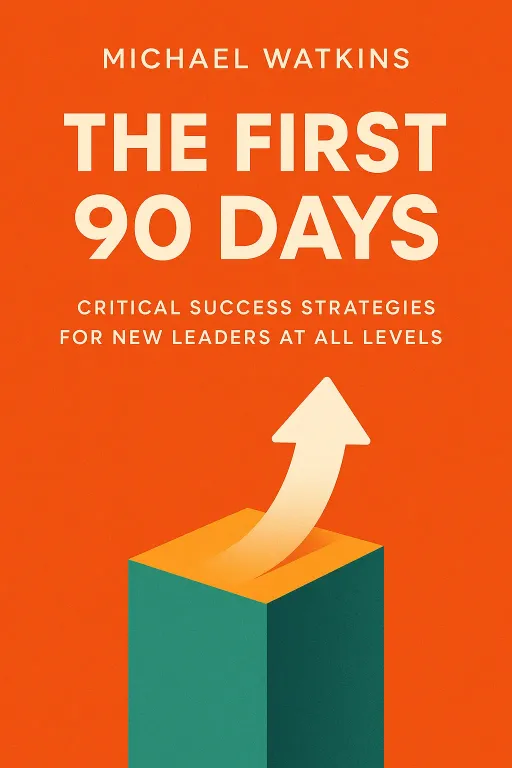
Socrates: And that's the trap. Today, we're diving into Michael Watkins' "The First 90 Days"—what The Economist called "the onboarding bible"—to build a playbook specifically for you. Watkins' central idea is the "break-even point." That's the moment you stop consuming value from the organization—through training, salary, and the time of others—and start creating net value. The average for a mid-level leader? 6.2 months. Our goal today is to show you how to slash that time.
AINEBYOONA ROBERT: I like the sound of that. Faster time-to-value is a metric any PM can get behind.
Socrates: Exactly. So, we'll tackle this from two perspectives. First, we'll explore the internal mindset trap—why your greatest strengths can suddenly become your biggest weaknesses. Then, we'll discuss the external strategic blueprint—how to diagnose your new environment and proactively negotiate your path to success.
Deep Dive into Core Topic 1: The Mindset Trap
SECTION
Socrates: Let's start with that internal challenge, because it's often the most overlooked and the most dangerous. Watkins tells a powerful cautionary tale about a rising star named Julia Gould. Robert, have you ever seen someone brilliant in one role just... struggle after a promotion?
AINEBYOONA ROBERT: All the time. It’s especially common in tech. You see a brilliant senior engineer get promoted to team lead, and suddenly they're miserable and ineffective. It's a completely different job.
Socrates: That's Julia's story precisely. She had been a star in the marketing department of a consumer electronics company for eight years. She was known for her incredible attention to detail, her deep knowledge, and her need for control. These qualities made her a phenomenal individual contributor and manager within her domain.
AINEBYOONA ROBERT: Sounds like a high-performer.
Socrates: Absolutely. So, the company promotes her. They give her a huge opportunity: lead a major, cross-functional project to launch a hot new product. She's now the launch manager, coordinating teams from marketing, sales, R&D, and manufacturing.
AINEBYOONA ROBERT: A classic project manager role. High visibility, high stakes.
Socrates: And she fails. Spectacularly. She brings the same style that made her a marketing star into this new leadership role. She tries to micromanage the engineers on technical specs they've spent years developing. She demands detailed reports from the manufacturing team on processes she doesn't understand. Her old strength—her need for control and detail—is now perceived as a lack of trust and a lack of respect for their expertise.
AINEBYOONA ROBERT: Ouch. I can feel the tension in the daily stand-ups already. The team would shut down.
Socrates: They did. They started challenging her authority, questioning her knowledge. So what does Julia do? She panics and retreats to what she knows. She starts focusing almost exclusively on the marketing aspects of the launch, essentially doing her old job and neglecting the cross-functional coordination that was her job. Within a month and a half, the project was so far behind and the team morale so low, she was removed from the role and sent back to marketing. Her career momentum was shattered.
AINEBYOONA ROBERT: Wow, that's a brutal story, but it's so recognizable. It's the classic case of a subject matter expert being promoted to a leadership role and failing to change their mindset. As a PM, your job isn't to be the best coder or the best designer anymore. Your job is to create an environment where can be the best. Julia was still trying to be the 'player' instead of the 'coach'.
Socrates: Exactly. Watkins has a killer quote for this: "It’s a mistake to believe that you will be successful in your new job by continuing to do what you did in your previous job, only more so." It's a fundamental mindset shift. So for you, Robert, as an ISTJ personality—someone who likely values order, facts, and correctness—what's the biggest challenge in letting go of that control when you take on a new project?
AINEBYOONA ROBERT: It's trust and delegation. My instinct might be to check every detail, to review every line of the project plan, to make sure it's all 'correct' according to my standards. But that doesn't scale, and it disempowers the team. The real shift is from ensuring the work is done myself, to ensuring the by the team.
Socrates: And how do you do that?
AINEBYOONA ROBERT: It comes back to what Watkins says about accelerating your learning. But you have to accelerate learning the right things. It's not about learning the technical details of every component. It's about learning the people. What are their strengths? What are their communication styles? Who are the informal influencers? It's about learning the culture and the politics. That's the information that allows you to delegate with confidence. You're shifting from technical knowledge to social and political knowledge.
Deep Dive into Core Topic 2: The Strategic Blueprint
SECTION
Socrates: And that's the perfect pivot. Once you've managed your internal mindset, like Julia failed to do, you need an external strategy. You can't just learn; you have to act. But you have to act in the right way. This is where Watkins introduces a brilliant diagnostic tool he calls the STARS model.
AINEBYOONA ROBERT: STARS? Okay, I like acronyms. They're practical.
Socrates: It stands for the five common business situations you can walk into: Start-up, Turnaround, Accelerated Growth, Realignment, and Sustaining Success. The key insight is that you cannot use the same strategy in each one. A leader who is a hero in a Turnaround might be a bull in a china shop in a Sustaining Success situation.
AINEBYOONA ROBERT: So it's about diagnosing the context before you make a move.
Socrates: Precisely. He tells the story of an executive, Karl Lewin. In Europe, his company's manufacturing was a mess—a clear "Turnaround." Karl was decisive, aggressive. He centralized functions, closed inefficient plants, and shifted production. He was a hero. Then, he gets promoted to run the supply chain in North America. The situation there wasn't a crisis. Performance was just... slipping. It was a "Realignment." It needed a more diplomatic, consensus-building approach to change systems and culture. If he had come in with his European turnaround playbook, he would have alienated everyone and failed.
AINEBYOONA ROBERT: The STARS model is gold for a Project Manager. It's essentially a project context assessment. Before you even write the project charter, you need to ask: Am I taking over a project that's on fire and needs saving? Or am I launching a brand new, version-one product into the market? Or am I taking over a mature, successful project and my job is not to break it? The project plan, the risk log, the communication strategy—they would all be completely different. It stops you from applying a one-size-fits-all template.
Socrates: But diagnosing is only half the battle. You have to get your boss—or in your case, your project sponsor—on board. This is where many people fail. They wait to be told what to do. Watkins argues you must your success. Let's look at the story of Michael Chen. He's a new CIO, and his new boss, Vaughan Cates, has a reputation for being incredibly tough, a real hard-driver who "eats people alive."
AINEBYOONA ROBERT: We've all heard of, or worked for, a Vaughan Cates.
Socrates: Right. So Chen could have been defensive, or reactive. Instead, he's proactive. On day one, he goes to her and says, "I need time to do a proper diagnosis. I'd like to propose a 90-day plan where I'll focus on learning, and I'll come back to you at 30, 60, and 90 days with my findings and a concrete plan." He gets her buy-in. Three weeks later, she pressures him to make a huge systems purchase. He holds firm. He says, "I'm not ready. It's on my 90-day plan, and I need to complete my diagnosis to make the right call."
AINEBYOONA ROBERT: That takes guts. But he's able to do it because he already got her to agree to the framework. He's not being insubordinate; he's sticking to their shared plan.
Socrates: Exactly! At the 30-day mark, he delivers a stellar diagnostic and a strong plan. He's built credibility. A month later, he uses that credibility to go back and negotiate for more headcount, successfully defending his business case against her tough questioning. He proactively managed his boss and architected his own success.
AINEBYOONA ROBERT: That's stakeholder management 101. His 90-day plan is like a 'Sprint Zero' for his new role. In Agile, Sprint Zero is where you do setup, discovery, and planning before you start building. Chen's not committing to deliverables immediately. He's committing to a discovery and planning phase. He's managing expectations from the start.
Socrates: And what about the conversations he's having with her?
AINEBYOONA ROBERT: The five conversations Watkins outlines—about the situation, expectations, resources, style, and development—that's the ultimate project kick-off meeting with your most important stakeholder: your sponsor. It's about co-creating the definition of success. You're not just receiving orders; you're building a partnership and aligning on what a 'win' looks like. For a PM, that's the most important conversation you can have.
Synthesis & Takeaways
SECTION
Socrates: So, when we pull back, we have these two powerful, interconnected pillars for mastering any transition. First, the internal discipline to do a mental reset, to recognize that your old strengths can be traps, forcing you to unlearn and adapt like Julia Gould failed to do.
AINEBYOONA ROBERT: And second, the external strategy to be an architect, not just a pawn. You use a tool like the STARS model to diagnose your environment, and you use a proactive 90-day plan to negotiate your success, just like Michael Chen.
Socrates: It's a complete playbook. It transforms the uncertainty of a new beginning into a structured, manageable process.
AINEBYOONA ROBERT: Exactly. It's a complete playbook. For anyone listening, especially in a project-based role, the most practical first step is this: for your very next project, or even your current one, take 30 minutes. Diagnose it using STARS. Is it a turnaround? A realignment? Then, draft a simple 30-day plan. What do you need to learn? Who do you need to meet? What's one small, early win you can secure to build credibility? Don't wait to be told what to do. Architect your own success.
Socrates: A perfect summary. And it leaves us with one final question to ponder, a question Watkins implicitly asks throughout the book: What is the one thing you need to to succeed in your next 90 days?