

The Silent Killer of Teams: How Psychological Safety Unlocks Innovation
Golden Hook & Introduction
SECTION
Nova: Most leaders believe their biggest challenge is finding talent, or perhaps securing funding, or maybe even navigating ever-changing market demands. But what if the real enemy of your team, the silent killer of innovation, isn't external at all? What if it's an unseen fear lurking right within your own ranks?
Atlas: Whoa, an unseen fear? That sounds like something out of a psychological thriller, Nova. But in a team context, what are we talking about here? Is it imposter syndrome? Or just plain old stage fright in a meeting?
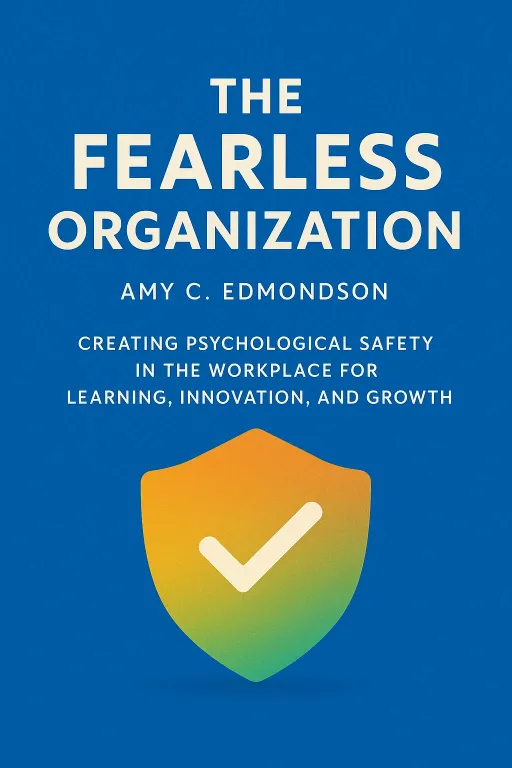
Nova: It's far more insidious than that, Atlas. Today, we're dissecting this profound truth through the lens of by the brilliant Amy C. Edmondson, a Harvard Business School professor whose groundbreaking research redefined how we understand team dynamics. She argues this silent fear actively kills honest feedback and true collaboration.
Atlas: So, we're not just talking about a lack of confidence, but something that fundamentally cripples a team's ability to function and innovate. That’s a powerful claim.
Nova: Absolutely. Today, we'll dive deep into this from two perspectives. First, we'll explore why the absence of psychological safety is a silent killer for teams, then we'll discuss the actionable strategies leaders can employ to cultivate an environment where every voice feels valued and heard.
The Invisible Barrier: Understanding Psychological Safety's True Impact
SECTION
Nova: So, let's start with the core concept: psychological safety. Amy Edmondson defines it as the belief that one will not be punished or humiliated for speaking up with ideas, questions, concerns, or even mistakes. It's this shared belief that the team is safe for interpersonal risk-taking.
Atlas: Okay, so it’s about feeling safe enough to take a risk without fear of being shamed or penalized. But wait, you're telling me that a team that makes mistakes, or at least reports them more, is actually? That sounds completely backward to what most high-performing environments preach. Most people want zero mistakes, right?
Nova: It does sound counter-intuitive, doesn't it? But this is where Edmondson’s research truly shines. She studied surgical teams in hospitals. What she found was fascinating: the "better" teams, those with higher performance metrics and fewer patient complications, actually reported errors.
Atlas: More errors? How does that even compute? My mind is trying to reconcile "more errors" with "better performance."
Nova: It’s not that they more errors, Atlas. It's that they felt safe enough to them, to talk about them openly, and crucially, to from them. In teams lacking psychological safety, errors don't disappear; they just go underground. They become hidden landmines waiting to explode, because no one wants to be the messenger of bad news or be blamed.
Atlas: That gives me chills. So it’s not about being error-free, it's about being fear-free to report errors and learn. For someone trying to build resilient teams, that's a huge reframing. But how does this play out in, say, a fast-paced tech environment where the stakes are incredibly high for innovation and rapid development?
Nova: In those environments, the cost of a lack of psychological safety is even higher. When people are afraid to share half-baked ideas, to challenge a flawed assumption in a design review, or to point out a potential bug early on, innovation dies a slow, quiet death. It's not just about mistakes; it's about the courage to experiment, to think out loud, to be vulnerable with nascent ideas. Without that safety, teams just execute existing plans, often poorly, rather than truly innovating.
Atlas: That's a profound insight. So many leaders I know are driven by impact, but they might be inadvertently stifling it by creating an environment where people just keep quiet, where the best ideas never see the light of day because someone's afraid of looking foolish.
Architecting Trust: Practical Steps for Leaders to Cultivate Psychological Safety
SECTION
Nova: If fear is the silent killer, then how do we actively build that antidote? How do we move from a culture of silence to one of vibrant, open dialogue? And this is where another incredible book, by General Stanley McChrystal, offers a fascinating parallel and some profound lessons for leaders.
Atlas: General McChrystal, a military leader, talking about shared consciousness and decentralized decision-making? That's quite a leap from the battlefield to fostering psychological safety in a corporate team. What's the connection there?
Nova: McChrystal led the Joint Special Operations Task Force in Iraq, a highly complex, high-stakes environment. He realized their traditional command-and-control structure, while efficient in stable situations, was failing against a decentralized, agile enemy. His solution was to transform his force into a "team of teams," fostering what he called "shared consciousness" and empowering decision-making at the lowest possible levels. This required immense trust and transparency, essentially a form of psychological safety at a massive, organizational scale, where information flowed freely and everyone felt a shared purpose.
Atlas: So, he built a system where everyone felt connected and empowered, even under extreme pressure. How does that translate to cultivation psychological safety in a more everyday team setting, especially for leaders who are trying to build cultures where solutions thrive?
Nova: It fundamentally shifts the leader's role. It's less about being the 'hero' who has all the answers and more about being the 'architect' of an environment where answers can emerge from anywhere. McChrystal modeled vulnerability, admitted what he didn't know, and actively sought input from every level. This directly mirrors Edmondson’s strategies: leaders must model vulnerability themselves, invite participation, and respond constructively to mistakes or bad news.
Atlas: That's brilliant. So it's about creating the conditions for trust to flourish. I imagine a lot of our listeners, who are focused on building high-performing teams, would find that empowering. But what's the very first, tiny step someone can take tomorrow? Without having to overhaul their entire leadership style or read a whole library on organizational psychology?
Nova: Edmondson offers a perfect "tiny step" for leaders. Tomorrow, at the start of your team meeting, simply ask, "What concerns do you have about this project?" And then, crucially, actively listen without judgment.
Atlas: That's brilliant because it's so simple, yet it directly addresses the fear of speaking up. It signals permission. By asking about concerns, you're not just inviting feedback; you're explicitly creating that 'safe space' from the very beginning, showing you value their perspective.
Nova: Exactly. It reframes potential problems not as individual failures, but as collective challenges the team can tackle together. It's a small act that can have a huge ripple effect, slowly chipping away at that "silent fear."
Synthesis & Takeaways
SECTION
Nova: So, to synthesize our discussion, psychological safety isn't a luxury item or a "nice-to-have"; it's the operational foundation for adaptability, innovation, and resilience. It's the leader's primary responsibility to cultivate this environment, to be the architect of trust.
Atlas: For anyone driven by impact, someone who cultivates environments where solutions thrive and wants to build sustainable, high-performing teams, understanding this is paramount. It’s about empowering your team, not just delegating tasks, but delegating the power of voice, of ideas, of even concerns.
Nova: When a team feels safe to be fully human – to question, to challenge, to admit mistakes, to bring their whole selves to the table – that's when their true collective genius is unlocked. It’s a profound shift from merely managing tasks to actively nurturing trust.
Atlas: It’s about building cultures, not just products. And that starts with the courage to ask a simple question and truly listen. What a powerful idea to take into the week.
Nova: Absolutely. Take that tiny step this week. Ask that critical question, and truly listen. See what unexpected insights surface, and how your team begins to transform.
Nova: This is Aibrary. Congratulations on your growth!









