The High-Performance Management Framework
Golden Hook & Introduction
SECTION
Nova: We've all been there: staring at an overflowing inbox, feeling overwhelmed, yet somehow... not moving forward. That feeling of being perpetually busy, but never truly productive, is a trap. And today, we're going to dismantle it.
Atlas: Oh, I know that feeling all too well. It’s like running on a treadmill, expending massive energy, but the scenery never changes. Is it even possible to truly escape that cycle? It feels almost ingrained in modern work culture.
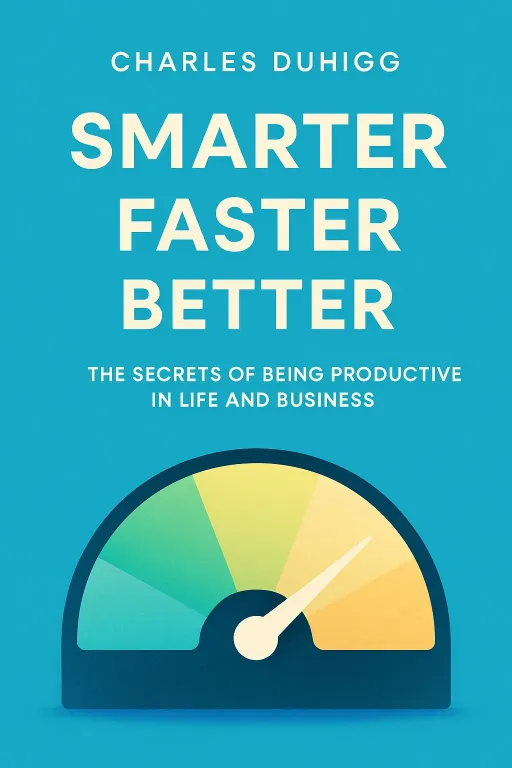
Nova: Absolutely, Atlas. And what's fascinating is that two towering figures in the world of productivity and management offer profoundly similar, yet distinct, pathways out of that very trap. We're talking about Charles Duhigg, with his brilliant insights in "Smarter Faster Better," and the legendary Peter F. Drucker, whose wisdom in "The Effective Executive" still resonates decades later.
Atlas: Right, so these aren't just modern-day gurus. We're looking at foundational thinkers here. Duhigg, if I recall, is a Pulitzer-winning journalist, which gives his work a really grounded, narrative quality. And Drucker, well, he’s essentially the father of modern management, isn't he?
Nova: Exactly. Duhigg, with his journalistic eye, synthesizes complex behavioral science into incredibly relatable stories, showing us the of how we can be more productive. Drucker, on the other hand, gives us the timeless of what it means to be truly effective. They both challenge this pervasive myth that more effort automatically equals more output.
Atlas: That makes me wonder, then, if productivity isn't just about raw effort, what it about? How do these two connect to help us move beyond just feeling busy?
Nova: That’s the perfect segue. Duhigg argues that productivity isn't about working harder; it’s fundamentally about making smarter choices. Specifically, choices around our motivation, how we set our goals, and where we direct our focus. It’s a profound shift from a quantity mindset to a quality-of-decision mindset.
The Illusion of Busyness vs. Intentional Productivity (Duhigg)
SECTION
Atlas: So you're saying it's not about the sheer volume of tasks we tick off, but the intentionality behind tasks we even decide to tackle? That sounds incredibly liberating, but also a bit daunting for anyone who feels like they to do everything.
Nova: Precisely. Think about it this way: imagine two project teams. Team A works 12-hour days, constantly reacting to every email, every new request. They’re busy, they’re exhausted, but progress feels slow, disjointed. Their motivation wanes because they feel like cogs in a machine.
Atlas: I’ve been on that team. It’s like a never-ending game of whack-a-mole. You hit one, and two more pop up.
Nova: Now, consider Team B. They might work fewer hours, but they start each day by explicitly defining their core objective for that day, that week. They discuss that objective matters—connecting it to a larger purpose, which fuels their motivation. They set clear, challenging, yet achievable goals, and then they ruthlessly protect their focus.
Atlas: Okay, but how do they that? How does Team B manage to protect their focus and maintain motivation when Team A is just drowning? For someone driven by progress and mastery, the urge to just is powerful.
Nova: It comes down to those choices Duhigg identifies. First,. Team B understands the concept of an internal locus of control. Instead of feeling like victims of circumstances, they actively choose to interpret challenges and to find meaning in their work. They ask themselves, "What choice can I make right now to feel more in control, more invested?" It's a mindset shift.
Atlas: That’s interesting. So it’s not about finding external motivation, but cultivating it from within by framing their work differently. But what about goal setting? How does that play into making smarter choices?
Nova: That's where clarity and specificity become paramount. Team B doesn't just have vague aspirations; they have what Duhigg calls "stretch goals" that are broken down into concrete, actionable steps. They understand that the of planning, of visualizing success, primes their brain for achievement. It’s not just dreaming; it's designing the path.
Atlas: So, it’s like reverse-engineering success. You start with the big, ambitious goal, and then you map out the specific choices that will get you there, rather than just hoping for the best. I can see how that would help focus. But focus itself feels like a muscle that constantly fatigues in our hyper-connected world.
Nova: It absolutely is. And Duhigg highlights that focus isn't about willpower alone; it's about building mental models and anticipating outcomes. Team B, for instance, might practice "pre-mortem" exercises, where they imagine everything that could go wrong and how they’d respond. This builds a robust mental framework that allows them to stay on track when distractions inevitably arise. They've already made the choice to anticipate and prepare.
Atlas: That’s a great way to put it. It’s about building a mental fortress against distraction, almost. For listeners who are seeking to deepen their knowledge and sharpen their edge, what's a practical first step to start making these smarter choices, especially when they're already feeling the pressure of being busy?
Nova: A fantastic question. Start with one small area where you feel overwhelmed. Instead of trying to "do more" there, ask yourself: "What is choice I can make about my motivation, my goal, or my focus that would fundamentally change the outcome here?" It might be choosing to spend 15 minutes deeply focused on critical email instead of skimming 20, or reframing a challenging task as an opportunity to master a new skill. The key is to start small and build that muscle of intentional choice.
The Habit of Effectiveness: Strategic Contribution over Task Completion (Drucker)
SECTION
Nova: And that naturally leads us to the second key idea we need to talk about, which often acts as a counterpoint to what we just discussed. If Duhigg shows us choices to make, Drucker tells us to turn that into a consistent impact. He argues in "The Effective Executive" that effectiveness isn't a personality trait; it's a learnable habit.
Atlas: Learning a of effectiveness sounds incredibly powerful for a focused learner, but also a bit abstract. What does Drucker mean by effectiveness being a habit, and how does it differ from just being productive, as Duhigg describes?
Nova: That’s a crucial distinction. Productivity, in Duhigg's sense, is about optimizing your output through smart choices. Effectiveness, for Drucker, is about optimizing your. It's about consistently choosing what to rather than just performing tasks. He famously said, "There is nothing so useless as doing efficiently that which should not be done at all."
Atlas: Whoa, that’s a mic drop moment right there. "Doing efficiently that which should not be done at all." That really challenges the conventional wisdom of just churning through a to-do list. So, how does one cultivate this habit of choosing what to contribute? Especially for someone who's a driven achiever, always wanting to add value.
Nova: Drucker outlines several practices, but one of the most critical is understanding where your time actually goes. Most executives, he found, vastly overestimate how much time they spend on important tasks and underestimate how much is lost to interruptions and low-value activities. The first step to effectiveness is often a brutally honest time audit.
Atlas: So, it's not about squeezing more into the day, but about consciously carving out space for what truly matters, based on where your time is actually going. Can you give an example of how this plays out in practice?
Nova: Certainly. Consider a leader, let's call her Sarah. Sarah used to pride herself on being available for every meeting, responding to every email immediately. She was productive in a reactive sense—always doing. But she felt like she wasn't making a dent in her strategic goals. After a time audit, she realized nearly 60% of her day was spent on non-essential meetings and administrative tasks that others could handle.
Atlas: That sounds like a lot of our listeners who are trying to reclaim their focus. So what did Sarah do to become more effective, not just busy?
Nova: Sarah made a conscious choice to become an effective executive by adopting Drucker's habits. She started by asking, "What is my unique contribution here? What can do that truly moves the needle for my team and organization?" She identified two key areas: strategic vision casting and high-level talent development. Then, she ruthlessly managed her time. She declined non-essential meetings, delegated tasks, and blocked out significant "deep work" periods for her strategic thinking.
Atlas: That’s powerful. It’s like she shifted from being a generalist problem-solver to a specialist impact-maker. But that takes courage, doesn't it? To say "no" to things, to push back against the demands that feel urgent but aren't important.
Nova: It absolutely does, and that’s why Drucker calls it a. It requires consistent practice and a clear understanding of your organizational contribution. It’s about focusing on results, not just effort. An effective executive asks, "What results are expected of me? And what resources do I need to achieve them?" This isn't just about personal efficiency; it's about organizational impact.
Atlas: This is fascinating because it connects directly to the pragmatic innovator's desire for impact. So, how does one practically identify those "few tasks that actually move the needle" when everything feels important, especially in a rapidly evolving field?
Nova: It comes down to clarity of purpose and leverage. Ask yourself: "If I could only accomplish one thing today, this week, or this quarter, what would have the most disproportionate positive impact?" And then, "What is the smallest number of actions I can take to achieve that one thing?" It’s an exercise in ruthless prioritization, not just of tasks, but of your energy and unique capabilities. It’s about leveraging your strengths for maximum contribution.
Synthesis & Takeaways
SECTION
Nova: So, bringing Duhigg and Drucker together, we see a powerful synergy. Duhigg gives us the granular tools for intentional productivity—how to choose our motivation, goals, and focus wisely. Drucker elevates that to the strategic level, teaching us to make effectiveness a consistent habit by prioritizing our unique contribution and managing our time for maximum impact.
Atlas: It really boils down to that deep question we started with: are you currently managing your time to busy, or are you prioritizing the few tasks that actually move the needle for your research, your career, your personal growth? It’s a profound distinction.
Nova: It is. It’s not about adding more to your plate, but meticulously curating what on it, and why. It's about moving from a reactive "to-do" mentality to a proactive "to-contribute" mindset. The journey of mastery, for any pragmatic innovator, isn't just about acquiring more knowledge, but about applying it with deliberate, impactful choices.
Atlas: I imagine a lot of our listeners, especially those driven by progress and seeking to connect disparate ideas, will find this a powerful framework for self-reflection. It’s about taking control of your impact, not just your schedule.
Nova: Absolutely. Take a moment this week to identify one area where you feel busy but not effective. Then, ask yourself: what is one choice you can make, inspired by Duhigg, about your motivation, goal, or focus? And what is one strategic contribution you can make, inspired by Drucker, that only you can deliver?
Atlas: That’s a great, actionable challenge. It’s about being deliberate with our most precious resources: time, energy, and attention.
Nova: Indeed. Thank you for joining us on this journey into high-performance management. This is Aibrary. Congratulations on your growth!