Stop Guessing, Start Scaling: The Guide to High Output Teams
Golden Hook & Introduction
SECTION
Nova: Atlas, if I say "high-output management," what's the first thing that springs to mind? Be honest.
Atlas: Oh, man, 'high-output management'? Honestly, my brain defaults to a frantic, over-caffeinated individual trying to juggle flaming chainsaws while simultaneously doing their team's job. It’s less 'management' and more 'heroic martyrdom.'
Nova: Right? It's that image of the indispensable, always-on leader, isn't it? But what if I told you that approach is actually your team's potential, and maybe even yours? Because today, we're diving into how to "Stop Guessing, Start Scaling: The Guide to High Output Teams." We're talking about a radical shift from that individual brilliance to something far more powerful: systems.
Atlas: That sounds like a much-needed paradigm shift. I mean, who tired of the hero narrative?
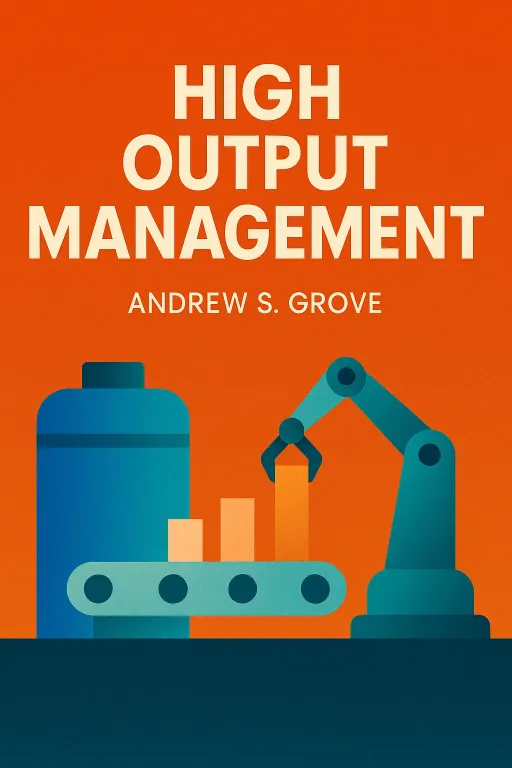
Nova: Exactly. And to guide us, we're pulling insights from two titans of management philosophy. First up, Andrew S. Grove's seminal work, "High Output Management." Grove, the legendary former CEO of Intel, literally built one of the most successful tech companies in history by applying these very principles. He didn't just theorize; he it.
Atlas: And then there's the equally formidable Peter F. Drucker, often called the "father of modern management," with his timeless classic, "The Effective Executive." Drucker's insights have shaped generations of leaders, and his ideas are as relevant today as when they were first penned.
Nova: So, how do these two iconic figures, from different eras yet with such resonant messages, teach us to move beyond that frantic individual effort and truly scale our teams? That's the core question for today.
The Manager as a System Architect: Amplifying Output Beyond Individual Effort
SECTION
Nova: Let's start with Grove. His core tenet is deceptively simple but profoundly impactful: a manager's output is the output of their organization the output of the neighboring organizations under their influence. It’s not just about what produce, but what.
Atlas: Wait, so it's not about being the smartest person in the room, or even the hardest working, but the best orchestrator of everyone else's efforts?
Nova: Precisely. Grove introduces the concept of 'leverage.' Think of it like this: a high-leverage activity is one where a small input from you as a manager creates a disproportionately large output from your team. For instance, a well-designed training program. You spend a few hours developing it, but it elevates the performance of ten, fifty, a hundred team members for months or even years. That's massive leverage.
Atlas: That makes sense. I can definitely relate to feeling like I'm constantly putting out fires, which feels like low-leverage activity. So, how does Grove suggest we actually these high-leverage systems?
Nova: He offers concrete strategies. One of my favorites, and something we can all apply this week, is his framework for 'meeting as a production process.' Most meetings, let's be honest, often feel like a drain, not a boost, to output.
Atlas: Oh, I know that feeling. The dreaded recurring meeting that eats up an hour but accomplishes… well, not much. So, how does Grove flip that script?
Nova: He argues that a meeting should be treated like any other production process. It needs a clear objective, a well-defined agenda, a designated leader, and a clear output – decisions made, actions assigned, information shared efficiently. It’s about ensuring that the time invested isn't just consumed, but something tangible.
Atlas: That’s a great way to put it. I imagine a lot of our listeners struggle with meeting bloat. So, applying this 'meeting as a production' framework to even one recurring meeting this week, as the "Tiny Step" suggests, could actually create significant leverage. It sounds like it prevents burnout by making the effort more focused and effective.
Nova: Absolutely. By systemizing something as mundane as a meeting, you're not just saving time; you're amplifying communication, improving decision quality, and fostering a culture of accountability. You're building a system that allows your team to operate more effectively, minimizing guesswork and maximizing collective effort. It's about creating a diversified future for the team, moving away from reliance on one or two key individuals to a robust, self-improving unit.
Effectiveness as a Discipline: Drucker's Blueprint for Proactive Leadership
SECTION
Nova: That systemic view from Grove naturally leads us to the individual discipline needed to those systems effectively, which is where Peter Drucker steps in. While Grove focused on the organizational architecture, Drucker focused on the executive who operates within it.
Atlas: Okay, so Grove gives us the 'what' – building systems. Drucker gives us the 'how' – the personal discipline. But how does someone who feels constantly swamped by tasks actually time for these 'practices'? It seems like a catch-22.
Nova: That’s a brilliant question, and it's precisely what Drucker addresses with his first practice: 'Know Thy Time.' He argues that effective executives don't time; they it. This starts with auditing how you actually spend your time. Most people are shocked by what they discover.
Atlas: So you're saying, before you even to be effective, you need to understand where all your time is actually going?
Nova: Exactly. Once you audit it, you can then move to eliminating non-contributing activities – the things that don't produce results. And finally, consolidating your discretionary time into meaningful blocks. It’s about moving from reactive 'firefighting' to proactive, focused work. It's a discipline, not a talent you're born with.
Atlas: That makes me wonder about Drucker's emphasis on 'contribution to results.' So, it's not just about being busy, but being busy. How do you define 'right things' in a way that scales a team, not just an individual?
Nova: Drucker insists that effective executives focus on outward results, not just inward effort. They ask, "What results are expected of me? What can I contribute that will significantly impact the organization?" This means constantly connecting their activities back to the strategic goals, ensuring their work, and by extension their team's work, is truly moving the needle. It's about making fewer, but better, decisions that have a high impact.
Atlas: That sounds like a mastery mindset – not just doing, but the art of doing the right things. How does this connect to enhancing "organizational psychology," which is a key interest for many of our listeners?
Nova: When leaders model this disciplined approach – managing their time effectively, focusing on results, making clear decisions – it creates a ripple effect throughout the organization. It fosters clarity, reduces ambiguity, and builds trust. It shifts the collective mindset from just getting tasks done to achieving meaningful outcomes. It’s a powerful driver for positive organizational psychology, because everyone feels they're contributing to something significant, rather than just being busy.
Synthesis & Takeaways
SECTION
Nova: So, when we bring Grove and Drucker together, we see a powerful synergy. Grove gives us the architecture for scalable output – the systems, the processes, the leverage points. Drucker then provides the executive discipline to operate within and continually improve that architecture.
Atlas: It’s like Grove builds the high-performance engine, and Drucker teaches you how to be the master race car driver. So, 'Stop Guessing, Start Scaling' really means stopping the guesswork of individual heroism and starting to scale through intentional systems and disciplined effectiveness.
Nova: Precisely. It's about understanding that your output as a leader is the sum of your team's output, and that sum is maximized not by working harder yourself, but by building robust systems and practicing relentless executive effectiveness. It allows you to trust your deep knowledge and apply it with confidence, knowing you're building long-term impact.
Atlas: That’s actually really inspiring. It redefines leadership from a burden to an empowering design challenge. So, for our listeners who are ready to stop guessing and start scaling, what's one system or one personal discipline they can audit this week to amplify their team's output?
Nova: I'd say, go back to that 'Tiny Step': pick one recurring meeting this week. Apply Grove’s 'meeting as a production' framework. Give it a clear agenda, defined roles, and a tangible outcome. You’ll be amazed at the leverage you create. It’s a small action with a huge systemic impact.
Atlas: I love that. Small, actionable steps leading to monumental shifts. That’s the kind of mastery we're all striving for.
Nova: Absolutely.
Atlas: This is Aibrary. Congratulations on your growth!